
Auction: 5012 - Orders, Decorations, Campaign Medals & Militaria
Lot: 531
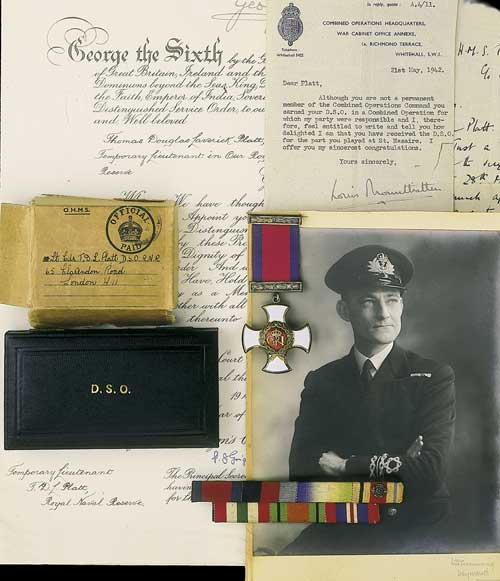
The Combined Operations D.S.O. Group of Seven to Lieutenant Commander T.D. Platt, Royal Naval Reserve, for Gallantry in Command of a Motor Launch Flotilla in the Raid on the German Naval Base at St Nazaire (a) Distinguished Service Order, G.VI.R., silver-gilt, gold appliqué and enamel, reverse of suspension bar dated 1942, with top riband bar, in Garrard, London case of issue (b) 1939-45, Atlantic, Africa and Italy Stars (c) Defence and War Medals, the group extremely fine (d) Forwarding box for campaign medals addressed to ´Lt. Cdr. T.D.L. Platt D.S.O. R.N.R., London W11´, with enclosure document (e) Full size and miniature riband bars, the former with rosette on Africa Star riband the group offered with the following documents etc; -- Commission appointing T.D.L.Platt as Temporary Lieutenant, Royal Naval Reserve, dated 21.5.1942 -- Supplement to the London Gazette of 19.5.1942, dated 21.5.1942 -- Admiralty Fleet Orders, Notice Board Issue 4.6.1942, including list of ´Honours and Awards´ -- Programme for the Investiture at Buckingham Palace 28.7.1942 -- Typed letter of congratulation dated Combined Operations Headquarters 21.5.1942, signed by Louis Mountbatten ´Dear Platt, Although you are not a permanent member of the Combined Operations Command you earned your D.S.O. in a Combined Operation for which my party was responsible and I, therefore, feel entitled to write and tell you how delighted I am that you have received the D.S.O. for the part you played at St. Nazaire. I offer you my sincerest congratulations.´ -- Hand written letter dated H.M.S. Tormentor II 27 May, signed by Robert Ryder (Commander R.E.D. Ryder, Royal Navy, who won the Victoria Cross for the St Nazaire Raid) -- Six photographs, four of Platt in uniform -- Books (2), C.E. Lucas Phillips ´The Greatest Raid of All´, and Commander R.E.D. Ryder V.C., R.N. ´The Attack on St Nazaire´ the latter inscribed ´to Johnny with love from Mammy Platt´. (lot) Estimate £ 2,000-3,000D.S.O. London Gazette 21.5.1042, Temporary Lieutenant Thomas Douglas Platt R.N.R. ´For great gallantry in command of a Motor Launch Flotilla. In the face of steady fire at point blank range, and bombardment by grenades from the jetty above, Lieutenant Platt tried to run his craft alongside, and when ten feet from the jetty, it became a blazing wreck, he did all he could, under heavy fire, to save survivors´. ST NAZAIRE The audacious plan to attack the port of St Nazaire, with its massive Normandy Dock and concrete U-Boat shelters, was the result of many months of conversation and argument. Admiral of the Fleet Sir Roger Keyes, of Zeebrugge fame, was Director of Combined Operations when the discussions first began in August 1941. All early plans came to nothing however as the heavily defended harbour was considered virtually impregnable by all who became involved with the project. This all changed when Vice-Admiral Lord Louis Mountbatten, newly appointed Chief of Combined Operations, and Captain Charles Lambe, Director of Plans at the Admiralty, heard of a new plan of attack using an ´explosive destroyer´, the brain child of Captain J. Hughes-Hallett, Chief Naval Planner at Combined Operations Headquarters. This plan, using a specially lightened destroyer and Motor Launches carrying Commandos, was eventually agreed upon. On 26.3.1942 the small task force, H.M.S. Campbletown and 17 Motor Launches, accompanied by one Motor Gun Boat and one Motor Torpedo Boat, left Falmouth and, clearing the minefield off Ushant , stood down into the Bay of Biscay. The Motor Launches were divided into two columns, port, whose target was the harbour Mole, and starboard, whose target was the Old Entrance, while a third group was to accompany the Campbeltown. Lieutenant Platt commanded Motor Launch 447, the leading boat of the port column, and number nine in the order of attack. The launches, the famous ´Fairmiles´ of the light coastal forces, were vulnerable and flammable craft, being built of mahogany and run on petrol. They had a range of only 600 miles, so additional petrol tanks were fixed to the sides, extending the range to 1,000 miles. If hit they were liable ´to go up like a box of matches´. They were also highly vulnerable to aircraft, having nothing to fight them with but a light ´twin Lewis´ machine-gun of Great War vintage. It was assumed that, if they survived the raid, the launches would be subjected to heavy attack from the air, and so they were fitted with two 20mm. Oerlikons. Remarking on the vulnerability of these craft Hughes-Hallett observed ´We may lose every man. Mountbatten replied ´I´m afraid you´re right, but if they do the job we´ve got to accept that.´ The attack on the Normandy Dock was a success, but the landing of the Commando groups on the Old Entrance and Mole did not go well. Platt´s ML 447 was carrying the assault party intended for attacking the two pill-boxes on the Mole itself. As Platt ran up towards the Mole both his Oerlikons were knocked out and their crews, together with some Commandos, were killed. He tried to land up stream of the Mole but was stopped short of the landing steps, apparently aground, and was at once attacked from above by small arms and grenades. Only six Commandos were now left who were fit for action. In a fresh attempt at landing, Platt went ´full astern´ and got clear but immediately the engine room received a direct hit and in a moment was a mass of flames. He drifted round to the south side of the Mole where he put some of the wounded on a Carley raft, and ordered the remaining Commandos to swim ashore before giving the order to abandon ship. ML 447 was one of seven that were lost in the immediate neighbourhood of the docks. The remaining ten turned for the open sea and the hazardous journey home. Three more were to be destroyed while attempting to make the rendezvous with the waiting Destroyers. But the adventure still was not over. Of the remaining craft, three others failed to meet the escorts for the return trip. In his own account of the raid, Commander Ryder V.C. records ´Besides our force, M.L.s 160, 307, and 443 had failed to make contact at the rendezvous. They accordingly followed the instructions which had been signalled to all ships the previous day. This told them to make for a position 46 N., 7 W., and thence north up the meridian of 7 W, thus routing them out of range of hostile fighters. This small force under the command of Lieutenant T.D.L. Platt R.N.R. was however attacked several times by enemy bombers. First by a Heinkel 111, which was hit by the concentrated fire of all these craft and crashed into the sea, and later by a large Bloom and Voss seaplane, which withdrew after being hit. It is to the credit of this small force that they completed their long passage and succeeded in reaching Falmouth without escort. They arrived there with scarcely a gallon of fuel to spare´.
Sold for
£5,500


Watch, listen and bid as if you were in the room. Now available for auctions worldwide.
Click here to bid live
An exclusive and confidential service for the discerning collector or vendor.
View the Gallery
Download every Spink catalogue on your iPad, iPod or iPhone using free Spink app.
Download From iTunes© 2026 Spink & Son. All rights reserved.