
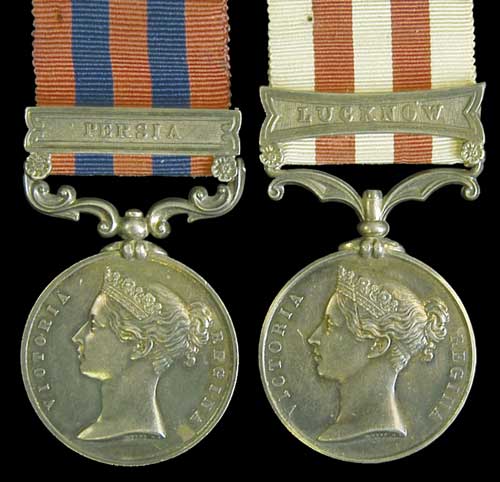
Auction: 5012 - Orders, Decorations, Campaign Medals & Militaria
Lot: 342
An Interesting Indian Mutiny Pair to Major H. Bruce, Superintendent of Police and Head of Intelligence for Oudh, Recognised for His Just Behaviour and Actions, During the Height of the Troubles at Lucknow India General Service 1854-95, Persia (Capt. H. Bruce, 2nd Bombay Eur. L.I.); Indian Mutiny 1857-58, one clasp, Lucknow (Major H. Bruce.), nearly extremely fine or better, both with contemporary silver buckles (2) Estimate £ 1,400-1,600"I assumed command here yesterday on General Havelock crossing over. I have at once set about re-establishing police and our authority in bazaar and city; promulgated Government orders for rewards for bringing in sepoys and public property; made Captain Bruce Superintendent of Police and Intelligence Department, already with good effect; has put a stop to plundering" (Telegram from Brigadier General Neill to Commander in Chief, dated Cawnpore 25.7.1857). In a time of great unrest, and during a period where grave attrocities had been committed by the mutineers, Bruce was applauded for his moral conduct and sense of justice, "in a time when the cry for vengeance was loud, [he] had the courage to temper judgement with mercy" (History of the Indian Mutiny, Kaye and Malleson, Vol. VI refers). Bruce, as a result of his position, was integral in acting, amongst other things, as the the supplier of intelligence to the command hierachy and indeed providing lines of communication between the Commander-in-Chief and Governor General through to General Outram and his newly beseiged forces in Lucknow, October 1857. Outram and Havelock´s forces had successfully broken through to Lucknow, but in the process had suffered heavy losses, and as a consequence were too weak to withdraw, thus the newly arrived garrison now found themselves besieged. Heavily protected supply columns were put together in an effort to deliver provisions to the troops at Lucknow via Alum Bagh, whilst relieving them of their sick and wounded. A force of 500 men under Major Barnston (with Bruce as Staff Officer) was set to go to the relief of Alumbagh, carrying provisions for a month which they were to deposit and then return to Cawnpore with the wounded. However, prior to embarking Bruce received intelligence that the Delhi mutineer fugitives were passing into the Cawnpore area with the aim of joining with the Nana´s forces at Bithoor. In light of this Colonel Wilson (Officer Commanding at Cawnpore) increased the intended force to 600 men and 6 guns, temporarily relinquishing its function of relief in an effort to engage the enemy in the field. This they achieved at Sheorajpore, "The following received from Captain Bruce dated Sherajpore 18th October, 7pm. We reached [Sherajpore] at 3.30; drove the enemy right out of the place which was strong with hardly any resistance" (Telegram from Major Stirling to General Mansfield, Chief of the Staff, dated 19.10.1857 refers). Colonel Wilson continues in his report, "The column has returned after driving the fugitives from Sheorajpore. They amounted to 2,500 with 8 guns, but their flight was so precipitate that I regret want of cavalry, prevented the capture of the guns; ordnance stores and a few horses fell into our hands. Our casualties only 8 or 10." (Telegram from Colonel Wilson to the Chief of the Staff, dated Cawnpore 20.10.1857 refers). As operations continued into November, further mutineers continued to stream into the Oudh region, and not without danger to Bruce´s police force, "One half of the Gwalior Contingent [6,000 men] has crossed, and 18 guns. The force at Shewalee has moved towards Akberpore. Captain Bruce´s police were attacked at Bunnee the day before yesterday; 74 killed" (Telegram from Major General Windham, to Governor General of India, dated Cawnpore 23.11.1857 refers). When Windham did tackle the Gwalior Contingent, "My force consisted of about 1,200 bayonets and 8 guns and 100 sowars", he did so over the course of four days (26-29.11.1857) commencing at Pandoo Nuddee and ending around Cawnpore itself, suffering 327 killed or wounded over the course of the four days, "The chief outwork was occupied by the Rifle Brigade, and in the course of the afternoon, by Your Excellency´s instructions, they were advanced, and gallantly drove the mutineers out of that portion of the city nearest to our works, under the command of Lieutenant Colonel Fyers who was supported by Colonel Walpole. Throughout the short period I have had the temporary command of this division, I have received both in the field and elsewhere, the most important assistance from Captain H. Bruce, 5th Punjab Cavalry. Without him I should have been at a great loss for reliable information, and although I am aware that Your Excellency is not ignorant of his abilities, courage, and assiduity, I think it my duty to make this mention of his service to the country." (Telegram from Major General C.A. Windham to His Excellency General Sir C. Campbell, G.C.B., Commander-in-Chief, dated Cawnpore 30.11.1857). Bruce continued his role with the same levels of achievment being similarly mentioned three more times (by Major General W.R. Mansfield, 10.12.1857; Brigadier Hope Grant, dated Camp Serai Ghat, 11.12.1857, and lastly mentioned in Brigadier Campbell´s despatch, 21.3.1858). Major Herbert Bruce; Ensign 2nd European Bombay Fusiliers, 1842; Lieutenant 1844; Captain Deputy Quarter Master General, Superintendent of Oudh Police and Intelligence Department, 1857; Major 1858.
Sold for
£1,800


Watch, listen and bid as if you were in the room. Now available for auctions worldwide.
Click here to bid live
An exclusive and confidential service for the discerning collector or vendor.
View the Gallery
Download every Spink catalogue on your iPad, iPod or iPhone using free Spink app.
Download From iTunes© 2026 Spink & Son. All rights reserved.