
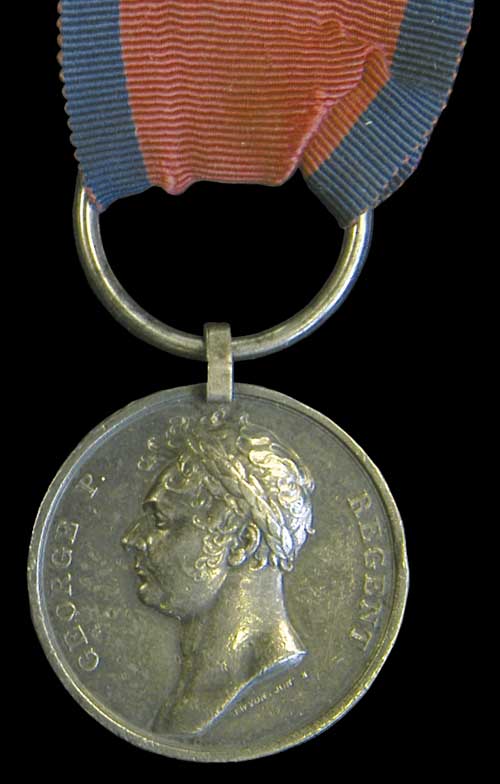
Auction: 5012 - Orders, Decorations, Campaign Medals & Militaria
Lot: 139
Waterloo 1815 (Lieut. George Gunning, 1st or Royal Dragoons.), original steel clip and ring suspension, light edge bruise and some contact marks, otherwise good very fine Estimate £ 6,000-8,000Lieutenant George Gunning; Ensign 17th Foot 1804; Commanded Grenadier Company, 9th Foot at Vimiera; transferred Lieutenant 1st Dragoons, 1809; served in Captain Methuen´s 7th Troop, during the Waterloo Campaign (wounded) and led his troop in the charge of the Union Brigade; he was also a claimant for having killed the Officer in charge of the colour party bearing the Eagle of the 105th Regiment of Line, which was subsequently captured. The Taking of the Eagle of the French 105th Ligne There is a certain amount of controversy surrounding the capture of the 105th´s Eagle, with two claimants from the same regiment contesting the honour, the first being Captain A.K. Clark 1st Dragoons (later Lieutenant General), and the other being Corporal F. Stiles (later Ensign 6th West India Regiment). At Waterloo, shortly before 2pm, the 105th as part of d´Erlon´s corps, advanced to attack Picton´s division. The 1st Dragoons charged, and pushed back the French column thus exposing the Eagle. It is at this point that Clark laid his claim that it was he who spotted the Eagle being rushed back towards safety, and that it was he who charged forward to kill the officer guarding the Eagle. He stipulated that as the standard fell to the ground he ordered Corporal Stiles to secure it and carry it back to the rear. Corporal Stiles, however, contended that he captured the Eagle, after being given an order to attack it by his troop commander Lieutenant Gunning. Colonel Clifton (the commanding officer of the 1st Dragoons at the start of the battle) ordered an investigation into the affair. This enquiry continued into 1816 when Clifton sent for Stiles, informing him that he needed witnesses to substantiate his claim. As a result of this Stiles wrote to his former troop commander Lieutenant Gunning, "Sir, This day Colonel Clifton sent for me about the taking the Eagle and Colours. He asked me if I had any person that see me take the Eagle, I told him that you see me, I believe, as the officer of the French was making away with it. I belonged to your troop at that time, and you gave me orders to charge him, which I did, and took it from him. When I stated it to him this day, he wants to know the particulars about it, and me to rite to you for you to state to him how it was. I would thank you to rite to the Colonel as you was the nearest officer to me that day. Sir, by so doing, you will much oblige." Stiles was twice promoted as a result of his claim, whereas Clark did not receive anything directly for his claimed actions, suggesting that the powers that be recognised Stiles´ claim, which was futher supported by Gunning himself when he wrote to Major General Sir H. Torens (22.2.1816), "Sir, It being believed that some military honour may be conferred in consequence of the Eagles taken at the ever-memorable Battle of Waterloo, induces me to state, for the consideration of his Royal Highness the Commander-in-Chief, that it was by my orders that Sergeant Stiles secured the Eagle of the 105th Regiment of French Infantry. I am enabled to prove this fact by Sergeant Stiles´ letter to me of the 31st ult. a copy of which I have the honour to enclose. I should have made this statement before, but my extreme ill state of health, in consequence of my wounds received at the Battle of Waterloo, has caused me to be absent from my regiment, and I did not consider it consistent to write to a Sergeant for the particulars which he has now unsolicited sent to me. I have heard that other claims are about to be made relative to the Eagle taken by Sergeant Stiles; his letter proves most clearly it was by my orders he did secure the Eagle, and as no other officer was near me at the time, I gave the order. I hope his Royal Highness, the Commander-in-Chief, will consider that it was owing to my orders the Eagle was captured from the enemy; as had I acted differently to what I did at that critical moment, I think the Eagle would not have been taken from the enemy, which, by a personal interview, I think I could explain fully to the satisfaction of his Royal Highness." This remained unacceptable to Clark, who was twice wounded at Waterloo, and during the next 23 years he made a further 10 official complaints. Gunning added another note of controversy by later claiming in "Documents of the Gunning Family" (privately published in 1834), that it was he who killed the French officer in charge of the Colours. Whatever conclusions can be drawn from this action, it is likely that in the heat of the battle several individuals may have contributed to the capturing of the Eagle.
Sold for
£14,000

Watch, listen and bid as if you were in the room. Now available for auctions worldwide.
Click here to bid live
An exclusive and confidential service for the discerning collector or vendor.
View the Gallery
Download every Spink catalogue on your iPad, iPod or iPhone using free Spink app.
Download From iTunes© 2026 Spink & Son. All rights reserved.