Auction: 4020 - Orders, Decorations, Campaign Medals & Militaria
Lot: 94
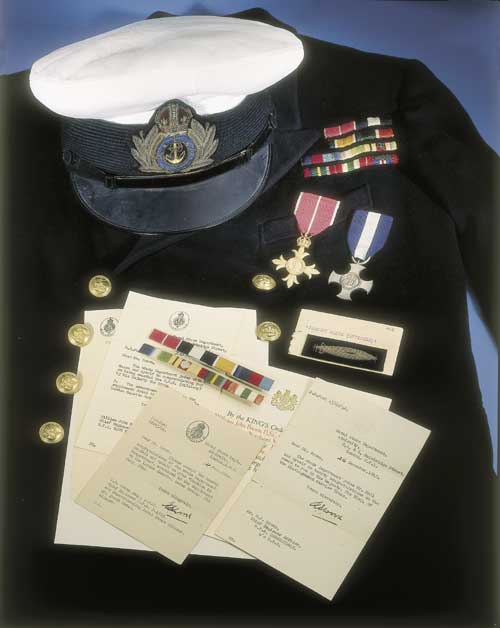
A Second War O.B.E., and 'PQ17 Russian Convoy' D.S.C. Group of Eight to Chief Engineering Officer W.J. Brown, Royal Fleet Auxiliary a) Order of the British Empire (O.B.E.), 2nd type, Military Division, in Royal Mint case of issue; b) Distinguished Service Cross, G.VI.R. reverse dated '1942' (Hallmarks for London 1945), in Garrard, London case of issue; c) 1939-45 Star; d) Atlantic Star; e) Africa Star, with North Africa 1942-45 bar (unnattached); f) Pacific Star; g) Italy Star; h) War Medal; M.I.D. Oakleaf (unnattached), extremely fine, the campaign medals in card box of issue i) Officer's Torpedo Badge j) Naval Officer's Cap and named Jacket with full riband set k) A quantity of documents and letters including framed O.B.E. Warrant; M.I.D. Certificate; copy of Life Magazine article on the action (3.8.1942) and a quantity of letters and congratulatory telegrams etc. (8) Estimate £ 1,200-1,500 O.B.E. London Gazette 11.5.1946. 'For distinguished services during the War in the East and good work in the "Wave Monarch"' D.S.C. London Gazette 22.12.1942 Mr. William John Brown, Chief Engineer Officer. 'For fortitude, seamanship and endurance in taking Merchantmen to North Russia through heavy seas and in the face of relentless attacks by the enemy aircraft and submarines.' Mentioned in Despatches London Gazette 7.7.1944 PQ17 This convoy originally consisted of 35 ships and the tanker Gray Ranger, however due to the latter receiving ice-damage, the tanker Aldersdale (the tanker upon which Brown was Chief Engineering Officer) was drafted into the ill-fated convoy as a late replacement. Initially protected by Commander Broome's Destroyer escort force the convoy made relatively good progress towards Archangel losing only one ship, the Christopher Newport in the four days that it had been shadowed by enemy aircraft. On 4.7.1942 the convoy was given the Order to Scatter, in conjunction with Broome taking his Escort force to join Rear-Admiral Hamilton's Cruiser force, in the hunt for the German Pocket Battleship Tirpitz, supposedly in the vicinity. Thus the convoy, with only weakly armed corvettes, mine-sweepers and trawlers, was left to cope as best as it could. In the first 24 hours without escort, the convoy was under constant attack, the enemy sinking 12 ships, bringing the total losses so far to 15 - already more than twice the number sustained by any convoy to North Russia. Among the victims of that first day was the tanker Aldersdale going down at the same time as the rescue ship Zaafaran. Luckily the Salmander was on hand to rescue the crew. PQ17 had endured an onslaught from 202 enemy aircraft in the course of its journey. Of its original tonnage of cargo it had lost 99,316 tons in the continual attack, including the loss of 430 tanks, 210 aircraft and 3,350 vehicles. Perhaps more surprising however, was that of the 35 ships and one tanker that had started the voyage, ten managed to make it to the final destination. Of the others, two had turned back, 13 and one rescue ship had been sunk by aircraft, ten had fallen prey to U-Boats all at the cost of only six enemy aircraft. [Figures taken from 'The Russian Convoys', B.B. Schofield, 1964]
Sold for
£1,800


Watch, listen and bid as if you were in the room. Now available for auctions worldwide.
Click here to bid live
An exclusive and confidential service for the discerning collector or vendor.
View the Gallery
Download every Spink catalogue on your iPad, iPod or iPhone using free Spink app.
Download From iTunes© 2026 Spink & Son. All rights reserved.