
Auction: 4020 - Orders, Decorations, Campaign Medals & Militaria
Lot: 152
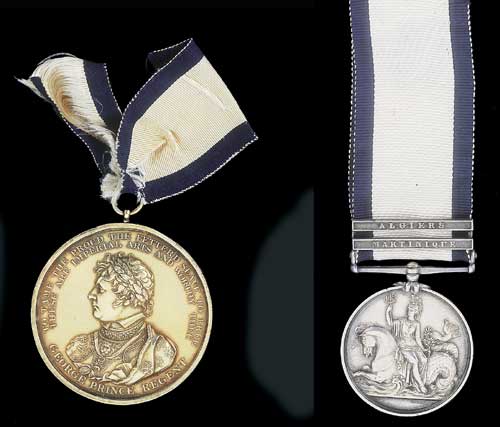
The Extremely Rare Naval General Service and Prince Regent Presentation Medal Pair for the Bombardment of Algiers to Commander R.H. Fleming, Royal Navy Naval General Service 1793-1840, two clasps, Martinique, Algiers (R.H. Fleming, Lieut R.N.); The Prince Regent's Medal for the Bombardment of Algiers 1816, silver-gilt, 49mm., by T. Wyon Snr. and T. Wyon Jnr., bust of the Prince Regent to left, rev. view of the bombardment, the edge engraved in large serif capitals 'Captain R.H. Fleming, R.N. August 27th 1816.' with ring for suspension, good very fine (2) Estimate £ 5,000-6,000 Commander Richard Howell Fleming, born c.1789 at Bratton Fleming, Devon; entered the Royal Navy as a Volunteer 1793 and served in the West Indies; received a musket-shot in the right hip at the recapture of Guadaloupe by the French; served variously on the Home Station, off Newfoundland and off Jamaica, and in the Mediterranean 1796-1802; was employed in the Revenue Department of the Navy 1802-1804; promoted to Midshipman and served in India 1804-07; as Master's Mate, H.M.S. York (74), he returned to the West Indies 1807, taking part en route in the capture of Madeira; advanced to Acting-Lieutenant in the same ship, 14 December 1808, Mr Fleming served on shore, in command of a division of 100 seamen, at the reduction of Martinique; he was also present at the taking of The Saints and the capture of the d'Haupoult (74). His appointment as Lieutenant in the Lion confirmed, 26 September 1809, Fleming next proceeded to the Mediterranean; served in the Conqueror (74) and the Ajax (74) and while in the former ship he commanded three boats against an armed vessel chained to the shore at Aras in the Gulf of Genoa; invested with the command of the gun-brig Pylades alias Carlotta, January 1812, and captured several small vessels, including a French privateer, off the coasts of Genoa and Tuscany; in March 1815 Fleming joined the Impregnable (98), from which ship, after the surrender of Naples, he was removed to the command of the Neapolitan sloop-of-war Joseppa, and was sent with the despatches announcing the surrender, to King Ferdinand at Messina; in the Joseppa he also assisted at the siege of Gaeta. The Bombardment of Algiers 1816 The city of Algiers continued to support both piracy and slavery, and as a consequence incurred the displeasure of most of the states of Europe. The Dey of Algiers refused to release the many Christian slaves held in captivity in Algiers, and in July 1816 a combined Dutch and British fleet under the command of Admiral Lord Exmouth was despatched. The bombardment of the city took place on 27 August, and the next day the Dey capitulated. Over 1,000 Christian prisoners were released. Fleming served as Lieutenant in H.M.S. Queen Charlotte (100), the flag-ship of Lord Exmouth. Arriving at Gibraltar he was given command of the Battery Ship Invincible, armed with a 68 and a 24-Pounder. On the 27 August Fleming took up a position under the stern of the Queen Charlotte and continued to fire until every cartridge on board had been expended. He then volunteered to blow up an ordnance-sloop, charged with 143 barrels of powder, close under the semi-circular battery to the northward of the lighthouse. So tremendous was the explosion that its shock destroyed every water-pipe in the town. For his services at Algiers Fleming was awarded the French Order of St Louis and the Sardinian Order of St Maurice and St Lazarus. He was promoted to Commander the following month and retired on half-pay. The Prince Regent's Medal for the Bombardment of Algiers was transmitted to him through Sir Sydney Smith by the Anti-Piratical Society at Paris. The Prince Regent himself presented Lord Exmouth with the gold medal, and this is now on display in the Portsmouth Naval Museum.
Sold for
£8,500


Watch, listen and bid as if you were in the room. Now available for auctions worldwide.
Click here to bid live
An exclusive and confidential service for the discerning collector or vendor.
View the Gallery
Download every Spink catalogue on your iPad, iPod or iPhone using free Spink app.
Download From iTunes© 2026 Spink & Son. All rights reserved.