
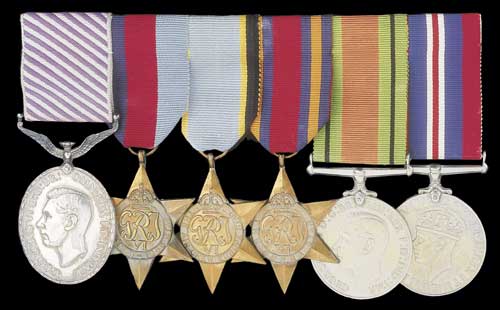
Auction: 4020 - Orders, Decorations, Campaign Medals & Militaria
Lot: 112
An Outstanding 'Immediate' Second War Bomber Command D.F.M. Group of Six to Flight Sergeant, Air Gunner Later Squadron Leader J.I.C. Waddicar, Royal Air Force Distinguished Flying Medal, G.VI.R. (953982 F/Sgt. J.I.C. Waddicar. R.A.F.), 1939-45 Star, Air Crew Europe Star, Burma Star, War and Defence Medals, good very fine, mounted as worn, with a group of six associated miniature awards (the fourth medal a France and Germany Star with Air Crew Europe Bar), medal riband bar, and a colour portrait photograph of the recipient in uniform (6) Estimate £ 1,400-1,800 D.F.M. London Gazette 21.7.1942 Aus 400468 Sergeant Frank Morton Griggs, Royal Australian Air Force, No. 214 (FMS) Squadron 1378114 Sergeant Arthur O 'Hara, 214 (FMS) Squadron 953982 Flight Sergeant James Ian Cunningham Waddicar, No.214 (FMS) Squadron. 1014907 Sergeant Ronald Watson, No. 214 (FMS) Squadron 527989 Sergeant Thomas Noel Castree Prosser, No. 214 (FMS) Squadron 1052356 Sergeant William Wildey, No. 214 (FMS) Squadron 'These airmen were members of the crew of an aircraft detailed to attack Bremen on the night of 27 June 42. Sergeant Griggs acting as captain. The objective was successfully bombed but, over the target area, the aircraft sustained much damage from anti-aircraft fire. One of the starboard engines was hit and put out of action. Shortly afterwards, the bomber was subjected to an attack by an enemy fighter, fire from which caused further damage. Almost immediately a second fighter opened fire, and Sergeant Wildey, the 1st wireless operator, was wounded in the arm. The first fighter then returned to the attack but was met with a long and vicious burst from Sergeant Waddicar's guns, which sent the aircraft spinning towards the ground, where it exploded on impact.
Some time later, after crossing Holland, Sergeant O'Hara, the navigator, who had skilfully guided his captain thus far, sighted two enemy fighters closing in. Sergeant Watson, who was tending the injured wireless operator, immediately attempted to man his turret, but it was jammed. With the assistance of Sergeant O'Hara who held his legs, he managed to reach his guns and he then delivered an effective burst at the leading fighter, which caused it to dive towards the sea completely out of control. Meanwhile, Sergeant Waddicar, with commendable ingenuity, had temporarily repaired one of his guns which had failed and opened fire at the second aircraft from close range. The attacker dived away and exploded before hitting the water.
The bomber was not yet out of danger, being subjected to machine gun fire from the sea. A few minutes later another fighter appeared opening fire with a long burst, but Sergeant Waddicar's return fire, caused it to break off the engagement. Sergeant Griggs, displaying fine airmanship, eventually flew his severely damaged aircraft safely back to base where he made a crash landing. Throughout the operation, these airmen displayed unflinching courage, great fortitude and splendid team work in foiling the attacks of five enemy fighters, three of which were shot down. Their conduct upheld the highest tradition of the Royal Air Force.'
Squadron Leader James Ian Cunningham Waddicar D.F.M, R.A.F.V.R. (1911-1974), enlisted as Aircraftman 2nd Class, March 1940; served with 96, 151 and 214 Squadrons and attained the rank of Flight Sergeant; commissioned as Pilot Officer, June 1942, and promoted to Flying Officer in December the same year; Flight Lieutenant June 1944, and Squadron Leader October 1944; he relinquished his Commission in September 1956.
214 (Federation of Malay States) Squadron, part of No. 3 Group, began operations with Wellingtons in June 1940, it was given Stirlings in the early part of 1942 and continued with these until January 1944. The Squadron was operating out of Stradishall, Suffolk, for most of 1942. Bremen was frequently the target for raids in June and July that year, and Bomber Command was to become increasingly concerned at the growing competence of the Luftwaffe night fighters in intercepting aircraft returning along the bomber tracks. The epic return flight of Stirling N3751 BU-P on the night of 27-28 June, badly damaged by flack over the target, attacked by five enemy fighters, and shot at from the sea, is an outstanding example of how perilous the return trips from these bombing raids had become. On its return to base at 0500, Stirling BU-P crash landed with its wheels retracted. Sergeant Sewell, who was killed in the air, is buried at Ocklynge, Eastbourne. In recognition of the sustained courage and fortitude shown by this crew, all the surviving members received the D.F.M.. Although not unique, the decision to decorate six airmen from one crew was most unusual.
Sold for
£2,800

Watch, listen and bid as if you were in the room. Now available for auctions worldwide.
Click here to bid live
An exclusive and confidential service for the discerning collector or vendor.
View the Gallery
Download every Spink catalogue on your iPad, iPod or iPhone using free Spink app.
Download From iTunes© 2026 Spink & Son. All rights reserved.