
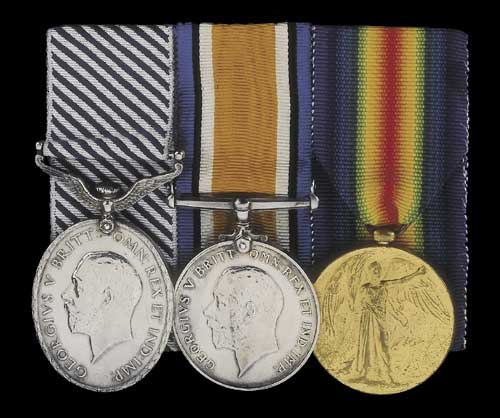
Auction: 4020 - Orders, Decorations, Campaign Medals & Militaria
Lot: 110
A Great War Western Front 'Immediate' D.F.M. Group of Three to Bristol Fighter, Gunner/Observer 'Ace' H.C. Hunt, Royal Flying Corps and Royal Air Force Distinguished Flying Medal, G.V.R. (P/6434 Sergt. Mech. Hunt, H.C., R.A.F.); British War and Victory Medals (317030 Sgt. H.C. Hunt. R.A.F.), good very fine, mounted court style; together with Hunt's original 'map-board' with three maps attached, some correspondence, and copied combat reports (3) Estimate £ 4,500-5,500 D.F.M. London Gazette 2.11.1918 Sgt. Mechanic Herbert Cecil Hunt, 'A keen and skillful Observer, on whose courage and resource, Pilots place absolute reliance. He has personally shot down and destroyed five enemy machines, two of which he accounted for during one patrol' The Recommendation, dated 29.8.1918, states; 'For conspicuous gallantry and devotion to duty. He has taken part in numerous offensive Patrols, Escorts, etc., and on all occasions has shown keenness and the real offensive spirit. By his skill and tenacity he has given confidence to his pilot and has set a fine example to other observers in his Squadron. He has personally accounted for enemy aircraft as follows:- On 26.8.18, when escorting a bomb raid to Peronne, about 40 enemy scouts attacked the formation. He fired a burst into a Pfalz Scout which spun down and was seen to crash West of Peronne. A triplane then attacked the Bristol and he fired a good burst into it. The enemy machine went down in a dive and was seen to crash near Maricourt. On 16.8.18, when on Offensive Patrol, two enemy two-seaters were attacked in the vicinity of Douai. He fired about a drum and a half into one which fell out of control and crashed near Fresnoy. This was confirmed by the pilot. On 8.8.18, when escorting D.H.4's over Vitry, several enemy scouts were encountered. He fired about 20 rounds into a Pfalz Scout at 80 yards range. The enemy machine burst into flames and went down. On 28.5.18, when on Offensive Patrol between Merville and La Bassee, 9 small enemy two-seaters were attacked. He fired 11/2 drums into one E.A., which nose dived, turned over and fell completely out of control.' Sergeant Hunt's related Combat Reports state: 25.8.18., B.F.2B no.C/1035, Pilot Lt. C.E. Hurst. ''While on escort with D.H.4s to Peronne at a height of 16,000 ft the formation was attacked by about 30 to 40 Scouts, including Pfalz Fokker and Triplanes. I fired approximately a drum into a Pfalz Sct. which went down in a spin and I saw E.A. crash W. of Peronne. A Triplane then dived on us I fired a burst at about 200 yds range, E.A.went down in a dive and crashed near Haricourt. I also fired at another Pfalz Sct. which went down in an irregular spin but I was unable to see E.A. crash as other E.A. were on my tail at the time.' 16.8.18., BF2B No.F/5824, Pilot Lt. C.E. Hurst. 'During O.P over Douai two machines (two-seaters with yellow elevators) followed us from Douai towards the line under our tail. I fired about a drum and a half at one and it went down and I saw it crash near Fresnoy.' 8.8.18., BF2B No.O/4706, Pilot Lt. T.H. Newsome. 'While on escort duty over Vitry between Arras and Douai a Pfalz scout flew parallel with our machine about 80 yds. away, I fired about 20 rds. at the E.A. and it went down in flames. I observed E.A. fired at by my pilot go down completely out of control.' 28..5.1918. BF2B No.C/4894, Pilot 2/Lt. C.W.M. Thompson. 'Whilst on O.P. I saw nine E.A. machines. We dived on same and engaged them in combat. My pilot dived and banked to the right and I fired one and a half magazines into one E.A. I then saw this E.A. go down in a nose-dive and then turn completely over completely out of control. I watched E.A. for some time then our fuselage covered it and when I last saw it, it was completely out of control. This E.A. had no crosses on its tail but had black streaks.' Remarks on Hostile machine:- New type small two-seater with two guns in front and one in observer's cockpit.' In a typed note Hunt later recalled 'I was sent to France after training etc., joining the 22nd Squadron which was a Fighter Squadron, flying Bristol Fighters with Rolls 200 H.P. Falcon engines. My duties with a fighter squadron were to take part in offensive patrols, in which we flew in formation at 18 to 20,000 ft. many miles over the enemy lines, looking for enemy machines to engage in combat and destroy (no oxygen or parachutes in those days). A Bristol Fighter was a two seater in which the Observer sat facing the tail, with his back to the pilot. Armament a Lewis Gun on a scarfe mounting and magazines of 303 ammunition. Enemy aircraft destroyed had to be confirmed or they were not credited to your account. I finished up with 9 enemy machines and 2 enemy observation balloons credited to my account.' In another, hand written, note Hunt states 'I have come across my old war map- I carried with me on all my flights which I am sending to you. We did not have log books in those days, when we returned from our offensive patrols we reported our successes or otherwise to our C.O.' 22 Squadron, formed at Gosport in September 1915, went to France in April 1916. Equipped with Bristol F2B Fighters in July 1917, the Squadron operated in a pure fighting role, unlike most other similarly-equipped Squadrons, which also undertook the reconnaissance function. In consequence much action was seen, allowing nearly 390 aircraft and balloons to be claimed.
Sold for
£5,200


Watch, listen and bid as if you were in the room. Now available for auctions worldwide.
Click here to bid live
An exclusive and confidential service for the discerning collector or vendor.
View the Gallery
Download every Spink catalogue on your iPad, iPod or iPhone using free Spink app.
Download From iTunes© 2026 Spink & Son. All rights reserved.