
Auction: 26002 - Orders, Decorations and Medals
Lot: 203
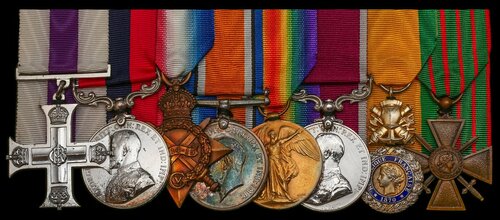
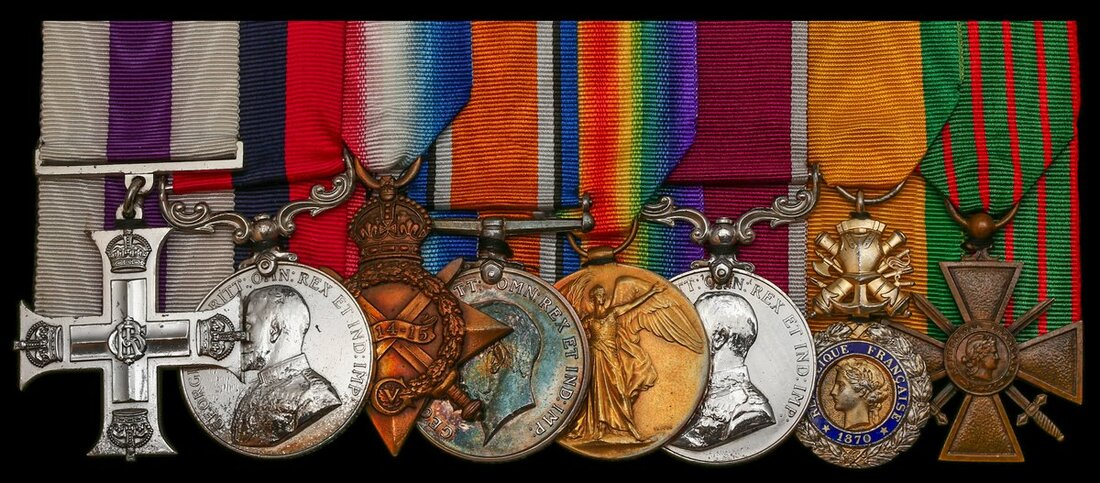
A Regimentally unique Great War 'Salonika' M.C., Western Front D.C.M. group of eight awarded to Warrant Officer Class I G. Pearce, The Rifle Brigade, the very epitome of a Regimental Sergeant-Major, who risked life and limb to rescue his wounded men on more than one occasion
Military Cross, G.V.R., the reverse contemporarily engraved '536. R.S.M. G. Pearce. D.C.M. 4th. Bn. The Rifle Brigade. Prosnic. 15-16 April 1918'; Distinguished Conduct Medal, G.V.R. (536 Sjt: G. Pearce. 4/Rif: Bde:); 1914-15 Star (536 Sjt. G. Pearce. Rif. Brig.), re-engraved naming; British War and Victory Medals (536 W.O.Cl.1 G. Pearce. Rif. Brig.), re-engraved naming; Army L.S. and G.C., G.V.R. (6905138 W.O. Cl. 1. G. Pearce. M.C., D,C.M., Rif. Brig.); France, Medaille Militaire; France, Croix de Guerre, dated 1914-1918, good very fine (8)
One of seven soldiers of the Rifle Brigade to be awarded the M.C. and D.C.M. in the Great War, his additional French decorations make this a unique combination to the Regiment.
M.C. London Gazette 16 September 1918:
'He organised directing posts for stragglers during the night under intense fire. In the morning, hearing that two men were lying out under fire, he obtained permission to take a party to rescue them. He approached right up to the enemy's position when his party picked up two wounded men, while he carried a third on his back to a place of safety.'
D.C.M. London Gazette 23 June 1915:
'For conspicuous gallantry and devotion to duty on the night of 28 February 1915. When it was very bright, he went out to look after a Corporal who had been wounded. The Corporal was again wounded but Sergeant Pearce remained looking after him until a stretcher could be brought. Sergeant Pearce has since been wounded.'
French Medaille Militaire London Gazette 6 November 1918.
French Croix de Guerre London Gazette 11 March 1919.
George Pearce was originally from Chorlton-on-Medlock, Manchester, although he appears to have moved to the West Country at a later date.
A regular soldier in the Rifle Brigade, he was serving in India on the outbreak of war in August 1914, when his unit was ordered home. Subsequently embarked for France as a Sergeant-Major in the 4th Battalion in late December 1914, he and his comrades moved up to positions at Blaringhem and Steenbecque.
And his D.C.M.-winning rescue exploits were enacted under heavy fire on the night of 28 February 1915, after the battalion relieved the 2nd King's Shropshire Light Infantry in trenches near Dickenbusch. Moreover, as cited above, he was himself wounded shortly afterwards, although whether his wounds necessitated his evacuation home remains unknown.
In mid-March 1915, the battalion was heavily engaged in clearing enemy troops out of St. Eloi, the latter leaving behind plenty of sausages, cigars and beer on making their hasty exit. But the Germans retained the Mound feature, from which machine-gun fire inflicted serious casualties. Then in April, the battalion moved into trenches in Polygon Wood, prior to its part in the second battle of Ypres, when ordered to take up positions on the Yser Canal. Here, then, its first experience of coming under gas attack.
And the casualties continued to mount at Hooge in May, where the riflemen dug-in at Sanctuary Wood and came under renewed gas attack. Thus, since April, they amounted to 116 killed, 606 wounded and 46 missing. Just four officers remained on duty by late May. Withdrawn to Armentieres, the battalion remained likewise stationed until September, undertaking weekly long tours in nearby trenches. Then in mid-October 1915, after a tour of duty at Cappy, it was embarked for Salonika.
On arrival, as part of 80th Infantry Brigade, the riflemen dug-in on the hills south of Baldza, from whence they moved east to Stavros in the new year. And there it remained until August 1916, the occasional run-in with Turks and Bulgars causing less trouble than rampant malaria. A tour of duty in Athens in July 1917 ensued and it was not really until early 1918 that Pearce and his comrades started to suffer battle casualties. Hence his M.C.-winning exploits enacted at Prosenic on 15-16 April 1918. Once again, however, it was malaria that dominated the casualty returns.
Following the Bulgarian capitulation, the battalion was embarked for service in the Army of the Black Sea, in which it remained employed until returning home in June 1919, the same month in which Pearce received his D.C.M. from Earl Fortescue in a special ceremony held at the town hall in South Molton, Devon; sold with copied research.
Subject to 20% VAT on Buyer’s Premium. For more information please view Terms and Conditions for Buyers.
Estimate
£1,600 to £2,000
Starting price
£1200

Watch, listen and bid as if you were in the room. Now available for auctions worldwide.
Click here to bid live
An exclusive and confidential service for the discerning collector or vendor.
View the Gallery
Download every Spink catalogue on your iPad, iPod or iPhone using free Spink app.
Download From iTunes© 2026 Spink & Son. All rights reserved.