Auction: 26002 - Orders, Decorations and Medals
Lot: 183
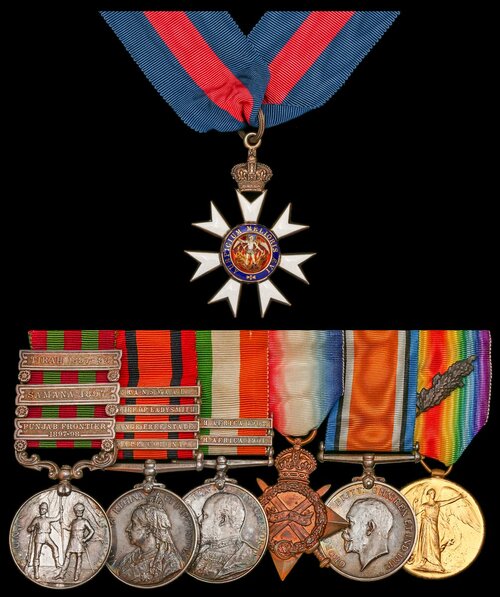
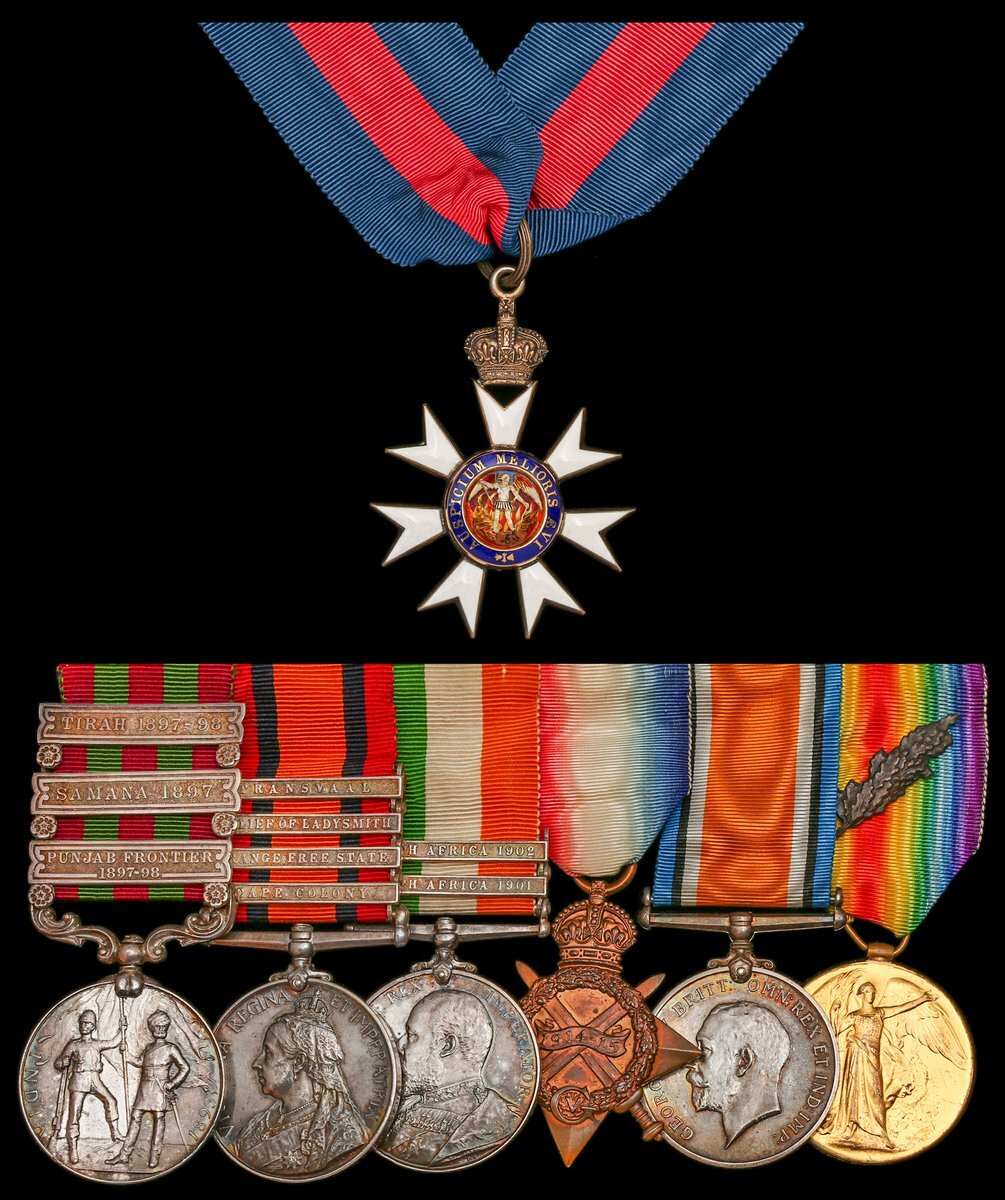
The C.M.G. group of seven awarded to Lieutenant-Colonel H. H. Northey, Royal Scots Fusiliers, an immensely popular officer referred to as 'Our Colonel' by the men of his Regiment, who was taken prisoner at Colenso and later invalided after a wound at Loos, being replaced as Colonel of 6th Battalion by none other than Winston Churchill
The Most Honourable Order of St. Michael and St. George, Companion's (C.M.G.) neck Badge, silver-gilt and enamel, in its Garrard & Co case of issue; India General Service 1895-1908, 3 clasps, Punjab Frontier 1897-98, Samana 1897, Tirah 1897-98 (Lieut. H. H. Northey.Ryl. Scots. Fusrs.); Queen's South Africa 1899-1902, 4 clasps, Cape Colony, Orange Free State, Relief of Ladysmith, Transvaal (Capt. H. H. Northey, R.Scots Fus:); King's South Africa 1901-1902, 2 clasps, South Africa 1901, South Africa 1902 (Capt. H. H. Northey. Rl.Scots.Fus.); 1914-15 Star (Lt:Col: H. H. Northey. R.Sc:Fus:); British War and Victory Medals, with M.I.D. oak leaves (Lt.Col. H. H. Northey.), the campaign awards mounted as worn, edge bruise to second, otherwise good very fine (7)
Provenance:
Spink, May 2001.
C.M.G. London Gazette 14 January 1916:
'For services rendered in connection with Military Operations in the Field.'
M.I.D. London Gazette 1 January 1916.
Herbert Hamilton Northey was born at Chichester, Sussex on 27 June 1870, the son of Lousia and George Northey J.P.. The young Northey was educated at Somerset College and the Royal Military College, Sandhurst. Commissioned Second Lieutenant in the Royal Scots Fusiliers in July 1891, he was promoted Lieutenant in July 1893 and served during operations on the North West Frontier of India in 1897-98, including those on the Samana and the action at Ublan Pass on 27 August 1897, in addition to service on the Staff in the Tirah Expeditionary Force.
Promoted Captain in June 1899, he served during the Boer War in South Africa and was taken Prisoner of War at Colenso whilst participating in operations to relieve the garrison at Ladysmith. Subsequently released, he went onto serve in the Transvaal from November 1900 until May 1902, and was latterly on the Staff and Commandant at Krokodil Poort.
Promoted Major in February 1912, on the outbreak of the Great War Northey was given command of the 6th (Service) Battalion, Royal Scots Fusiliers. He served with the Regiment during the Great War on the Western Front from May 1915 and was wounded at the Battle of Loos on 27 September 1915:
'Just after dawn the Germans attempted to attack us from the direction of Haisnes, but were repulsed without difficulty. Immediately after this I received a report that the enemy were trying to bomb down the right of Fosse Alley. I had two machine guns and also parties of bombers on that flank, and the enemy was held until our bombs were exhausted and both machine guns put out of action by being hit by German bombs. As the German bombing parties were now making headway down the trench, I ordered the company on the right to get out of the trench into the open so as to charge round the bombers. This was done, but not without severe loss from machine-gun fire from St. Elie, and also artillery fire from the direction of Haisnes. With this party I eventually retired on to the old German trenches south-east of the Hohenzollern Redoubt. All this time we received no reinforcements and no support from our guns. On consultation with Colonel MacKenzie (10th Argyll and Sutherland Highlanders) we agreed that the only thing to do was to get back to the old German trenches with as little loss as possible. However as this meant returning over the open for some 300 to 400 yards, severe losses were inevitable. I was hit myself, shot through the left leg about 200 yards from the trench we were making for, and I believe Colonel MacKenzie was also hit about the same time but I never saw him again. This must have been about 3 p.m. and from onward I took no further part in the fighting. After I was hit, I stumbled on through communication trenches hopping as best I could for what seemed an interminable distance - the trenches being deep with mud and choked with dead and wounded men - and was eventually helped into a German dugout by a stretcher-bearer, who tied up my leg. I then imagine I must have fainted, probably because I had lost a lot of blood, and came to finding myself being pulled out of the dug-out by two stretcher-bearers, with a terrific din going on all around. This was the German counter-attacking, and I found I was between the German and British lines. I slowly and very painfully made my way along the German trenches towards our own lines - fighting going on all round and very much afraid of being collared by the enemy. At one point a stretcher was obtained, and the two stretcher-bearers tried to carry me over the open, but just as I was being lifted a shell came, a splinter of which blew the unfortunate stretcher-bearer's brains all over me. The other stretcher-bearer then carried me away over the open on his back under a heavy fire some 150 yards - until we reached a trench in our organised front line. Very soon after this I got another stretcher, and after many varied vicissitudes I arrived at Barts where there was a dressing station. From Bart's I was carried to Vermelles, then to Bethune (a very painful dressing and injection there), then to Lillers (for two days) and then on to the No. 20 General Hospital, Etaples.' (recipient's diary refers).
Appointed a Companion of the Order of St. Michael and St. George, and Mentioned in Despatches, Northey relinquished command of the 6th Battalion on account of his wounds in January 1916, and was replaced as Commanding Officer of the Battalion by Lieutenant-Colonel Winston Churchill. After a year's recuperation, Northey returned to the 6th Battalion in France as Commanding Officer in November 1916 (Churchill having relinquished command in May 1916 in order to return to the House of Commons), and remained on active service until April 1917. He retired with the rank of Lieutenant-Colonel, October 1919.
Northey and Churchill
Lieutenant-Colonel Northey relinquished command of the 6th Battalion, Royal Scots Fusiliers following the Battle of Loos, and Winston Churchill was appointed as his successor. It is interesting to parallel Northey's and Churchill's military careers. Both men passed out of the Royal Military College, Sandhurst (only four years apart). In 1897-98 as Lieutenants, both were present in the Punjab Frontier and the Tirah campaign against Afridi insurgents. Later in the Boer War Northey, like Churchill, was captured by the Boers and interned as a Prisoner of War.
Did Northey and Churchill ever meet? Probably - at a historic reunion of the Regiment on 1 July 1919, their first post-War Regimental Dinner with H.R.H. The Prince of Wales, the newly-appointed Colonel-in-Chief, as the guest of honour. Among the 80 guests was Churchill, who toasted the Prince of Wales and spoke of the 'magnificent spirit that existed in the famous old Regiment, and how much that spirit meant, and would mean in the future.' Also present was Lieutenant-Colonel Northey, the man Churchill had replaced. An eyewitness wrote: 'Old friends gripped hands very warmly, but with few words. There was a feeling of reunion and thankfulness, and the regret for those who had gone, and words did not come easily.' To believe the two commanders did not share a greeting is impossible. They had much in common.
Northey died at Glasgow, Lanarkshire on 7 January 1938 and obituary written after his death states:
'Many old Friends and comrades will learn with regret of the death, which occurred at East Mains, Callander, on Friday, 14th January, of Lieut-Col. Herbert Hamilton Northey, C.M.G., late of The Royal Scots Fusiliers. His death comes soon after a lamentable motor accident in which his only son, Mr. H. W. H. Northey, was killed, on the day after his promotion to an important post with the B.B.C.
Col. Northy, who was sixty-seven years of age, was the third son of the late Lieut.-Col. G. W. Northey, J.P., D.L., Ashley Manor, Box, Wilstshire. He held the medal with two clasps for the North-West Frontier Campaign, 1897-98; the clasp for the Tirah Expedition, 1897-98; the Queen's Medal with four clasps and the King's Medal with two clasps for the South African War, 1899-1902; and was mentioned in despatches and awarded the C.M.G. for his services in the Great War, 1914-17. Col. Northey, it may be recalled, was in command of the Depot at Ayr in the year prior to the war. He was mentioned on several occasions in John Buchan's "History of The Royal Scots Fusiliers," and in the reference to the Great War the eminent historian quotes from the Colonel's diary. Col. Northey, then a captain, is mentioned as among the officers taken prisoner at Colenzo on the day when the first Victoria Cross in the history of the Regiment was awarded to Pte. C. Ravenhill.. In 1915 he commanded the 6th Battalion of The Royal Scots Fusiliers, the first of the Kitchener units, which formed part of the famous Ninth Division. Col. Northey was wounded in the Battle of Loos, and it is with regard to his experiences here that his diary gives such a vivid account. He tells of how two stretcher-bearers bore him along, and just as he was being lifted from a trench a shell came and a splinter blew one unfortunate stretcher-bearer's brains all over him. "The other stretcher-bearer then carried me away over the open on his back, under a very heavy fire, some 150 yards, until we reached a trench in our original front line. Very soon after this I got another stretcher and after many and varied vicissitudes I arrived at Bart's where there was a dressing station. When I arrived there I found that the stretcher-bearer who had carried me had disappeared, and I have never been able to find out anything about him since".'
Sold together with copied research.
Subject to 20% VAT on Buyer’s Premium. For more information please view Terms and Conditions for Buyers.
Estimate
£1,000 to £1,400
Starting price
£1000
Watch, listen and bid as if you were in the room. Now available for auctions worldwide.
Click here to bid live
An exclusive and confidential service for the discerning collector or vendor.
View the Gallery
Download every Spink catalogue on your iPad, iPod or iPhone using free Spink app.
Download From iTunes© 2026 Spink & Son. All rights reserved.