
Auction: 26002 - Orders, Decorations and Medals
Lot: 178
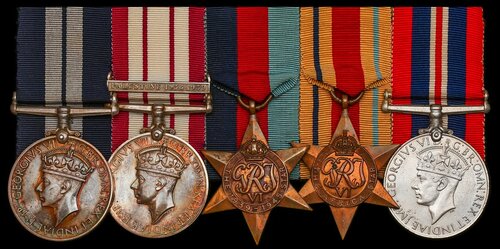
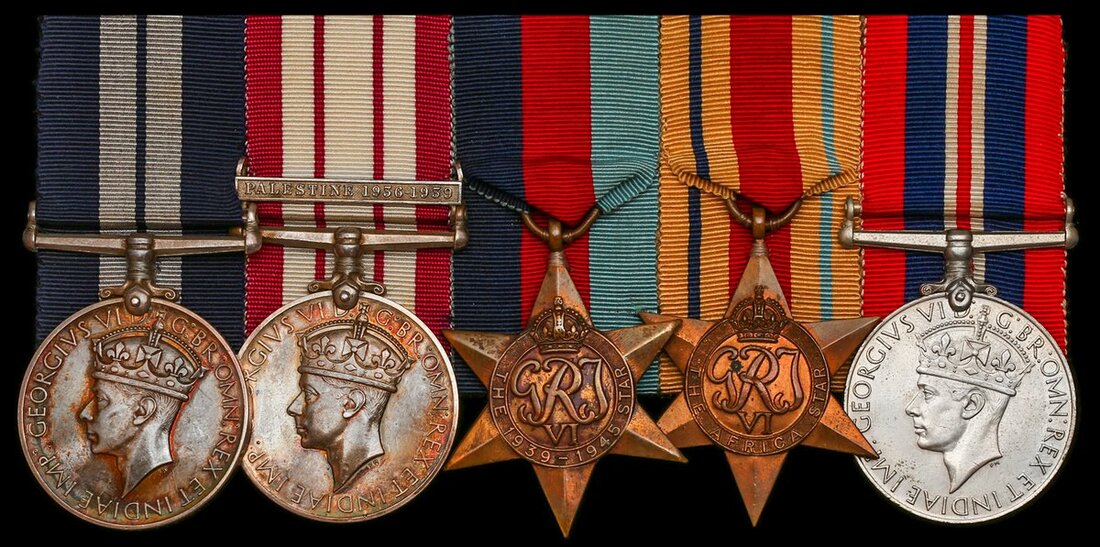
The superb 'Coastal Forces 1942' D.S.M. group of five awarded to Able Seaman G. L. Edwards, Royal Navy who also added a 'mention' to his accolades
Edwards won both awards and a wound whilst serving as an Oerlikon gunner on MGB 64 under the legendary Coastal Forces Commander R.P. 'Hitch' Hichens, D.S.O. and bar, D.S.C. and two bars
Distinguished Service Medal, G.VI.R. (JX.145757 G.L. Edwards. A.B.); Naval General Service 1915-62, 1 clasp, Palestine 1936-39 (JX.145757 G.L. Edwards. A.B.R.N.); 1939-1945 Star; Atlantic Star; War Medal 1939-45, mounted court-style as worn, very fine (5)
D.S.M. London Gazette 10 July 1942, the original citation states:
'For determination and coolness in the protection of a convoy.'
The original recommendation states:
'Though a large part of the platform on which he stands was shot away and his gun mounting hit repeatedly, he continued to keep up an accurate fire and to clear two jams that occurred in his gun due faulty rounds.'
M.I.D. London Gazette 10 February 1942, the original recommendation states:
'For coolness, skill and readiness when our Naval Patrols and light Coastal Forces went into action against Enemy E. boats, sinking three and damaging others.'
George Leslie Edwards, after serving on destroyers prior to the Second World War, transferred to Coastal Forces being posted to MGB 64 in the 6th M.G.B. Flotilla at Beehive, the Coastal Forces base at Felixstowe. His Flotilla and boat C.O. was to become a Coastal Forces legend, namely 'Hitch' Hichens, the winner of two D.S.Os and three D.S.Cs prior to his death in April 1943.
The 6th Flotilla under 'Hitch' claimed its first victory on 19-20 November when they went on patrol planning to intercept S-boats off the Hook of Holland. Unfortunately, mechanical problems with one of the boats meant only two could continue and 'Hitch's' own boat, 64, lost the power in one of its engines. The planned destination was now out of the question and the two remaining boats made instead some 20 miles seaward of the convoys route and the returning German vessels.
Firefight - East Coast - 19 /20 November 1941: 'mention'.
Bryan Cooper in the Battle of the Torpedo Boats takes up the story:
'It was an ideal night for small boats - a flat calm sea, an early moon. Slowly the unit formed into line ahead and headed past the harbour boom setting course of the Hook of Holland. The two boats reached this position at 02.00 on November 20th, cut engines and lay in wait for any sound of the returning S-boats. Reports of their activities were still coming in from the convoy route, so it meant a long wait. It was not until 04.45 that the faintest murmur of engines was heard. The moon had set by now and with a mist rising over the sea, visibility was no more 200 yards. The chances of two small boats, one capable of only 18 knots, intercepting a force of 40-knot S-boats seemed only slight.
The sound became steadily louder for about eight minutes and then seemed to bear slightly to the south. Altering course once more the MGB's set off once more. Suddenly Hichens caught sight of a tiny blue light winking quite close to port. The faint outline of a hull loomed out of the mist. Although certain that it was an S-Boat he had to identify before attacking. A challenge was flashed. The reply was faint and indecisive. And then there they were ahead, five S-Boats, their hulls low and painted white, clustered together, almost stopped or moving very slowly, having arrived at their rendezvous position.
The two MGB's surged in amongst them firing at 50 yards range. Before the Germans knew what was happening, one S-Boat was engaged to starboard, another to port and one which was moving slowly across Hichen's bows was given a burst of fire by the forward guns at less than 20 yards. A fourth was attacked on a parallel course. Most of the enemy fire was erratic and passed harmlessly overhead. But a burst from the fourth boat put Hichen's main gun out action. By now the S-Boats had somewhat rec overed from their initial surprise and were scattering in all directions. The speed of the MGB's was not sufficient to keep up with them. Deciding that the enemy's general disengaging course was likely to be south-east towards the Dutch coast, Hichens headed in that direction, followed by Campbell. Suddenly a fifth S-Boat loomed up to starboard taking a similar course. It was at this point that Hichens found his starboard guns had either been knocked out or were jammed.
He had nothing with which to engage the S-Boat except a hand controlled .303 Lewis gun'.
Despite the lack of firepower, the boats headed off again heading southwest after 64's coxswain heard the faint sound of boats. With dawn rising the two MGBs found an abandoned boat which had suffered significant damage, clearly she had been scuttled and was sinking. The MGB crew boarded her planning to take the 'prize' home, but it was too late, her seacocks had been opened and the engine room was full of water. They removed everything from the sinking vessel as fast as they could, cheering as she went down.
The MGBs returned home to a triumphant welcome flying the Nazi flag beneath the white ensign. 'Hitch' was rewarded with a bar to his D.S.C. and Edwards a mention.
Leonard Reynolds in Home Waters MTBs & MGBs at War 1939-45 describes the action, stating:
'On 21 April, after intelligence had revealed that a flotilla of E-boats was now operating from Ostend, Hichens tried a new ploy. He took four boats of his flotilla, leaving base much earlier than usual in order to arrive off the port by dusk with the intention of catching any E-boats just setting out on patrol. They did not have to wait long. First came the rumble of engines and then a few minutes later, as eyes were glued to glasses, they were suddenly in sight: four E-botas possibly six in line ahead.
Hichens in 64 rapidly overtook the last E-boat in line, which was already firing and was closing all the time as they ran on in close station up the line on a parallel course. They saw their shells burst on the E-boats hull, and in no time, they were up to the next in line, switching their attack to her.
By this time 64 had been severely hit. The starboard gun had been silenced and two of its crew lay wounded, but others sprang forward to reload. Relentlessly 64 swept up the line-there were six E-boats and as they headed towards the leader she too broke off and turned away. The first objective had been achieved: the E-boats had at least temporarily been diverted from their course towards their patrol area.
MGB 64 had suffered grievously: five of the crew of ten were wounded, mostly seriously; the starboard gun was hatred; and the hull was holed in at least thirteen places. But luckily none of the holes was vital.'
MGB 64 was out of the action and returned to base as fast as possible to get medical attention for the wounded, 'Hitch' having transferred to MGB 65 to pursue the fight. 'Hitch' was awarded his first D.S.O. and Edwards the D.S.M. following this engagement.
Wounded - 14 July 1942
The flotilla was moved to Dartmouth, Devon in July 1942. The first action they were involved in was during the night of 14-15 July. Ordered to engage E Boats using Cherbourg as a base, they found a convoy of naval trawlers escorting a small tanker. The flotilla engaged the two rear escort trawlers and carried out a depth charge attack. The tanker was last seen to be on fire as the flotilla reformed off Alderney.
This was an especially grisly action and again half the crew of 64 were casualties, one dead and two of them seriously wounded. 'Hitch' had lost the equivalent of his whole crew in two successive actions within three months including his dependable Oerlikon gunner, Edwards. 'Hitch' was fearful that he would never handle his gun again at sea. There is no doubt that serving under a legendary MGB commander came at a price.
Subject to 20% VAT on Buyer’s Premium. For more information please view Terms and Conditions for Buyers.
Estimate
£1,600 to £2,000
Starting price
£1200

Watch, listen and bid as if you were in the room. Now available for auctions worldwide.
Click here to bid live
An exclusive and confidential service for the discerning collector or vendor.
View the Gallery
Download every Spink catalogue on your iPad, iPod or iPhone using free Spink app.
Download From iTunes© 2026 Spink & Son. All rights reserved.