Auction: 26002 - Orders, Decorations and Medals
Lot: 170
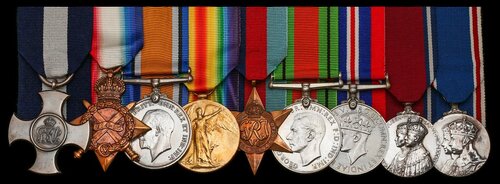
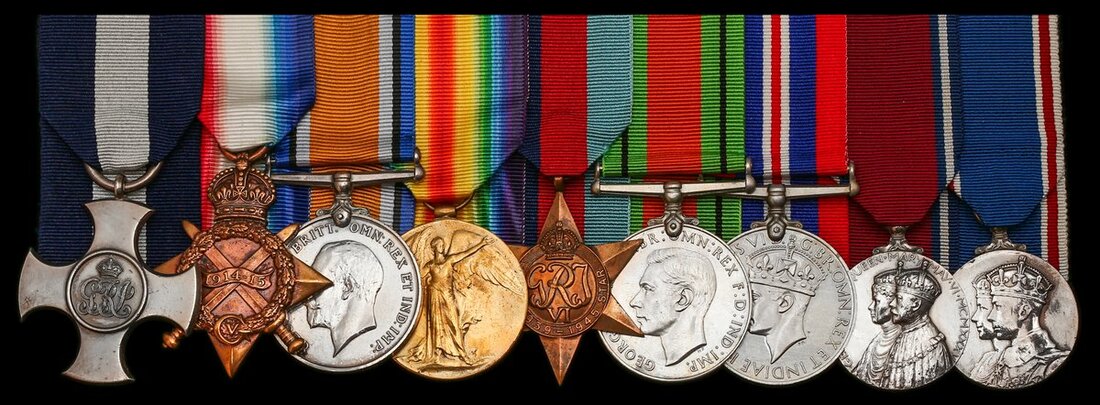
A superb 'Destroyer Commander's 1917' D.S.C. group of nine awarded to Captain E. C. Thornton, Royal Navy, a Jutland veteran who was decorated by the Royal Humane Society for his bravery commanding Derwent when she was mined in 1917
Returning for service in 1939 as a Commodore Class II he commanded the Naval Air Station Daedalus, supporting the Normandy Landings
Distinguished Service Cross, G.V.R., hallmarks for London 1917; 1914-15 Star (Lieut. E. C. Thornton, D.S.C., R.N.); British War and Victory Medals (Lieut. E. C. Thornton, R.N.); 1939-45 Star; Defence and War Medals 1939-45; Jubilee 1935; Coronation 1937, slight edge bruising and light contact wear, overall very fine (9)
Provenance:
D.N.W., December 2007.
D.S.C. London Gazette 8 March 1918, the original citation states:
‘For services in Destroyer and Torpedo Boat Flotillas during the period ending 31 December 1917.’
Edward Chicheley Thornton was born at Buttevant, County Cork, Ireland on 19 September 1889, the son of Lieutenant-Colonel Richard Thornton of the 77th Foot and his wife Henrietta. Joining the Royal Navy as a Naval Cadet at Britannia on 15 January 1905, and passing out as a Midshipman, he was posted to the cruiser Black Prince in May 1906. He was promoted Sub-Lieutenant with H.M.S. Africa on 15 August 1909, just prior to her return to the Home Fleet, and later joined Angler with whom he was advanced Lieutenant in April 1912.
Thornton was serving in the destroyer Grasshopper on the outbreak of hostilities in August 1914. This vessel began the war in the Mediterranean and was part of the effort by the Allies to force the Dardanelles prior to the Gallipoli Campaign. She later supported the Cape Helles Landings on 25 April 1915 at 'S' Beach and the Suvla Bay Landings in August.
Removing to H.M.S. Marksman on 22 October 1915, Thornton joined her with the 12th Destroyer Flotilla. This formation was stationed with the Grand Fleet under Admiral Jellicoe at the Battle of Jutland the next year. Becoming detached from her Squadron, Marksman attached herself to the 13th Destroyer Flotilla as the night phase of the Battle set in. Avoiding damage during the Flotilla's encounter with German Battleships early on 1 June she instead rescued survivors from Ardent and Sparrowhawk.
After the Battle Thornton was given his own command, the destroyer Derwent, and joining the 1st Destroyer Flotilla in November 1916 she conducted anti-submarine sweeps out of Portsmouth. It was in this role that she was present off La Havre on 2 May 1917 when she struck a mine laid by UC-26.
Her Thornton's bravery was on full display which the case file for the Royal Humane Society's Silver Medal, awarded for the incident, makes clear (case no. 43,713, refers): '‘Lieutenant Thornton got hold of a lifebuoy, but seeing that Ellis was severely hurt and unable to keep afloat, he gave up the buoy to him, and having secured another buoy, he endeavoured to keep the man afloat but failed, and was himself picked up about ten minutes later in a state of collapse.’
His service records give further detail stating: "'Sinking of the Derwent, Expression of their L's appreciation of his conduct on this occasion, although blown off the bridge by the explosion continued to take charge from the water, at the same time attempting to support the Gunner who had also been blown overboard."
Surviving the sinking, which claimed the lives of some 58 officers and men, Thornton was given command of Lucifer on 12 July 1917. Only a few weeks later he again earned Their Lordships' praise for aiding in the salvage of S.S. Bellogia. His final wartime command was Romola between January 1918 and March 1919. Shortly after leaving her, he was advanced to Lieutenant-Commander on 1 April 1920.
Continuing to serve, Thornton was notably in command of Raider in February 1921 when he was reprimanded for the loss of a torpedo. Advanced Commander on 31 December 1925, he received a posting to Naval Intelligence the next year. Increasingly posted ashore he did manage to earn another commendation for his command of Wryneck in towing in the damaged S.S. Florida off Malaga after she collided with H.M.S. Glorious on 1 April 1931. Florida's passengers did suffer 22 dead in the collision but doubtless Thornton's prompt actions saved many lives.
Appointed Commodore Class II on the outbreak of the Great War, he was given command of the Royal Naval Air Station Daedalus from March 1941. Naval Aviators in Spitfires gives some clue as to the role of this station in the run-up to the Normandy Landings, stating:
"The scope of pre-invasion preparation was enormous. Besides the logistical nightmare of bringing the largest fleet ever assembled to the various ports along the southern British coast, peripheral support activities needed to be planned. One of these support organizations was the Air Spotting Pool, the 34th Reconnaissance Wing, 2nd Tactical Air Force, commanded by Royal Navy Commodore E. C. Thornton. By June 1944, the wing included five Royal Air Force (RAF) fighter squadrons (2, 26, 63, 268, and 414), with Spitfires and Mustangs, as well as several flights with Seafires - the Royal Navy version of the Spitfire- and Hawker Typhoons: huge, powerful single-seaters originally intended as ground attack aircraft. [...]
By 1 June 1944, the 34th Wing had assembled at RNAS Lee-on-Solent with more than 100 aircraft carrying the distinctive black and white "invasion stripes" on their wings and fuselages. Seafire took off at 0441 on 6 June for the first spotting missions of the D-Day invasion. The pace was hectic, and by the end of the day, seven aircraft, including one VOS-7 Spitfire, had been lost to heavy German flak. The following day saw German fighters attacking the spotter flights, even though RAF and USAAF fighters flew escort."
Thornton survived the war and retired to Hook Gate in Titchfield, Hampshire where he died on 27 March 1959; sold together with copied research including, census data, records relating to the recipients family tree, service papers and medal rolls as well as extracts from the London Gazette, Naval Aviators in Spitfires, Royal Navy Vessels under Construction and Jane's Fighting Ships for 1919.
Subject to 20% VAT on Buyer’s Premium. For more information please view Terms and Conditions for Buyers.
Estimate
£2,000 to £2,500
Starting price
£1600

Watch, listen and bid as if you were in the room. Now available for auctions worldwide.
Click here to bid live
An exclusive and confidential service for the discerning collector or vendor.
View the Gallery
Download every Spink catalogue on your iPad, iPod or iPhone using free Spink app.
Download From iTunes© 2026 Spink & Son. All rights reserved.