
Auction: 26002 - Orders, Decorations and Medals
Lot: 101
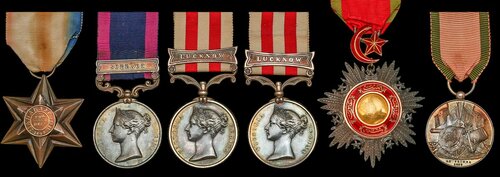
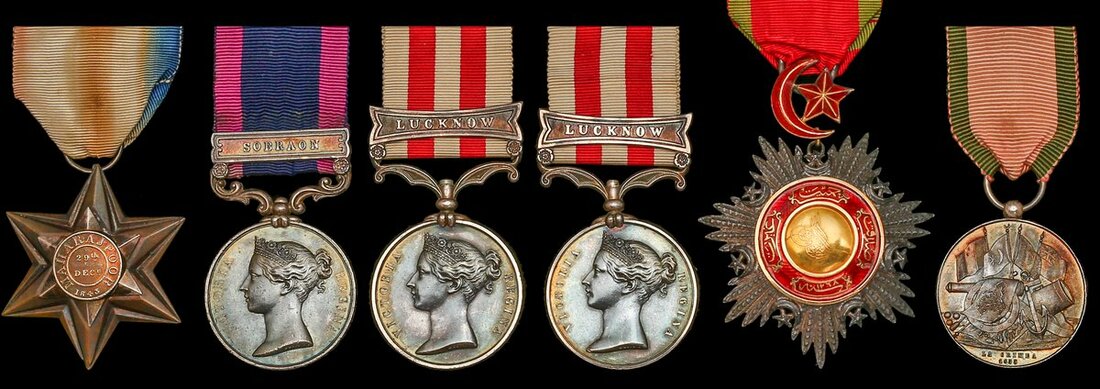
A notable and emotive India service group of six awarded to Major-General D. McNeill, Royal Artillery, late Bengal Artillery, who also served in the Turkish Contingent in the Crimea in 1855-56
But it was his command of the Nepalese Artillery in the Goorkha Force in the Oudh in 1857-58 that proved to be his most memorable appointment - and one which earned him the rare accolade of the 'double issue' of the Medal - imbued as it was with gallant deeds on the battlefield and resultant accolades
It also included his instrumental part in the rescue of two ladies from the clutches of the rebels on the outskirts of Lucknow in March 1858. As happily reported by one of them, Miss Anna Jackson, suddenly 'there was a tall Englishman!' and 'We were saved!'
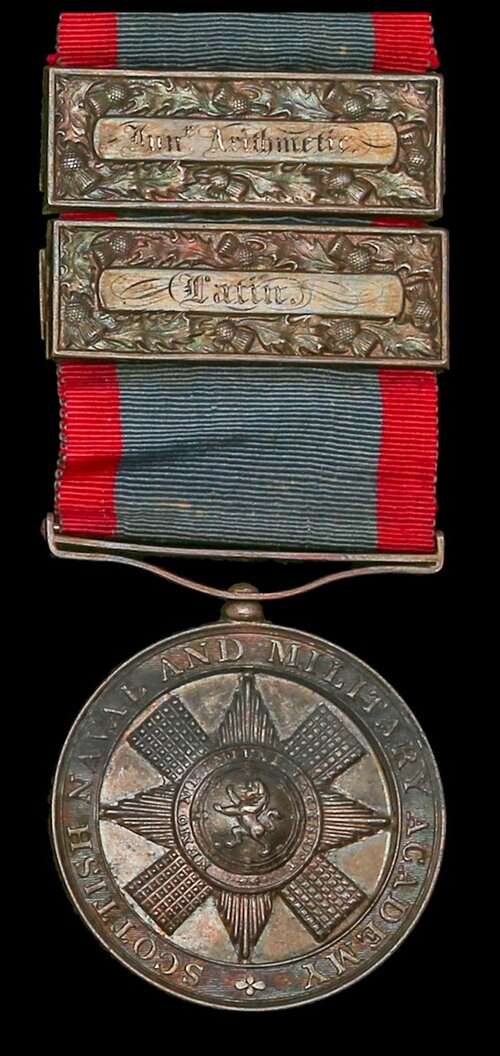
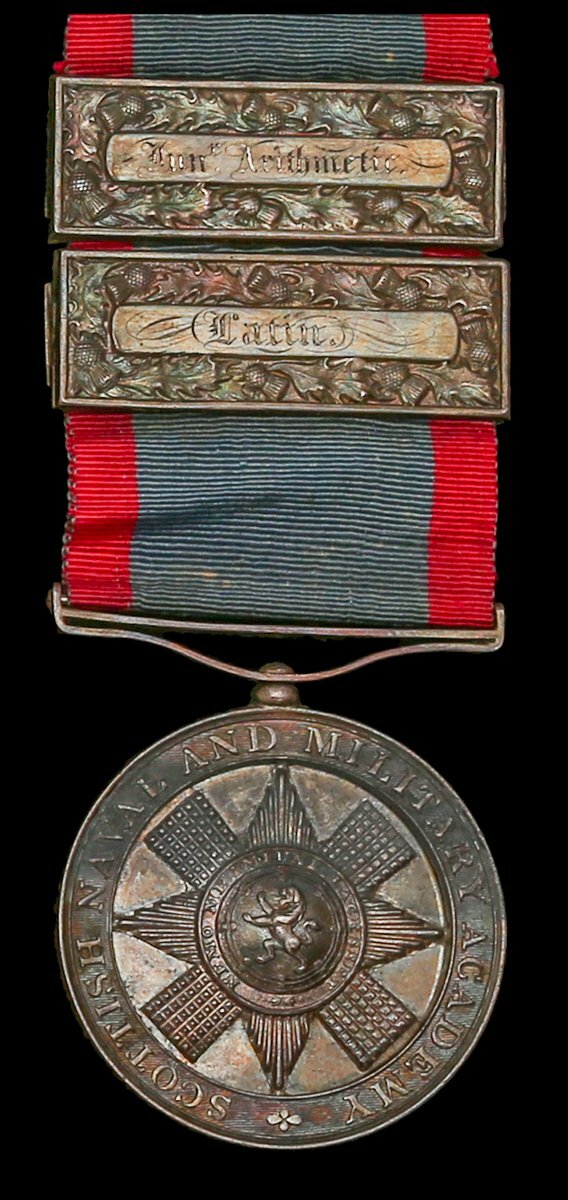
Maharajpoor Star 1843 (2d Lieutt. H. D. McNeill 3rd Comp. 4th Battn. Artillery); Sutlej 1845-46, for Ferozeshuhur, 1 clasp, Sobraon (Lieut. D: McNeill 3rd Brigade H: Ay.); Indian Mutiny 1857-58, 1 clasp, Lucknow (Capt. Donald McNeill, 2nd Bn Bengal Art.); Indian Mutiny 1857-59, 1 clasp, Lucknow (Captn McNeill, Attd. Goorkha Force); Turkish Crimea, Sardinian die, unnamed; Turkey, Ottoman Empire, Order of the Medjidie, 4th Class breast Badge, silver, gold and enamel, together with Scottish Military and Naval Academy Prize Medal, the reverse engraved 'Junr. Mathematics 1st Prize Mr Donald McNeill 26th July 1839', with additional Bars for 'Junior Arithmetic' and 'Latin' on the same date, the reverse of the first adapted for ring suspension, generally good very fine (6)
Donald McNeill was born in 1824, the son of a Colonel in the 91st Regiment and likely a descendant of the Lairds of Colonsay. Appointed a 2nd Lieutenant in the Bengal Artillery in June 1842, he quickly saw action in the Gwalior campaign in the following year, when he was present at the battle of Maharajpoor, and likewise in the Sutlej campaign in 1845-46, when he was present at the battles of Ferozeshuhur and Sobraon.
Advanced to Lieutenant in July 1845, he raised a Light Field Battery at Dera Ghazi Khan about the time of the Punjab Campaign in 1848-49 and served in it on attachment to the Nusseeree Battalion on the Mukwal Dhoon on the Dehra Jat Frontier in 1850-52, in addition to the punitive expedition against the Scinde Ameer Ali Moorad in Spring of the latter year.
Having then served in the Turkish Contingent in the Crimea in 1855-56, he was selected by Major-General Michel to conduct a Brigade of Turkish Troops from Kertch to Varna, which services were rewarded by the 4th Class of the Order of Medjidie (Edinburgh Gazette 5 March 1858, refers) and Turkish War Medal.
Gallant Goorkhas
But it was his extended service in the Goorkha Force under the Maharajpoor Jung Bahadur in the Indian Mutiny that afforded him an opportunity to shine, his resultant active service record gaining him the Brevets of Captain in July 1857 and Major in July 1858, in addition to being mentioned in despatches and receiving the special thanks of His Excellency the Governor-General in Council.
The part played by the Goorkha Force in the Oudh campaign, and more specifically in the final advance and capture of Lucknow in early 1858 is the subject of wide coverage and recognition. And within that context the part played by the force's gunners was a prominent one. A case in point would be the Force's action against 10,000 rebels at Shahgunge on 5 February 1858, when McNeill had command of the artillery. Judging by his resultant mention in despatches (London Gazette 2 April 1858, refers), he did not disappoint:
'I halted the line when he [the enemy] approached within 500 yards. Captain McNeill opened his battery on his right, with most accurate precision, the shells bursting immediately over the rebels, causing them at once to make a rapid retreat, and seek shelter in villages on our right and left; they were soon driven out of these by the well-directed fire of the batteries under the superintendence of Captains McNeill and Holland - a shell from the former having set one of the villages on fire. After this the force continued its advance as far as the village of Shahgunge, driving the rebels before it, who retreated with such rapidity that they were in a short time out of gun range.'
In his capacity as senior artillery officer, McNeill had to write a despatch himself, dated at Camp Belwa on 6 February 1858, namely a report of the activities of the Nepalese Batteries attached to the Goorkha Force. In it, he adds that large numbers of enemy cavalry attempted to outflank the Force but that both flanks were secured by a very heavy fire.
Again, on 5 March 1858 in an action against 4,000 rebels who had taken up positions on the Kandoo Nuddee on the approaches to Lucknow, the Goorkhas emerged victorious. As reported in a related despatch, they fought splendidly, rushing after the fleeing rebels:
'With a loud cheer … the Goorkhas were quite at home in this mode of warfare; their pursuit was so rapid through the ravines that numbers of the rebels were very soon overtaken, shot, and cut down. Many instances of individual bravery on the part of the Goorkhas were brought to my notice; there were several who each cut down three of four of the enemy …'
Some 600 rebels were killed.
Damsels in Distress
It was, however, for his part in a rescue operation on the outskirts of Lucknow on 20 March 1858 that McNeill's name next came to notice, so, too, his colleague, Lieutenant Andrew Bogle. The incident in question is recalled in gushing tones in A Personal Narrative of the Indian Mutiny by Miss Anna Madeline Jackson, she being one of the rescued ladies. The other was Mrs. Alexandra Orr.
In it she refers to their enforced captivity over several months, and how they ended up under the care of an Indian ex-member of Sir James Outram's staff. It seems the rebels were on their case and due to mount a murderous assault on their place of hiding. Happily, however, when Miss Jackson heard 'a rush below and a rush up our stairs and I flew out to see what was happening, there was a tall Englishman! We were saved!' Jackson goes on to praise McNeill's 'little Goorkhas', who 'carried us off - up and down ravines like cats - Captain McNeill with us - and we were in the English camp - saved - It seemed such an impossible thing - English soldiers rushed out to greet us, and Sir Colin Campbell and the Goorkha Chief and lots of others.'
News of the rescue soon reached the famous Times correspondent, William Russell, who wrote:
'It was subsequent to this success that Captain M'Neill, of the Bengal Artillery, attached to the Ghoorkhas, and Lieutenant Bogle, of the same force, succeeded in saving Mrs. Orr and Miss Jackson, who had been so long in captivity.
As these officers were exploring the deserted streets in front of the Ghoorkha advanced posts they encountered a native who said he was one of Sir James Outram's employees, and implored their protection for his house and property. In the course of his appeal he mentioned incidentally that he knew where the English ladies were confined and offered to point out the place. Almost immediately afterwards, another native appeared and presented two notes - one from Mrs. Orr, the other from Miss Jackson, imploring immediate succour, as their enemies were making a search for them.
The officers returned to the nearest Ghoorkha post, asked for volunteers; forty or fifty of these hardy, dirty and loot-loving Calmucks stepped forth, and, with the native at their head as guide, the party at a rapid rate started off on their errand of deliverance. They proceeded for more than half a mile through the silent, tortuous streets, expecting to receive a volley at every turn, when they came to a house, apparently shut up and abandoned. "This is the house," said the guide. At the noise of their footsteps, the owner - Meer Wajeed Ali, Daroga of the Court - made his appearance, and began to stipulate for his property, but Captain McNeill demanded the immediate production of the ladies, and, finding that he was resolute, the Daroga led him to an obscure apartment where there were two ladies in Oriental costume in a dark corner. At the sound of the voice, "Are you the English ladies, and do you wish to leave this place?" those whom he addressed were not able to reply to the officer from excessive joy, and for a moment or two they were over-whelmed with thankfulness and emotion. But there was no time to be lost. The Moulvie and his followers were known to be searching for them.
The ladies, clad as they were, descended to the street, and were about to be placed on the officers' horses, when a palanquin caught the eye of Captain M'Neill in the court of the house. Just as the ladies were getting into it a few budmashes, with drawn swords, sallied out from an adjoining house to attack them, but a shot from a revolver and the bayonets of the Ghoorkhas soon disposed of the resistance, and six of the Daroga's being impressed as palanquin bearers, the party and a portion of the escort moved back as rapidly as possible to the Ghoorkha post, and the poor ladies were placed in safety'.
Subsequent career
McNeill was given the Brevet of Lieutenant-Colonel in April 1859 and was advanced to Colonel in March 1870. Having then been placed on the Retired List as a Major-General, he died in Edinburgh in December 1891; sold together with copied research.
Subject to 20% VAT on Buyer’s Premium. For more information please view Terms and Conditions for Buyers.
Estimate
£3,000 to £5,000
Starting price
£2400

Watch, listen and bid as if you were in the room. Now available for auctions worldwide.
Click here to bid live
An exclusive and confidential service for the discerning collector or vendor.
View the Gallery
Download every Spink catalogue on your iPad, iPod or iPhone using free Spink app.
Download From iTunes© 2026 Spink & Son. All rights reserved.