Auction: 25124 - Spink Numismatic e-Circular 43: British and World Coins and Medals - e-Auction
Lot: 18
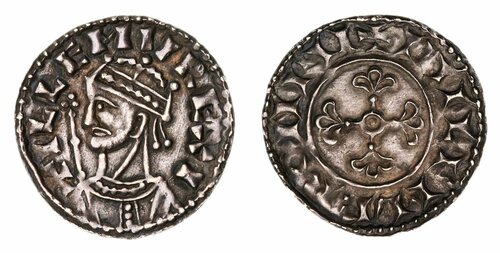
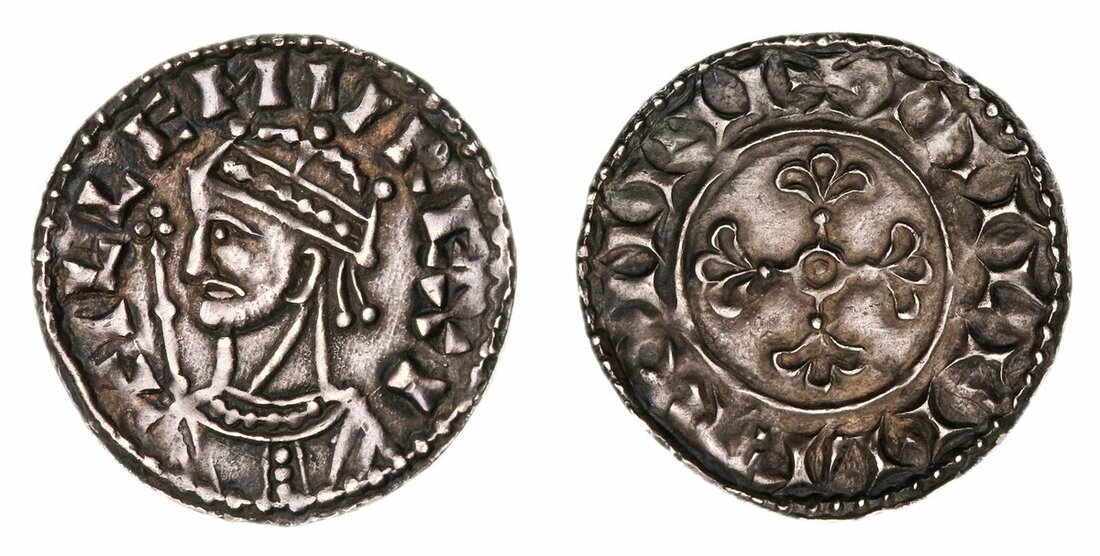
(x) William I 'the Conqueror' (1066-1087), 'Profile/Cross Fleury' Type, Penny, 1066-1068, Romney, Wulfmær, + ILLEMV REX I, crowned and diademed bust left, sceptre to left, rev. + PVILFMÆR ON RII, cross fleury with annulet in centre, 1.20g [18.52grns], 9h (SCBI 68 [Lyon] 1036; SCBI 12 [Ashmolean], 11-17 same dies; FEJ III, 1602 same dies; North 839; BMC I, 39-41 same dies; S.1250), slightly soft of strike, otherwise with a uniformly dark tone, a pleasingly good very fine, and with an exemplary pedigree
Provenance
SNC, April 2006, HS2271 - "on a full flan, toned nearly EF" - £1,100
[with F Elmore-Jones ticket, but mysteriously not that which was offered in Part III, Glendining, 7 October 1986, lot 1602*]
Denge Marsh Hoard, 1739
The Denge Marsh Hoard was reconstructed from Antiquarian accounts by the late Professor Metcalf for the Numismatic Chronicle in 1957 (Vol. XVI, pp. 186-190). His opening remarks state simply: "there are quite a number of conflicting accounts of this hoard in eighteenth century literature". However, as Purefoy adduced some four decades later from his sample size of 50 coins: "The recorded history of 40 of the coins [80%] starts in England and none of these has a pedigree that conflicts with the possibility that it came originally from the [Denge Marsh] hoard."
As documented by the late Peter Purefoy, and corroborated by this cataloguer's separate enquiries: "In the first or Profile Left type only Canterbury, Dover and Romney are represented [for Kent]. The coins disclose that three moneyers were striking at the important mint at Canterbury at this time, and we have respectively eight, five and nine of their coins. One of the moneyers Wulfred, used at least two pairs of dies. Dover has one moneyer in evidence with four coins all from the same dies. Rochester, Sandwich and Hythe have no coins of Type I to show. But Romney is exceptional. In fact, the incentive to write this article came from the listing in the Numismatic Circular for June 1996 of a Type I Penny of Romney which is the fiftieth coin of its mint and type that I have found, all struck from the same pair of dies".
It is now all but certain that the source of most, if not all known examples of the Profile Left type of William I Penny struck by Wulfmær at Romney must originate from the Denge Marsh trove, on account of tone, weight standard, striking quality, defects and production 'treatments' and of course, rather tellingly, the universal die matching of all known examples from a sole obverse and reverse die. Not even the recent and comprehensive Chew Valley Find (2019) presented a new example for this type, even though strikings by the moneyer Wulfmær at Romney are present for Harold II. Compellingly, a single further find has been recorded with the Fitzwilliam Museum (EMC 2019.0282) also reported as from "Denge Marsh" which may ultimately reveal the find location of this early trove.
Subject to 5% tax on Hammer Price in addition to 20% VAT on Buyer’s Premium.
Sold for
£2,500
Starting price
£700

Watch, listen and bid as if you were in the room. Now available for auctions worldwide.
Click here to bid live
An exclusive and confidential service for the discerning collector or vendor.
View the Gallery
Download every Spink catalogue on your iPad, iPod or iPhone using free Spink app.
Download From iTunes© 2026 Spink & Son. All rights reserved.