
Auction: 25113 - Orders, Decorations and Medals - e-Auction
Lot: 398
'Eventually we were compelled to withdraw from this position, having lost […] the other ranks and I myself had a bullet through my right arm. We continued our withdrawal and on the approach of a party of the enemy (about 20) I, the Sgt. Maj. & Company runner got into an old T head and opened fire on the enemy. We killed the majority and my revolver was twice emptied, most of the bullets finding an excellent billet, including one German Officer.'
(The repatriation report of Captain Thomas Cyril Maders, refers)
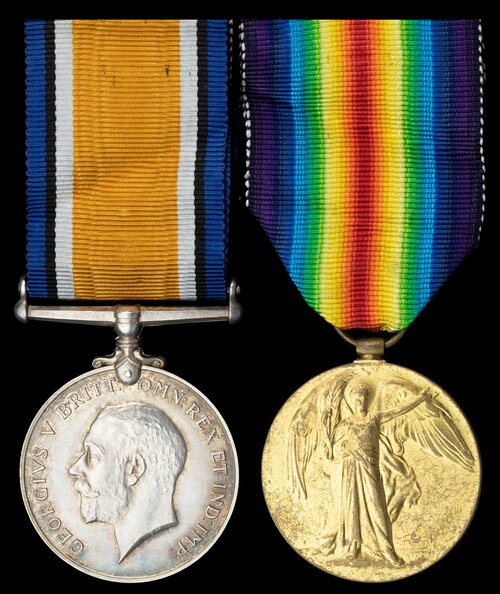
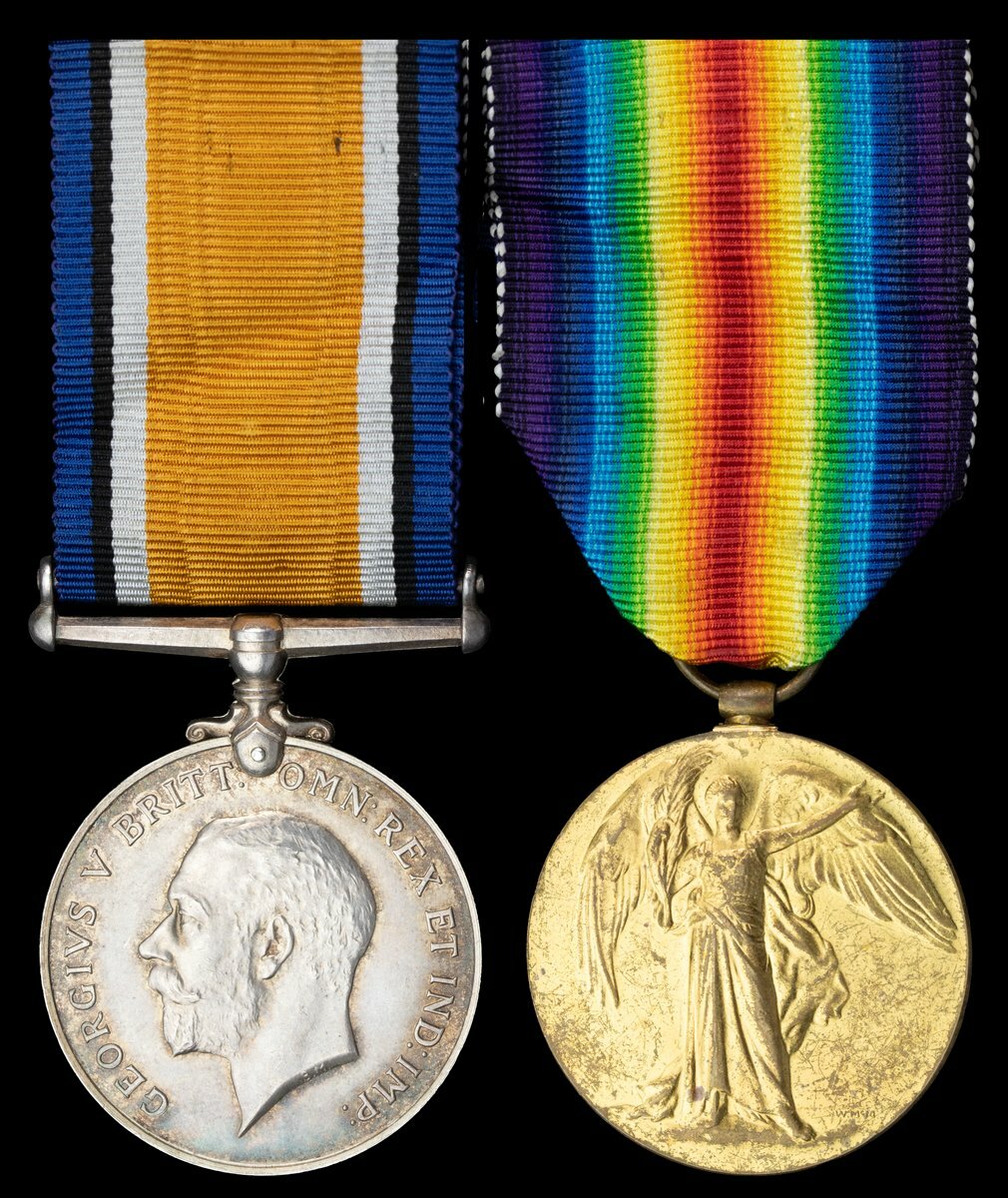
An unusual campaign pair awarded to Major T. C. Manders, 16th (Public Schools) Battalion, Middlesex Regiment, later British Honduras Defence Force
An Old Marlburian who went 'in the bag' in dramatic circumstances during the dying days of the Spring Offensive
Heading for British Honduras where he became District Commissioner for El Cayo Manders died as a result of a gunshot wound in 1938
British War and Victory Medals (Capt. T. C. Manders.), good very fine (2)
Thomas Cyril Manders was born in Farnham, Surrey in 1881, the son of Dr Horace Manders of York Town, Surrey. Educated at Marlborough College between 1891-1899, he earned the rank of Corporal in the Cadet Corps in the process. Upon graduating he embarked upon a career as a merchant in India where he married his wife Hilda in 1908.
Commissioned 2nd Lieutenant in the 16th (Public Schools) Battalion, Middlesex Regiment on 17 May 1915, Manders was promoted Captain in July 1916. Serving with 'C' Company, 2nd Battalion at Chemin des Dames on 27 May 1918 he found himself facing a dramatic battle for survival.
The Germans started the day with a heavy bombardment before attacking the Allied lines and driving through them. Manders and a party of ten men remained behind to cover the retreat of his platoon with a Lewis gun but were soon forced to withdraw. After the ambush described above the trio withdrew to a wood, while Manders scouted ahead the rest of his small party was captured, he takes up the story:
'I lay in the word for roughly an hour and then, with considerable difficulty, owing to my wounded right arm and I had dislocated my left shoulder, commenced to slowly crawl towards the rear. Eventually while working down a trench 3 of the enemy jumped on me and helpless and unnamed as I was there was nought else to do but surrender quietly. It was then roughly 10 a.m. but my watch had been broken.
Up to the time of their capture the Sgt. Maj. And the Coy. runner had both acted with great gallantry and the three of us must have accounted for quite 30 of the enemy'
Manders was repatriated back to Britain on 6 December 1918, his debrief on 17 April 1919 provides us an extremely full account of the action which led to his capture. Upon his return he was in a poor condition, having caught influenza, which was aggravated by his time as a prisoner of war.
The next year a court marshal was opened against Manders for £650 fraudulently misapplied whilst he was a company commander. He relinquished his commission in February 1920 and applied for a role in the Colonial Office, fleeing for Honduras. Notably he was listed as missing at least one hearing on the matter.
Despite this disgrace he appears to have done well in British Honduras (Belize), being appointed a District Commissioner at El Cayo. Appointed Major commanding the British Honduras Defence Force in April 1928 he commanded this unit for many years. A series of letters in 1933 culminated in his acquittal for the charge of misappropriating funds and it may very well be that Manders took the B.H.D.F. to London for the 1937 Coronation.
His death was reported the next year in The Times as the result of a gunshot wound on 1 June 1938; sold together with a comprehensive file of copied research.
Subject to 20% VAT on Buyer’s Premium. For more information please view Terms and Conditions for Buyers.
Estimate
Starting price
£60

Watch, listen and bid as if you were in the room. Now available for auctions worldwide.
Click here to bid live
An exclusive and confidential service for the discerning collector or vendor.
View the Gallery
Download every Spink catalogue on your iPad, iPod or iPhone using free Spink app.
Download From iTunes© 2026 Spink & Son. All rights reserved.