
Auction: 25113 - Orders, Decorations and Medals - e-Auction
Lot: 180
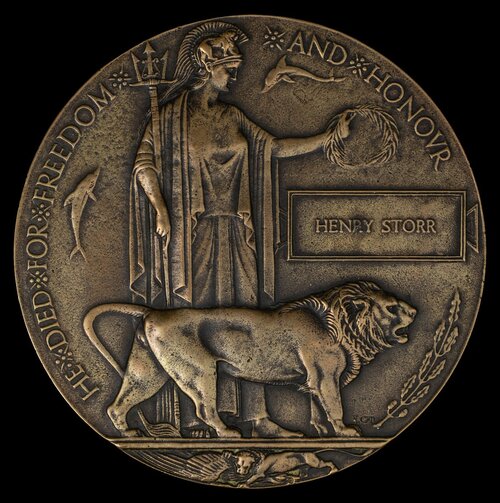
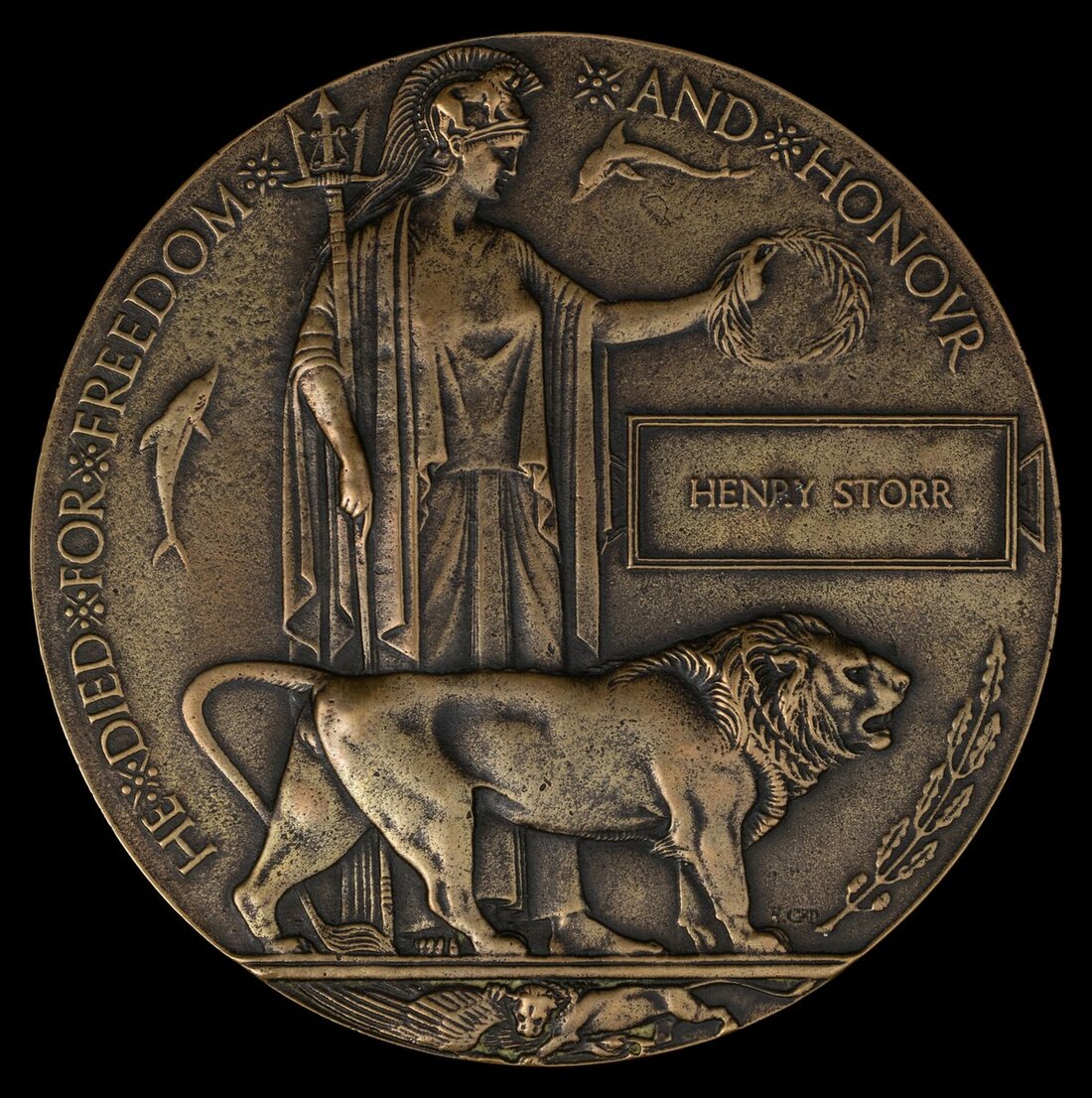
(x) The Great War Bronze Memorial Plaque to Lieutenant Colonel H. Storr, Middlesex Regiment, a veteran of the Second Boer War who was awarded a Distinguished Service Order in February 1917 and who died of pneumonia on 15 August 1918 as a result of wounds he had sustained on 13 March 1918, Storr was additionally 'mentioned' five times
Great War Bronze Memorial Plaque (Henry Storr), scratch to name otherwise very fine
D.S.O. London Gazette 15 February 1917
M.I.D. London Gazette 29 December 1899, 17 February 1915, 15 June 1916, 4 January 1917, 25 May 1917.
Henry Storr was born on 8 July 1875 at Brenchley, Kent to the wealthy agricultural merchant Henry Storr and Marian Storr (nee Martin). He attended Harrow School from the second term of 1889 (the year after Winston Churchill) to the second term of 1893. He then attended the Royal Military Academy Sandhurst between 1894 - 1895 before being commissioned into the Duke of Cambridge's Own Middlesex Regiment on 27 September 1895. He initially served at home before serving in South Africa between September 1895 - April 1898. Storr was promoted to Lieutenant on 27 August 1898. He saw action in the East Indies between 8 April 1898 - 24 June 1899 and transferred to the 2nd Battalion, Middlesex Regiment on the 25 June. Storr then returned to South Africa during the Second Boer War where he served as Adjutant. He was mentioned in despatches on 29 December 1899 and promoted Captain on 21 May 1901. He saw action at Spion Kop, Tugela Heights and the Relief of Ladysmith. For his service in the Boer War, he was awarded the Queen's South Africa Medal with six clasps and the King's South Africa Medal with both clasps. Storr was later promoted Major on 10 February 1911 and retired a year later in March 1912.
Upon the outbreak of the First World War, Storr was recalled and served with the 4th Battalion, Middlesex Regiment on the 2 November 1911. He partook in the action at Obourg Railway Station during which the battalion suffered severely - at the beginning of the day they had been 1000 men strong, by the end, a mere 300. He was appointed Temporary Lieutenant Colonel on 19 November 1915 and was given the control of a Battalion. He was later awarded the Distinguished Service Order on 16 February 1917 and mentioned four times in despatches. He died of influenza turned pneumonia in Queen Alexandra's Military Hospital, Millbank, London on 15 August 1915, following wounds he received in action on 13 March 1918. On this latter date, Storr was wounded in both hands when a shell exploded just behind him. The details to his funeral were reported in The Times on 21 August 1918. A brother-officer wrote of him:
"I cannot tell you how greatly impressed I have been by his devotion to his convictions, and what a loss he is to the Army generally and to his Regiment in particular. Not only will he be missed as a fine soldier, but for his splendidly strong and earnest example and good influence".
He was further entitled to the 1914 Star Trio with M.I.D. oak leaves. Sold with copied research.
Subject to 5% tax on Hammer Price in addition to 20% VAT on Buyer’s Premium.
Estimate
Starting price
£140

Watch, listen and bid as if you were in the room. Now available for auctions worldwide.
Click here to bid live
An exclusive and confidential service for the discerning collector or vendor.
View the Gallery
Download every Spink catalogue on your iPad, iPod or iPhone using free Spink app.
Download From iTunes© 2026 Spink & Son. All rights reserved.