
Auction: 25112 - Orders, Decorations and Medals - e-Auction
Lot: 659
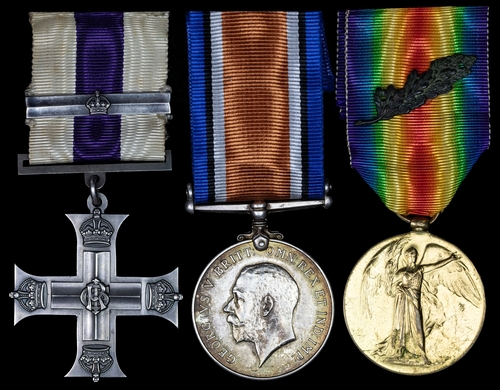
A Great War M.C. and Bar group of three attributed to Lieutenant and Temporary Captain C. Campbell, King's Own Scottish Borderers, who shot five of the enemy at point blank range and who was further 'mentioned' for his service
Military Cross G.V.R. with Second Award Bar; British War and Victory Medals (Capt. C. Campbell.), with M.I.D. oak leaves very fine (3)
Numerous claims for a Great War Pair named to 'Captain C. Campbell' - thus sold as viewed and not subject to return.
M.C. London Gazette 7 November 1918.
For conspicuous gallantry in leading a raiding party against an enemy position which was very strongly held. He himself shot down five of the enemy at point-blank range. The success of the raid was largely due to his fine courage and leadership.
Bar to the M.C. London Gazette 8 March 1919.
For conspicuous gallantry and devotion to duty near Cuerne on 16th/17th October 1918. Throughout the whole operation he kept his commanding officer informed of the situation. Under intense machine-gun fire he crossed the pontoon bridge and cleared up the situation, and it was largely due to his tireless work that was kept between the various companies. Further, during an enemy counterattack, he rallied the stragglers and evacuated them back to the line of resistance.
M.I.D. London Gazette 27 December 1918.
Charles Campbell was born in Dumfrieshire, Scotland in 1896. He worked for the Bank of Scotland in Jedburgh before being commissioned into the 1/4th Battalion, King's Own Scottish Borderers. He remained in the U.K. for about a year and was promoted to Lieutenant before landing in France on 17 April 1918. He was attached to the 6th (Service) Battalion as part of the 27th (Lowland) Brigade, 9th Scottish Division, part of the Second Army who had suffered heavy losses during the German Spring offensive. He was soon in action in the Lys Valley (Flanders) Sector as a Platoon Commander in charge of 50 soldiers, during the last week of the German attack.
He soon came to official notice for 'Leading a Trench Raid' in the Meteren/Outtersteene Ridge area, in the weeks prior to the British Flanders Counter-Offensive.
These '1916 style' night trench raids were a deadly affair of crossing no-mans-land, getting through enemy barbed wire and crashing into the enemy trench to kill or capture them in close hand-to-hand fighting. If the enemy heard any noise or saw movement, heavy machine-gun and artillery fire would immediately fall on the 'Raiders'. Despite being heavily outnumbered, the raiders aim was to identify the enemy unit number or name, and if possible, to capture and bring back prisoners for interrogation. Heavy losses among the raiding party were always expected.
On 18 August 1918, Campbell took part in the attack and capture of the Outtersteene Ridge and four days later he was appointed Temporary Captain.
On 25 October 1918, the 6th K.O.S.B. fought their last action. On the River Scheldt, they helped to capture the village of Ooteghem. After ten weeks of ceaseless fighting, 9th Division were taken out of the line for rest. Finally, 9th Division marched to the Rhine, crossing into Germany on 4 December 1918 and held the Cologne bridgehead. On his return to England Campbell returned to work in the bank and applied for his medals on 4 February 1922 and gave the address as the Bank of Scotland House, Jedburgh.
Subject to 20% VAT on Buyer’s Premium. For more information please view Terms and Conditions for Buyers.
Sold for
£800
Starting price
£420
Watch, listen and bid as if you were in the room. Now available for auctions worldwide.
Click here to bid live
An exclusive and confidential service for the discerning collector or vendor.
View the Gallery
Download every Spink catalogue on your iPad, iPod or iPhone using free Spink app.
Download From iTunes© 2026 Spink & Son. All rights reserved.