
Auction: 25112 - Orders, Decorations and Medals - e-Auction
Lot: 634
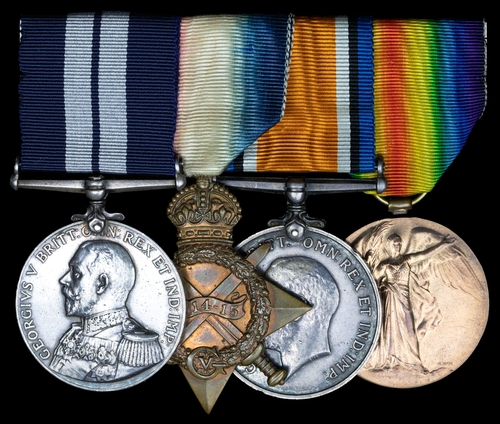
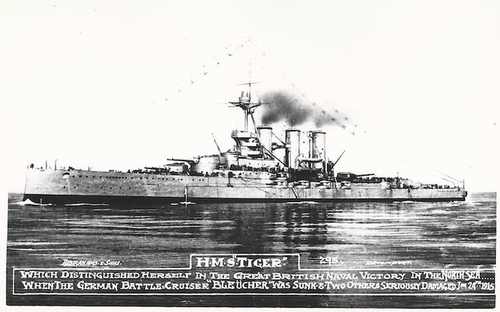
(x) A scarce Great War 'Battle of Dogger Bank' D.S.M. group of four awarded to Able Seaman H. Davis, Royal Navy, who served in H.M.S. Tiger and was decorated for brave and prompt action when Engineer Captain Taylor was killed in the gun control tower
She was further to the fore at the Battle of Jutland, being hit a total of 17 times during the battle, Tiger suffered a loss of 24 men killed and 46 wounded; notwithstanding such severe punishment, she delivered over 300 shells from her main armament and a further 136 rounds from her 6-inch guns, inflicting telling damage on the Moltke, Wiesbaden and Von der Tann
Distinguished Service Medal, G.V.R. (184526 H. Davis. A.B. H.M.S. Tiger.); 1914-15 Star (184526 H. Davis, D.S.M., A.B., R.N.); British War Medal 1914-20 (184526. H. Davis. A.B. R.N.); Victory Medal, with M.I.D. oak leaves, unnamed, mounted for wear, contact marks, very fine (4)
D.S.M. London Gazette 2 March 1915, the original citation states:
'HMS Tiger, action in North Sea, Dogger Bank, 24 January 1915. For brave and prompt action when Engineer Captain Taylor was killed.'
M.I.D. London Gazette 2 March 1915.
Henry Davis was born at Trowbridge, Wiltshire. A market gardeners boy he gave his date of birth as 10 February 1880 when he enlisted in the Royal Navy as a Boy 2nd Clas on 26 July 1895. However from census returns it appears he was born a year earlier.
Assigned to the Devonport division he commenced his basic training on Impregnable. Advanced to Boy 1st Class, he was drafted to the coastguard ships in Bantry Bay, Ireland; first Dreadnought, then Collingwood. In May 1897, he was drafted to Calypso in the sail training squadron. She and her sister ship, Calliope, were launched in 1885 and were the Royal Navy's last sailing corvettes taking part in the Diamond Jubilee Fleet Review at Spithead.
Davis was drafted in January 1898 to the cruiser Arrogant and served with the Mediterranean Fleet from September 1899-March 1903. Further postings followed and at the beginning of the Great War Davis was shore based being drafted to Tiger on 3 October 1914. It was to be an action-packed Great War for him.
On 16 December 1914 she took part in an unsuccessful attempt to intercept the German battle-cruisers which had just bombarded Scarborough, Whitby and Hartlepool. Cruisers attached to the Battle Cruiser Fleet exchanged fire with the enemy but then lost contact as a result of the bad weather and faulty signals. In response to public indignation at the absence of the Royal Navy, the Battle Cruiser Fleet moved its base from Scapa Flow to Rosyth (near Edinburgh) where it would be better placed to respond promptly to further raids on the British mainland.
Dogger Bank
Just below the signal bridge in the forward part of the Tiger's superstructure there was a large compartment known as 'Rowton House'; this was the station for the upper deck fire and repair party under the command of the canteen manager. From this compartment there were ladders giving access to the two gun control towers for the 6-inch guns, one on the port side, one on the starboard; these were crowded with gunnery officers and ratings. Davis's action station was in the port gun control tower although the exact nature of his duties is unknown. Also present there was Engineer Captain C.G. Taylor, the senior engineer officer of the Battle Cruiser Squadron. Captain Pelly had stationed him there to give him advice and make notes of the battle. Taylor had a distinguished career as an engineer; he was known personally to King George V, who had appointed him as a member of the Royal Victorian Order. In the 1880s he had been a Welsh rugby international and champion all-round athlete.
In January 1915, British code-breakers provided advance warning of a German naval operation in the North Sea and Admiral Beatty led the Battle Cruiser Fleet to intercept the Germans, who were sighted in the vicinity of the Dogger Bank at around 07:50 on 24 January 1915. Beatty had five battlecruisers with him (Lion, Tiger, Princess Royal and the older New Zealand and Indomitable) to the Germans' four, and Admiral Hipper immediately turned to escape.
The action developed as a stern-chase. The British stokers made heroic efforts and the older vessels achieved 26 knots, in excess of their design speed when new. Lion opened fire at 08:52, Tiger at 09:00 at a range of 20,000 yards. Each British ship initially fired upon the Bluecher, the rear-most German ship, then - as all came within range - Beatty signalled each to fire at its opposite number in the German line. Due to a misunderstanding, Tiger concentrated her fire (which, in any case, was inaccurate) on the same target as the Lion, leaving the second ship in the German line, the Moltke, to fire on Lion without interruption. At 09:45 a shell from the Lion struck Seydlitz, piercing the armour of her aftermost turret. The resulting explosion and fires killed more than 150 men and put two turrets out of action; the ship was saved only by flooding the magazines. Bluecher was also hard hit and fell behind. However, Lion too was repeatedly hit; by 10:52 she had been hit fourteen times and 3,000 tons of sea-water had entered her, causing a list of ten degrees to port, and the rising water short-circuited her last dynamo, resulting in a complete loss of electric power.
As Lion began to drop astern, Tiger - next in line - passed her and took the lead. She then became the primary German target. At 10:50 a 12-inch shell struck the roof of 'Q' turret (second from the stern), and fragments penetrated the gunhouse, damaging the breech mechanism of the left gun and jamming the training gear. Several crew members were killed or wounded. The captain of the turret called for spare men, the dead and wounded were removed and the turret was brought back into action, although only the right gun could be used.
Eighteen minutes later - 11:08 - another heavy shell hit the forward part of the superstructure and exploded in the 'Rowton House' compartment where the upper deck fire and repair party had been passing the time by playing cards. Five stokers were killed and four others severely wounded, suffering burns and fractures. Four men went into the wreckage to rescue the wounded and were awarded the D.S.M., whilst Victor Hayward, one of Tiger's seamen, described the scene:
'After the action, I went up to see the damage and found broken bodies, cards and money scattered everywhere. It seemed as if a cyclone had swept through the compartment, and what was left of the ship's canteen manager was a shattered arm and hand still clutching the ace of spades. Jerry had trumped his trick.'
The hatchway giving access to the starboard 6-inch gun control tower was closed with a steel cover which protected the occupants but the one on the left had been left open. At the moment when the shell exploded Engineer Captain Taylor had been standing astride the open hatchway - the blast tore him apart. Several others suffered wounds, burns and shock. It was here, in the port 6-inch gunnery control tower, that Davis won his award. Details of his brave actions are not provided; one can speculate that, although only an Able Seaman, as an older and more mature man Davis took the lead in removing the shattered remnants of Taylor's body from the hatchway and organizing the evacuation of the wounded. Two Boy Seamen, Francis Bamford and Julius Rogers, were also awarded their D.S.M. for carrying Midshipman Grier down the broken ladder and to the sickbay although suffering from burns and shock themselves.
Another shell struck the boat stowage area between the two after funnels. The ship's boats were set on fire and the blaze produced plumes of flame which rose above the tops of the funnels. Seen from other ships in the squadron, Tiger looked like a roaring open furnace. On the German side, officers on Moltke believed that she could not survive and reported her destruction. In fact, within fifteen minutes the fire had consumed everything that would burn and was then brought under control. In all, six heavy shell hits were recorded on Tiger and her casualties amounted to 10 killed and 11 wounded. In a departure from naval tradition the dead were not buried at sea, instead being returned home for burial ashore.
From his crippled flagship, Beatty sent a series of confusing signals which Rear Admiral Moore, his second in command, interpreted as an order to break off the chase and concentrate on the crippled Bluecher, which was soon sunk. Her end was captured in a photograph that became one of the best-known images of the Great War. By sinking this ship and inflicting severe damage on the Seydlitz, the Royal Navy had won a victory over the Germans but the Admiralty and high command were extremely disappointed with the battle - the entire German squadron should have been annihilated. Moore was made the scapegoat and transferred to a backwater. Lord Fisher was even more vitriolic in his condemnation of Captain Pelly, describing him as a poltroon. Jellicoe and Beatty also criticized him: for firing at the wrong ship, for the poor standard of Tiger's gunnery and for breaking off the pursuit of the fleeing German battle-cruisers. Pelly was left in command but his gunnery officer was replaced.
As cited above, Tiger sustained far severer damage and losses at Jutland, but not without having inflicted significant damage on the Moltke, Wiesbaden and Von der Tann. Her significant part in the battle is echoed in the words of numerous eye-witness accounts that appear in Jutland 1916 - Death in the Grey Waters, by Nigel Steel and Peter Hart. Tiger reached Rosyth on the morning of 2 June, where she became the first of the "Splendid Cats" to undergo repairs.
Davis was finally discharged to ashore from Vivid on 20 May 1920. Married to Florence he returned to Trowbridge working as a general labourer and died there in 1943; sold together with a file of copied research.
Subject to 5% tax on Hammer Price in addition to 20% VAT on Buyer’s Premium.
Sold for
£950
Starting price
£950

Watch, listen and bid as if you were in the room. Now available for auctions worldwide.
Click here to bid live
An exclusive and confidential service for the discerning collector or vendor.
View the Gallery
Download every Spink catalogue on your iPad, iPod or iPhone using free Spink app.
Download From iTunes© 2026 Spink & Son. All rights reserved.