Auction: 25111 - Orders, Decorations and Medals - e-Auction
Lot: 693
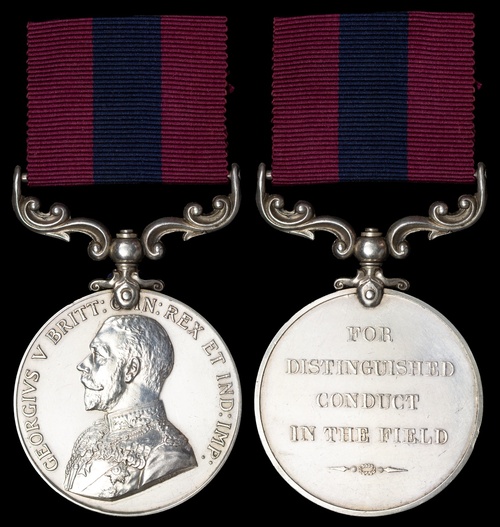
A 'Liverpool Pals' Battle of Scherpenberg Great War D.C.M. awarded to Corporal/Lance Sergeant A. R. Russell, Liverpool Regiment, who won his award for taking out a machine gun position and who later died of wounds on 8 May 1918
Distinguished Conduct Medal, G.V.R. (57984 Cpl - Sjt. - A. R. Russell. 17/L:Pool. R.), small correction to rank, otherwise good very fine
D.C.M. London Gazette 3 September 1918, the original citation states:
'For conspicuous gallantry and devotion to duty during long operations. On one occasion, when the battalion counter-attacked he went forward alone, put out of action an enemy machine gun, which was holding up the advance, and then led his men forward. His determined courage and coolness set a splendid example to all near him.'
Albert Roland Russell enlisted at London, having previously been part of 324 London Divisional Cyclist Company. He died of wounds on 8 May 1918 and is commemorated on the Tyne Cot Memorial. Russell is entitled to a British War and Victory Medal pair, and his Medal Index Card erroneously has him as 'Arthur' R. Russell.
The Battle of the Scherpenberg, 29th April
'We left the 17th, 18th and 19th Battalions of the King's Regiment back in their camps on the night of the 26th of April. On the morning of the 27th the G.O.C., 21st Division, visited Headquarters, 89th Brigade, and gave verbal instructions for the relief of the 39th Composite Brigade, then in the line about Voormezeele. During the afternoon the C.O.s and O.C.s, Companies, reconnoitred the line and at night battalions moved up to relieve the 39th Composite Brigade. The relief was completed early on the morning of the 28th. The 18th King's went into the line on the right and the 19th on the left. The 18th took over a line running roughly from Elzenwalle to Ridge Wood: this line was between Voormezeele and Dickebusch Lake. The 19th King's, on the left of the 18th, were apparently between Voormezeele and Kruisstraat–hoek. The 17th Battalion, as far as can be gathered from the diary of Brigade Headquarters, went into the line Convent Lane to Voormezeele defences, i.e. on the left of the 19th Battalion. On the left of the 17th other troops held the line from Convent Lane to Lock 8, Ypres-Comines Canal. During the 28th local fighting took place in the neighbourhood of Voormezeele. At about I p.m. the troops on the left of the 89th Brigade front, i.e. from Convent Lane to Lock 8, were violently attacked and the enemy penetrated the line.
For five hours there was a desperate struggle between the enemy and the left of the 17th King's, and the C.O. of the latter ordered his reserve company to make a counter-attack at 7.45 p.m. to restore the situation. But ten minutes before the attack was due, the enemy put down a very heavy barrage and the counter-attack was unable to proceed. This bombardment lasted until 10.30 p.m. and, all hope of making the counter-attack having been abandoned, the 17th King's formed a defensive flank on their left. Neither the 18th nor 19th King's were attacked during the 28th, and both battalions were able to turn their attention to the improvement of the defences. Just after 3 a.m. on the 29th a bombardment of exceptional intensity and violence was opened by the enemy, and two hours later a series of strong attacks were launched against the French and British positions from west of Dranoutre to Voormezeele. The narrative of the 17th King's of this attack is brief: their line was forced back to G.H.Q. where "I reorganised and held on to the position”.
The gallant Third and Fifth Armies had fought a greatly superior enemy to a standstill, so on the Lys in April the First and Second Armies had entirely broken the power of the German advance. In the Lys battles it is well to remember that, of the total twenty-five British divisions employed against forty-two German divisions, seventeen had already taken a prominent part in the Somme operations and were battle-worn and weak in numbers, whereas the enemy's divisions were composed of fresh troops. Never, indeed, had the British soldier fought more grandly than on the Somme in March and on the Lys in April, 1918.'
The History of The King's Regiment (Liverpool) 1914-1919 by Everard Wyrall, refers.
Subject to 20% VAT on Buyer’s Premium. For more information please view Terms and Conditions for Buyers.
Sold for
£900
Starting price
£320


Watch, listen and bid as if you were in the room. Now available for auctions worldwide.
Click here to bid live
An exclusive and confidential service for the discerning collector or vendor.
View the Gallery
Download every Spink catalogue on your iPad, iPod or iPhone using free Spink app.
Download From iTunes© 2026 Spink & Son. All rights reserved.