
Auction: 24113 - Orders, Decorations and Medals - e-Auction
Lot: 652
Sold by Order of the Family
'A few days later, on a Sunday, during roll call, the KARPO - head prisoner in the cell - reported to the guards two fellow prisoners for a misdemeanour. Whilst these two wretched creatures were forced to strip naked, everybody looked on, including the German officers and their wives, who stood watching from above the cells. The officers' wives would amuse themselves by looking down from this vantage point.
On this occasion, the two men, standing there naked, covered with lice bites and their skin torn from scratches, were forcibly rubbed down with caustic soda powder by other prisoners, then made to run up and down the parade ground shouting "We are two dirty swine." They were made to run until they collapsed, whereupon the amusement of the spectators ceased and the guards angrily ordered the two men to be dragged into the cells … Taking away the bodies each day was a regular ritual, and we very soon became tired of trying to count the number.'
So observed Sergeant Leonard Camplin, M.M., himself an inmate of Theresienstadt concentration camp, following a brutal rifle-butting introduction to his new surroundings.
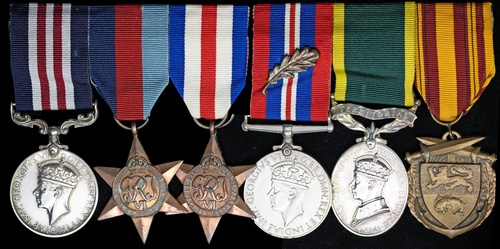
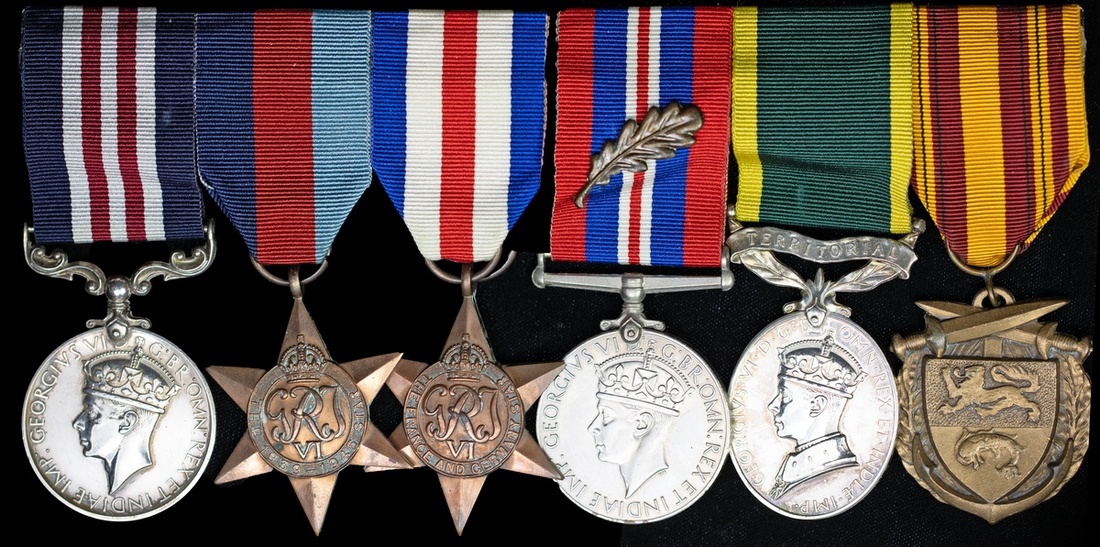
The outstanding Second World War escaper's M.M. group of five awarded to Sergeant L. E. Camplin, Royal Signals, who was captured at St. Valery in June 1940 and - after nine previous attempts - managed to break out, join a partisan group and reach advancing American forces in May 1945
His remarkable story is recounted in the pages of Escapade, his accompanying - hitherto unpublished - wartime memoirs, an epic story which encompassed him being chained hand and foot by the Gestapo, prior to being incarcerated in a concentration camp
In between all that, he faced a Court Martial for hitting a German guard and, by one account, interrogation at the hands of Dr. Ludwig Fischer, a brutal Nazi lawyer who was executed for his many war crimes after the war; beyond his memoirs, Camplin also went on tape for the Imperial War Museum in 1989 to speak of his experiences
Military Medal, G.VI.R. (2572226 Sigmn. L. E. Camplin, R. Signals); 1939-45 Star; France and Germany Star; War Medal 1939-45, with M.I.D. oak leaf; Efficiency Medal, Territorial, G.VI.R., 1st issue (2572226 Sigmn. L. E. Camplin, R. Signals), together with Dunkirk commemorative medal, minor official correction to service number on the first, campaign awards slightly later issues with large ring suspensions, good very fine (6)
M.M. London Gazette 21 February 1946. The original recommendation states:
'Signalman Camplin was captured at St. Valery on 12 June 1940. Whilst at Wartelager Working Camp, attached to Stalag XXIB, Camplin and a companion constructed a boat from tarpaulin which, however, was discovered before an attempt to escape could be made. On 25 June 1942, they went to Oborniki in a stolen boat. Continuing by train, Camplin reached Bitterfeld before he was caught by the Gestapo.
From September 1942 to February 1944, Camplin organised escape activities at Stalag XXIB and carried out valuable intelligence duties. In February 1944, he escaped from another working camp at Fort Rauch by hiding amongst empty tins being taken out of the camp. Although he reached Stettin all attempts to board a neutral ship failed; he therefore went to Marienau, where he found help. Travelling by train to Belgium, he was arrested at the frontier at the beginning of April 1944 and received brutal treatment for several months.
Early in September 1944, he was sent to Lamsdorf. Although he was imprisoned in the Straf compound, he organised digging a tunnel and when he was ordered back to gaol he hid in the tunnel shaft. He remained hidden for a month until he was removed to hospital under an assumed name. When Lamsdorf was evacuated in the face of the Russian advance, Camplin escaped from the train S.W. of Prague. About a fortnight later he was arrested after being betrayed by a Slovak.
At the beginning of May 1945, he was included in a column of prisoners being marched westwards. With several others he broke away at Mokrosuky, near Pilsen, and joined a group of partisans. Camplin and five Americans were sent with a message to the American lines. After completing the mission they returned to the Czech partisans, who had in the meantime freed the remaining P.O.W.s in the area. Camplin helped make arrangements for the welfare of the prisoners until the Americans arrived in force.
For his enthusiasm in trying to escape himself and his efforts on behalf of others, Camplin has been commended by an officer and four Non-Commissioned Officers.'
Leonard Edward Camplin was born in London on 12 July 1920 and grew up in difficult circumstances in Brixton. On leaving school aged 14 - and having had an argument with his father - he joined London 56 Divisional Signal Regiment as a boy recruit and Territorial.
Duly called-up on the outbreak of hostilities in September 1939, he was drafted to a Signal Troop attached to 1 R.H.A. in the 51st Highland Division and embarked for France. And it was here, at St. Valery, that he was taken prisoner on 12 June 1940. Soon afterwards, he made his first bid for freedom on being force marched to Aalst in Poland but was quickly recaptured.
Of subsequent escape attempts, full details of which are included in his unpublished memoirs Escapade, his sheer grit and determination shine through, whatever the challenges, whatever the hardships, and whatever the dangers. It is a story imbued with high courage in the face of adversity and well-worthy of reaching a wider audience. But for the purposes of this catalogue entry, the following summary of events is taken from an accompanying synopsis of his memoirs:
July 1941:
Mounts 2nd escape attempt from a working camp at Wartelager, in the company of Private Isaacs, but their hoarded equipment was discovered in a routine search.
January-April 1942:
Moved to Marienau, ingeniously managing to take with them a small fold-up boat made from tarpaulin, which they christened 'H.M.S. Escapade'. In April, the boat was taken out under the wire and hidden in reeds on the River Warte, in readiness for his 3rd escape attempt, but it was discovered three days later, before it could be used.
June-July 1942:
Still with Isaacs, Camplin made his fourth bid for freedom, the pair of them exiting the wire, stealing another boat and paddling 15 miles to Orbiniki. They then jumped a train to Posen, but Isaacs was recaptured on the 29th and Camplin, who continued alone, on 5 July. Imprisonment at Fort Grolman at Posen ensued, in which period Camplin organised an Escape Committee and nearly got away with the assistance of a worker at the nearby Focke Wolfe factory, but the latter was arrested before plans could be brought to fruition.
November 1942:
On being transferred to Fort Rauch, Camplin exchanged his P.O.W. number with another prisoner, thereby giving him access to working parties. Employed as an interpreter on a medical supply working party under the control of Herr Heinrich, a Nazi Party official, Cumplin stole the latter's wallet, passport and party membership badge. But he had to hit a German guard who was going to search him on the return journey to avoid being caught with incriminating evidence. He was moved to Fort Pritwitz, where his switch of identity was discovered.
December 1942:
He was returned to Fort Rauch, where he was confined awaiting a Court Martial to be held on 26 February 1944.
February-March 1944:
About 10 days before his Court Martial, Camplin managed to get out of the fort hidden in a rubbish cart - his 5th escape attempt - and made his way to Frau Bailey, a widow of an American, who lived in Posen. She hid him for 10 days, as did the Walkowsa family another in Marienau, prior to him posing as a representative of an electrical company and travelling by train, to Stettin, Berlin and Dortmund. He then enlisted the help of a German farmer's daughter, who was secretly engaged to a member of the Walkowsa family.
April 1944:
Camplin next intended to journey to Brussels by train but on reaching the Belgian border on the 4th, via Aachen, he was arrested for not having the necessary pass. Imprisoned at Eupen, where his captors accused him of being a spy, his future looked bleak. Bleaker still when he was caught filing through the bars of his cell window. Three body searches later, he was transferred to Aachen criminal prison and thence to Gestapo H.Q. in Posen, where he was chained hand and foot and interrogated over 13 weeks. But for his military background catching up with him via Stalag H.Q. records - and the intervention of friends back at Fort Rauch - a firing squad was surely his fate. Instead, he was transferred into military custody.
July 1944:
His return to military care was nonetheless an unhappy experience, for in July he was moved to Fort Zinna at Torgau, near Leipzig, where he was kept in chains and interrogated by Attorney General Dr. Ludwig Fischer. The latter, who wished to obtain information in respect of Camplin's escape methods and helpers, was subsequently executed for war crimes in Warsaw in 1946.
September 1944:
Extremely lucky to escape the clutches of Herr Dr. Fischer - having signed a declaration not to divulge his treatment at Torgau - Camplin was transferred to Stalag 344 at Lamsdorf in Upper Silesia. But the old charges against him for striking an enemy guard and theft now faced him at a Court Martial to be heard at Breslau on 23 December. Camplin immediately set about the digging of a tunnel, running from his special compound to the adjacent main camp.
December 1944:
Camplin mounted his 7th escape attempt on the 13th, when the Germans ordered him to collect his belongings for incarceration in a special cell, no doubt wary of him evading his pending Court Martial. He hid in the shaft of a tunnel whilst fellow prisoners created a false escape scenario by placing blankets over the wire. That night he managed to reach the main camp, where he was hidden in a 'hidey hole' under beds in an accommodation block, but he contracted diphtheria at the end of the month and had to seek hospital treatment, luckily using the identity of an old friend.
February-May 1945:
On returning to the camp after three weeks, Camplin enacted his 8th escape, exiting the wire with two comrades, but their freedom was short-lived, all three being recaptured on the following day. With the Russians now approaching, the camp was evacuated, Camplin and his fellow inmates being loaded onto cattle trucks for Czechoslovakia. Thus ensued his 9th escape, when he and four others sawed a hole in the floorboards of their truck and jumped the onto the lines near Prague. Camplin found refuge with a farmer for 11 days but was betrayed by another farmer.
His capture led to yet another encounter with the Gestapo - in which he maintained his false identity as a 'Flight Sergeant Baddy Pragnall' - following which he was incarcerated in Theresienstadt concentration camp. His block comprised a mixture of British and Russian P.O.W.s, in addition to Jewish inmates, and the daily regime was as brutal as one might expect. But for a chance encounter with passing German officers, in which they were alerted to the fact the camp contained military personnel, their future looked bleak indeed. Instead, three weeks later, they were transferred to a P.O.W. camp at Eger.
The British party then joined a column of prisoners being marched westwards under a German captain's command, the latter enlisting Camplin as an interpreter. Granted relative freedom and the use of a bicycle, he moved ahead of the column to try and acquire food and medical supplies. And it was in the process of his advance forays that he met the leader of a Czech partisan group. Camplin - and four other P.O.W.s - duly absconded and joined the partisans outside Susice, with whom he helped take the German surrender of the town.
Having then journeyed west to liaise with the advancing Americans in early May 1945, he was flown home for hospital treatment. Shortly afterwards debriefed by M.I. 9 officers at the Victoria Hotel in London, and later at military intelligence's H.Q. at Beaconsfield, he was told that his coded letters home to his fiancée proved vital for accruing information in the early part of the war. He was offered - but declined - a commission.
Postscript
Discharged in October 1946, Camplin returned to Brixton and started a mobile coffee stall. Over the coming years he expanded his business into a small catering firm specialising in work 'on location' for the film world. On his retirement in 1985, he settled in Winchelsea. Happily, for posterity' sake, he was interviewed at length by the Imperial War Museum's Department of Sound in July 1989; catalogue reference 10710 and available via https://www.iwm.org.uk/collections/item/object/80010487. It was not until September 1988 that Camplin claimed his Campaign Stars and Medal for the Second World War. And the accompanying bound manuscript of his wartime memoirs Escapade comprises 95pp. of typed text, with a well-arranged opening synopsis.
Subject to 20% VAT on Buyer’s Premium. For more information please view Terms and Conditions for Buyers.
Sold for
£6,000
Starting price
£3800
Watch, listen and bid as if you were in the room. Now available for auctions worldwide.
Click here to bid live
An exclusive and confidential service for the discerning collector or vendor.
View the Gallery
Download every Spink catalogue on your iPad, iPod or iPhone using free Spink app.
Download From iTunes© 2026 Spink & Son. All rights reserved.