Auction: 24113 - Orders, Decorations and Medals - e-Auction
Lot: 642
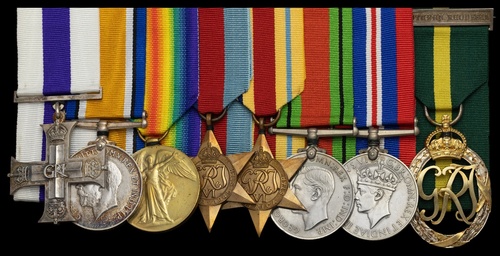
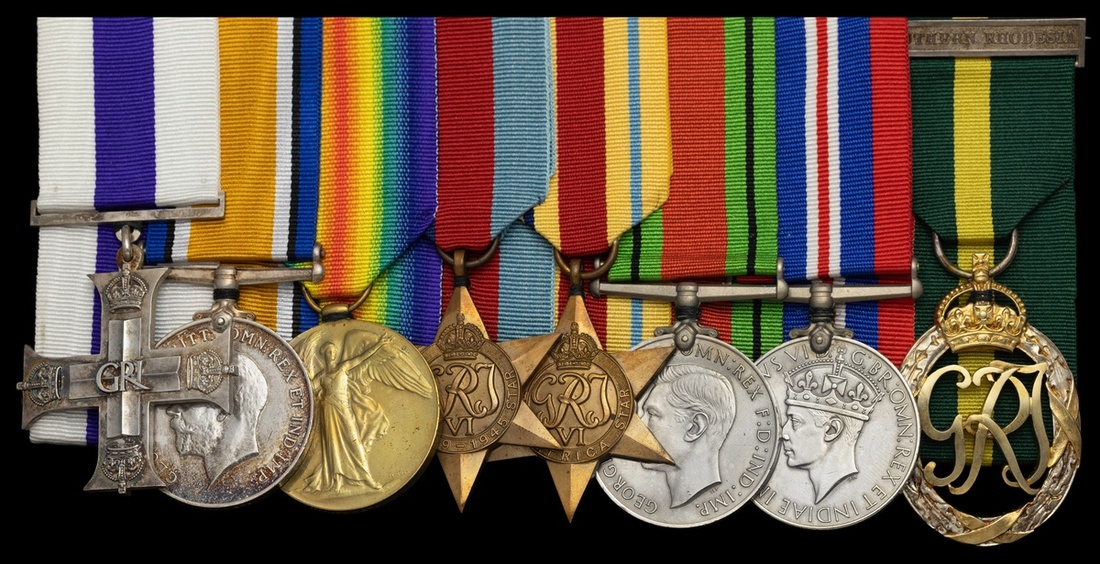
A Second World War 'North Africa' M.C. group of eight to Lieutenant Colonel W. H. Power, Cheshire Regiment, late Royal Engineers, who saw service in the Great War and who subsequently served in the North Russia campaign and later served in the Rhodesia Regiment in the 1930s and who was stationed in Malta during the toughest part of the North African campaign
Military Cross, G.VI.R., officially dated '1941' and additionally inscribed 'Lt Colonel W. H. Power.'; British War and Victory Medals (Capt. W. H. Power.); 1939-45 Star; Africa Star; Defence & War Medals 1939-45; Efficiency Decoration, G.VI.R., Southern Rhodesia (T/Lt./Col. William. H. Power. M.C.), engraved naming, very fine (8)
M.C. London Gazette 8 July 1941, the original citation states:
'During the operations in Egypt & Libya between Dec 1940 and Feb 1941 Major Power commanded his company with conspicuous success. His example and energy inspired his men. At Tobruk he was one of the first to cross the anti-tank obstacle on this front, and always - as on this occasion - he never hesitated to expose himself to danger. That his company so successfully carried out the tasks demanded of it, in support of the infantry throughout the operations, was due to his command and leadership.'
E.D. Southern Rhodesia Government Gazette 16 July 1943.
Wiliam Henry Power was born at Crewe on 14 May 1918. He received his education at Crewe Academy from 1900-06 and having completed his education was employed on the London & North-Western Railway from 1906. With the outbreak of the Great War, he enlisted at Liverpool on 2 September 1914 and first served in the ranks with the 18th King's Liverpool Regiment. Power served at home until 7 July 1915, during which time he was promoted to Lance Corporal on 23 March 1915. He went on an Officer's General Course held at Freshfield in May-June 1915 and was discharged on appointment to a temporary commission as a Second Lieutenant in the 18th Service Battalion, Liverpool Regiment, on 7 July 1915.
Power transferred to the Machine Gun Corps on 23 November 1915 and went to the Machine Gun School at Grantham in November-December 1915. He entered the war in France on 9 May 1916, landing at Boulogne, and went to a further Machine Gun School at Camiers in September 1916. Power then transferred to the Royal Engineers on 23 January 1917 where he was promoted to Lieutenant on 1 July 1917.
Power completed his service in France in November 1918 and then served with the Military Mission to Siberia in Russia from January through November 1919. During this time, he married a Russian lady by the name of Epishina. He held the rank of Acting Captain from 2 February 1919 until 4 January 1920, and was released the same day allowed to hold the rank of Captain. Power was elected as Associate Member of the Institution of Civil Engineers on 11 March 1919 and emigrated to Southern Rhodesia in February 1927. Appointed as a Lieutenant with the Territorial Force of the Defence Forces of Southern Rhodesia from 13 July 1928, Power served within their Mechanical Transport Section. He was transferred as Temporary Captain with the 2nd Battalion Rhodesia Regiment on 22 April 1931 and was promoted to Adjutant on 1 May 1932. He was later advanced Captain on 1 January 1933 and then to Major on 1 October 1933. Power was made Second in Command of the 2nd Battalion Rhodesia Regiment on 1 April 1934 and commanded the Battalion from 31 August 1935 until 21 April 1936 during the absence on leave of Lieutenant Colonel Baker E.D..
After his service in the Southern Rhodesian Territorial Force, Power was appointed to an Emergency Commission as Lieutenant with the Cheshire Regiment, with seniority from 3 September 1939. He was sent to No. 2 T.C. for full-time service on 22 November 1939 and proceeded to N'Kana (Northern Rhodesia) on Special Duty on 3 April 1940, returning a week later. On 14 January Power proceeded on commitment outside of the Colony and was granted War Substantive rank of Major on 30 April 1940.
The Regiment was sent to Suez and was split up and alloted to regular M.G. regiments of the British Army. This was split into companies joining the King's Royal Rifle Corps, Northumberland Fusiliers, 11th Hussars and the Cheshire Regiment - which Power joined. The Cheshires initially moved to Cairo before proceeding to the Western Desert. They were briefly based at Mersa Matruh where he met General Wavell.
The first phase of the campaign had ended in complete success: within a week 80,000 Italians had been routed, 38,000 prisoners taken, and the battle carried forward into Libya by 31,000 British and Indian troops. A total of 500 vehicles and 50 tanks had fallen into British hands. At a cost to the British of 75 killed and 730 wounded, the great Fascist army that had planned to enter Cairo in a tumult of glory was scattered and driven out of the borders of Egypt. By the end of this first campaign Wavell's army numbered 40,000 and had captured 100,000 Italians at a cost of 700 killed and 2,300 wounded between December 1940 and February 1941.
Power was originally put forward for a Distinguished Service Order however this was downgraded to a Military Cross, which was signed off by General Wavell. The Cheshire Regiment earned fourteen Battle Honours for its service in North Africa, and of these, three were selected for display on their Regimental Colour: Capture of Tobruk, El Alamein and Mareth. The Cheshire Regiment was then moved to Malta where it was responsible for the defence of the Dockyard between 1 April 1941 and 23 January 1943. The regiment won the Battle Honour of 'Malta 1941-42' in the process, it was one of only four regiments to receive that particular Battle Honour.
Rhodesians in Malta
'During this period the island experienced 2,710 air alerts, of which 119 bombing attacks were concentrated on the dockyard, and an estimated aggregate of 3,200 tons of bombs being dropped in this in the month from March to April; 6,000 odd tons of bombs were dropped on Malta during this same period. "B" Company of the Battalion was stationed in the dockyard and had their quarters destroyed four times by direct hits. The unit distinguished itself by unloading S.S. Pampas while subjected to continuous enemy bombing, the vessel becoming a total wreck. On another occasion they assisted Penelope to get to sea by helping to supply ammunition to her during heavy enemy bombing, her ammunition having exhausted owing to her anti-aircraft weapons being in continuous action. Thus the unit shared with the dockyard personnel the rigours of the second siege of Malta'.
After completing his time on Malta, Power returned to Southern Rhodesia on 30 January 1942 and was initially attached to "G" Branch at Defence Headquarters, Southern Rhodesia. He was appointed O.C. of the Southern Rhodesia Reserve Regiment and was promoted to Temporary Lieutenant Colonel. He relinquished his commission as War Substantive Major on 3 April 1945 on appointment to the Southern Rhodesia Forces. He was awarded his Efficiency Decoration in the Southern Rhodesia Government Gazette of 16 July 1943. There were only 103 awards of the Efficiency Decoration with the Southern Rhodesia suspender gazetted between 1933-1967, of which only two held the Military Cross.
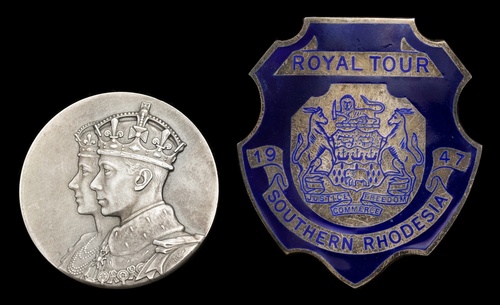
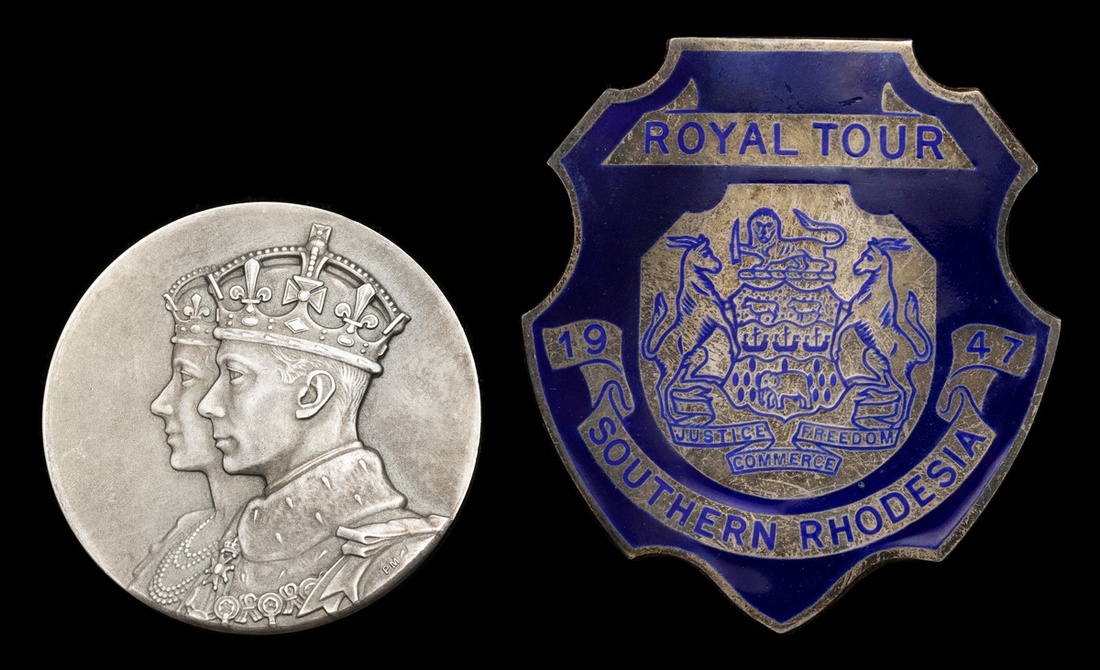
Post-war Power served as an engineer on the Southern Rhodesia Railways and was based at Bulawayo at the time of the Royal Visit in April 1947. The Royal Party travelled throughout South Africa and Rhodesia in the White Train and Power presumably had a lot to do with this aspect of their visit. As a result of the visit he was given the 1947 medallion and Royal Tour badge. Power retired from the railways in 1955 and died at Pietermaritzburg on 25 February 1970.
The lot comes with the following archive:
(i)
Royal Visit Medal of 1947 (Lt Colonel W.H.Power M.C.) engraved, housed in Royal Mint case of issue. Sold with letter from the Central Chancery that confirms that 100 recipients of the silver medallion were given to recipients in Southern Rhodesia. It also confirmed that Power is confirmed as a recipient in his capacity as Mechanical Superintendent, Bulawayo, Rhodesia Railways.
(ii)
A Royal Tour Southern Rhodesia 1947 badge in silver and enamel, marked to the reverse '925 S.A.I.'
(iii)
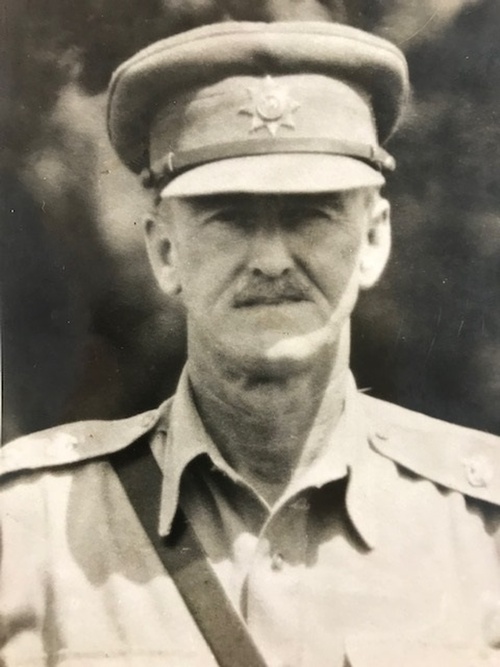
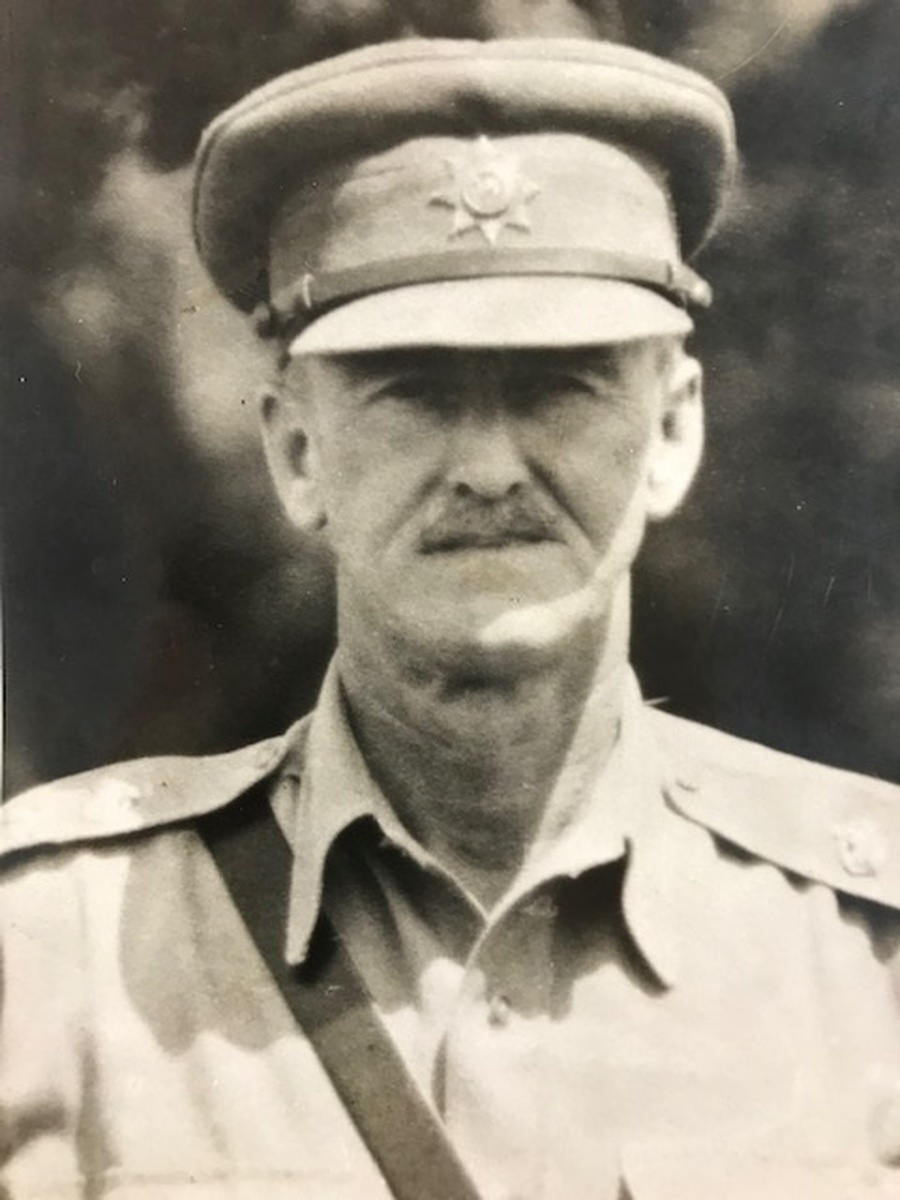
Assorted copied research and photocopied documents including several assorted photographs.
Subject to 20% VAT on Buyer’s Premium. For more information please view Terms and Conditions for Buyers.
Sold for
£3,000
Starting price
£1200
Watch, listen and bid as if you were in the room. Now available for auctions worldwide.
Click here to bid live
An exclusive and confidential service for the discerning collector or vendor.
View the Gallery
Download every Spink catalogue on your iPad, iPod or iPhone using free Spink app.
Download From iTunes© 2026 Spink & Son. All rights reserved.