

Auction: 24111 - Orders, Decorations and Medals - e-Auction
Lot: 543
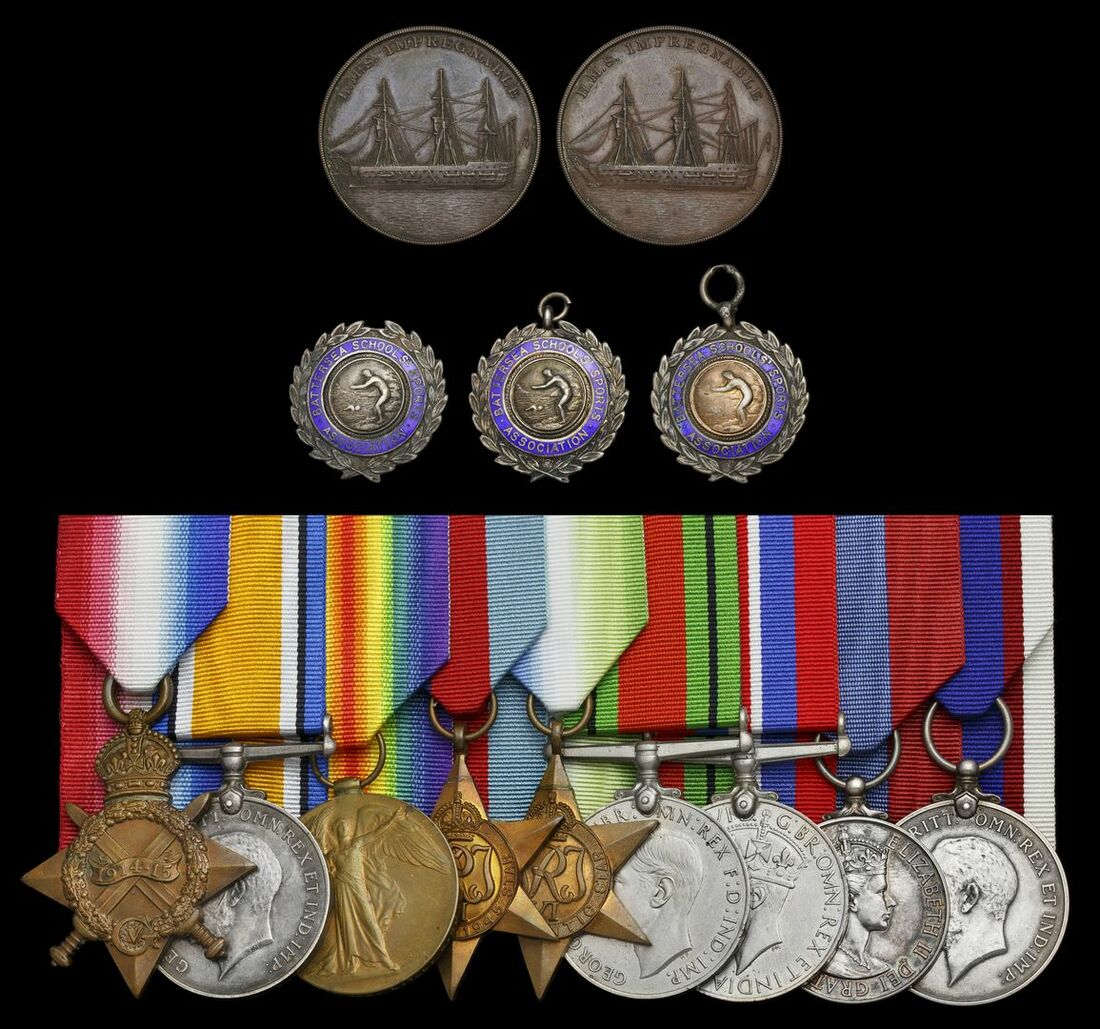
(x) A well-documented campaign group of nine awarded to Leading Telegraphist F. Tones, Royal Navy, who kept a journal while serving with H.M.S. Attentive in North Russia in 1918, seconded to gunboats in August he saw heavy action on the Dvina River
Returning to action with Fitzroy in June 1942, he was sunk with her in 1942 and recommended for a 'mention' for his coolness
1914-15 Star (J.22539. F. Tones, Tel. R.N.); British War and Victory Medals (J.22539. F. Tones. L. Tel. R.N.); 1939-45 Star; Atlantic Star; Defence and War Medals 1939-45; Royal Fleet Reserve L.S. & G.C., G.V.R. (J.22539 (CH.B, 16720) F, Tones. L. Tel. R.N.R.); Imperial Service Medal, E.II.R., (Frederick Tones) in its Royal Mint case of issue, court mounted for wear, very fine (10)
Frederick Tones was born at Battersea, London on 8 December 1896 and enlisted as Boy Class II on 14 January 1913. Posted to H.M.S. Russell days before the outbreak of the Great War he saw service with her first in the Channel and later in the Mediterranean. Advanced Ordinary Telegraphist on 25 July 1915 and later Telegraphist on 30 December 1915 with her he left just 8 prior to her sinking on 27 April. Over the next two years he was to see service with Ark Royal, Racoon and Rattlesnake.
Posted to the scout cruiser Attentive on 18 May 1918 Tones was aboard during her voyage to North Russia in late October of that year. He kept an interesting diary of both the journey to Russia and the service they performed at Murmansk. This tracks the difficult situation the British Expedition found themselves in facing a constantly shifting political landscape.
Attentive was at the front of the British fleet advancing towards Archangel on 2 August 1918. Tones's diary records a tense advance upstream with the expectation of ambush from 'machine guns, maxims, snipers or even mines'. As Telegraphist he was the first to learn of the White Russian coup in the city and records in full the message he received stating:
'To the Commander of the Armed Forces of the Allies of Russians in Northern Russia. The power of the Bolsheviks in Archangel fell today. There have been elected, by general voting, the representatives of the people, members of the Constitutional assembly together with the representatives of the villages and towns, creating thus a provisional chief Government of the Northern Districts. We avowed enemies of the shameful Brest peace salute in your person the armed Forces of the Powers Allied to Russia and peoples coming to the help of our country. We missed that our relatives [SIC] with the Allies are shared by the majority of the population not surely of Northern Russia but by the whole of Russia. We believe that in the fight with the General enemies we go with the allies in close and friendly unity because of the conviction that by the allies will not be broken the right of the Russia people to the free creation of their own life. From Chief of the Government of the Northern Districts. signed. Chaikvosky.'
Amusingly the diary notes that not long afterwards the crew 'had purchased a nice brown bear for a mascot'. The next day begins with the entry 'Wed 7th Aug:- Our bear gets a little disorderly so we tie him to the forestay'. The next day Tones was posted to a gunboat for services upon the Dvina river, supporting allied troops at the front. The next few days were a series of running battles until on 15 August a major action developed, the diary states:
'Was suddenly shook at about 7am to go up on deck as three enemy craft were in sight. We let them get closer and at about 8am went out to tackle them. We had another running fight with them and drove them about twelve miles to a place which appeared to be their base. All of a sudden we came upon a proper hornets nest, they were firing maxims, pom-poms, rifles etc and bullets were flying around us in all directions and then I saw Lawrence one of our chaps behind a maxim dive for the hatch- he had been shot clean through the thigh, of course before a blind fire, which by the way was worse than the Dardanelles, it was useless to go on so we turned and made our way back to the base.'
The journal continues and it became increasingly clear that Tones was tiring of the conflict. Eventually he was ordered to return to Archangel on 19 September 1918 and rejoin Attentive there. His service in North Russia had been brief but intense as his diary makes clear, one of the final entries reads:
'Read in papers about outrages of Bolsheviks of which I have seen a great deal up river, We remember our 3 men who were shot against a wall and outraged also the Frenchmen crawling back with hands and feet cut off- and we don't forget our five men one the Metrofan who are said to be starving in Moscow.'
Returning to Britain Tones was discharged ashore on 5 February 1920 and joined the Royal Fleet Reserve on 3 March 1921. This was not the end of his service however as he rejoined the action in the Second World War. Posted aboard Fitzroy as leading Telegraphist for minesweeping operations in 1942. Tones was recommended for an Immediate 'mention' when she was mined on 27 May 1942. The recommendation states:
'Although badly shocked and suffering superficial cuts as a result of the explosion, carried out the disposal of the S.P.'s in his charge under great difficulties, with admirable efficiency and calmness.
For cool and efficient devotion to duty.'
The mine struck Fitzroy between 1 and 2 boiler rooms, both of which flooded almost immediately. She began to take on a heavy list and sank remarkably quickly, being totally submerged in approximately 10 minutes. Sadly despite his remarkable good service over the course of a long and varied career Tones' recommendation was not approved.
Sold together with three ‘Battersea Schools’ Sports Association’ medals, silver and enamel, ‘Junior League Champions 1908; Junior Team Champions 1909; Boy Champion 1910’, all named ‘F. Tomes’; two ‘H.M.S. Impregnable’ bronze prize medals, 38mm, reverses inscribed ‘Open Championship Second F. Tones. 15th Sept. 1913’ and ‘Fully Dressed Swimming 50 Yards Second F. Tones. 15th Sept. 1913’; along with a manuscript diary kept during the recipient's service in North Russia between 2 June to 26 October 1918, 66 pages, lacking title page and first two pages detached and damaged at edges, otherwise easily legible and full of good detail of operations and fighting against the Bolsheviks along with copied research including service papers and the official report of Fitzroy’s sinking.
Subject to 5% tax on Hammer Price in addition to 20% VAT on Buyer’s Premium.
Sold for
£300
Starting price
£210

Watch, listen and bid as if you were in the room. Now available for auctions worldwide.
Click here to bid live
An exclusive and confidential service for the discerning collector or vendor.
View the Gallery
Download every Spink catalogue on your iPad, iPod or iPhone using free Spink app.
Download From iTunes© 2026 Spink & Son. All rights reserved.