Auction: 24111 - Orders, Decorations and Medals - e-Auction
Lot: 484
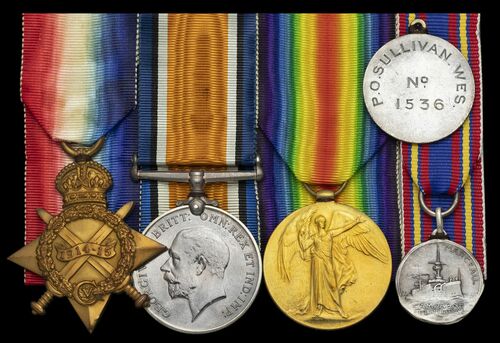
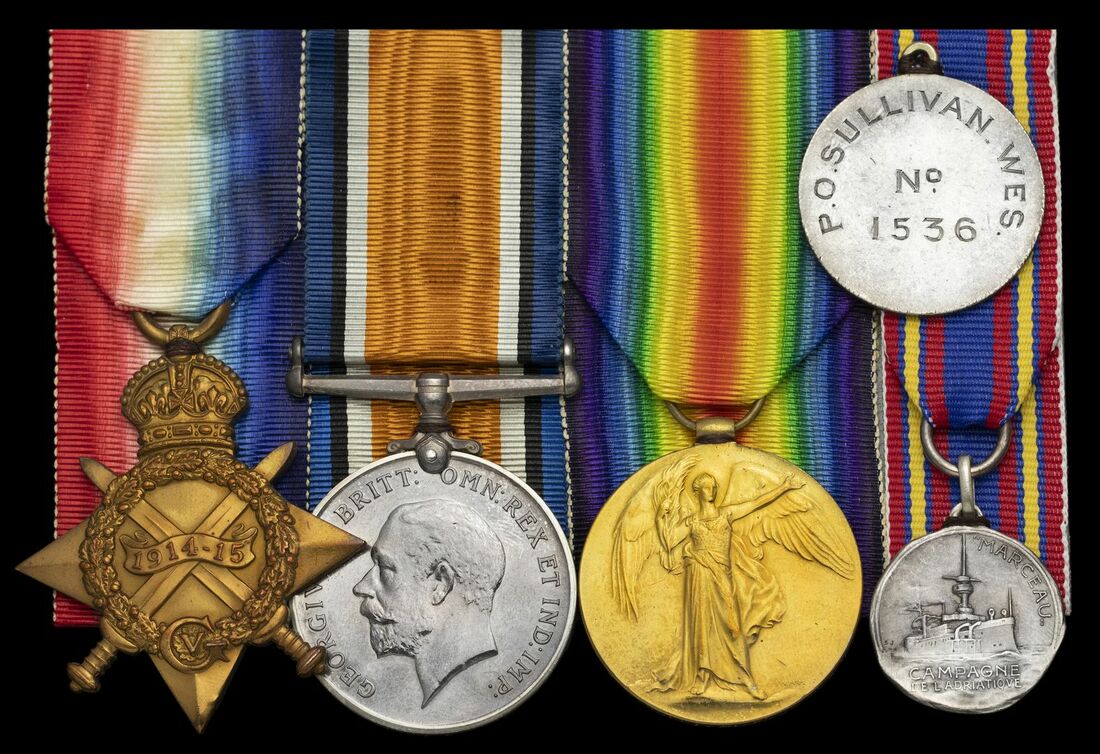
(x) Three: Petty Officer P. D. Sullivan, Royal Australian Navy
1914-15 Star (O.N. 1536 P.O. Sullivan. Ldg. Sea.); British War and Victory Medals (1536 P. O. Sullivan. P. O. R.A.N.), mounted for display, good very fine (3)
Percival Ormond Sullivan was born on 24 March 1890 at Sorrento, Victoria, Australia. He joined the Royal Australian Navy on 20 March 1912 and served in the German New Guinea in September 1914 on the Australia. Promoted to Leading Seaman on 27 May 1915 he served on the London Depot between 9 October 1915 - 15 February 1916. Sullivan then served on Cerberus between 16 February 1916 - 5 June 1917 and then on Warrego between 6 June 1917 - 31 March 1919 and during this time was promoted to Petty Officer on 24 January 1918. He completed his service on 30 July 1919.
H.M.A.S. WARREGO IN THE GREAT WAR
Warrego, Yarra and Parramatta consequently sailed from Sydney on 9 June 1917 bound for Aden, being joined en route on 7 July at Cocos Island by Huon, Torrens and Swan, which had sailed from Singapore after refitting. From Cocos Island the flotilla proceeded to Diego Garcia to search the archipelago for survivors from two British ships, Jumna and Wordsworth, which had disappeared without trace early in 1917. Nothing was found and the destroyers continued their voyage to the Mediterranean, arriving at Port Said on 9 August 1917.
After refitting at Malta and conducting anti-submarine work-ups, the Australian Flotilla proceeded to its new base at Brindisi, on the heel of Italy, arriving there in October 1917. There the destroyers were assigned the task of patrolling the Strait of Otranto. The purpose of the patrol was to prevent the passage into the Mediterranean of enemy submarines operating from Austrian Adriatic ports. Deployed in two divisions the Australian Destroyer Flotilla maintained patrols on a basis of four days at sea, followed by four days in harbour.
Many sailors of the young Australian Fleet took great pride in having their portraits taken as can be seen in this image of one of Warrego's stokers. Joined first by a French flotilla and later by Royal Navy destroyers, the Australian ships eventually became part of an anti-submarine force numbering more than 200 vessels. During the early period of their involvement, the enemy, whose submarines were based in Pola at the head of the Adriatic, was active and detection and chases were commonplace. Later, however, as the Allies implemented more effective sea control and sea denial measures, the enemy’s effort diminished significantly. As new methods of detecting submarines were developed Huon, Parramatta and Yarra were each fitted with captive observer balloons whose object was to detect lurking submarines from the air while attendant destroyers stood by ready to act as ‘killer’. Other duties involved screening British and Italian cruisers and bombarding the Albanian port of Durazzo on 2 October 1918.
On 16 November 1917 Warrego, in company with Huon, was involved in rescuing troops and crew from the torpedoed Italian transport Orione. Yarra and Parramatta, also on the scene, assisted too, bringing the damaged transport safely into port. For their work in rescuing the men in the heavy sea and successfully salvaging Orione, whose stern was blown off, the crews of the Australian destroyers received high praise from the Italian naval authorities.
In January 1918, Warrego and Huon conveyed the Greek Premier Venizelos and his suite from Taranto to Athens on his return from an Allied conference in London. Tragedy struck the Australian destroyer flotilla on 13 April 1918 when its leader, Commander WHF Warren, RAN, was drowned in Brindisi Harbour. Command of the Australian flotilla consequently passed to Commander AGH Bond, RN.
When the Armistice was declared, Warrego was attached to an Allied fleet which made a demonstration before Constantinople. A short visit to the Russian Black Sea port of Sebastopol followed before returning to the Mediterranean. After assembling at Gibraltar, the Australian flotilla sailed for England on 3 January 1919 in preparation for its return to Australia. En route the flotilla became separated in a storm off Cape St Vincent, with Torrens and Warrego taking refuge in the Tagus - they subsequently arrived in Devonport together on 11 January 1919.
Finally, after many delays, the six destroyers assembled at Malta and in the company of HMAS Melbourne sailed for home waters on 17 March 1919. Warrego arrived in Sydney on 21 May 1919 and paid off on 22 July 1919
Sold together with a Named dog tag and Commemorative medal for Marceau for the Adriatic campaign.
Subject to 5% tax on Hammer Price in addition to 20% VAT on Buyer’s Premium.
Sold for
£190
Starting price
£110
Watch, listen and bid as if you were in the room. Now available for auctions worldwide.
Click here to bid live
An exclusive and confidential service for the discerning collector or vendor.
View the Gallery
Download every Spink catalogue on your iPad, iPod or iPhone using free Spink app.
Download From iTunes© 2026 Spink & Son. All rights reserved.