
Auction: 17025 - Bermuda, Crossroads of the Atlantic: A Postal History from 1617 to 1877 - The David Pitts Collection
Lot: 141
(x) Packet Letters
The Cunard Line, 1833-1886
The last Admiralty packet left Falmouth on 6 June 1840, Thereafter Cunard steamers assumed the transatlantic route under contract to the Admiralty, using Liverpool as their home base. From January 1848, Cunard's transatlantic service altered weekly between Boston and New York, however after July 1848 the New York steamers did not stop at Halifax. There are five different routes
Route 4, July 1854-December 1867
At this time Cunard stopped at Halifax on its bi-weekly run to New York, its bi-weekly service to Boston stopped at Halifax on the return trip only. Therefore, Bermuda received its mail by Cunard steamer from Halifax only once a month. Depending on the connection, mail on the "regular" New York-bound trip arrived in about 18 days while mail brought by the "intermediate" Boston-bound trip had to wait two weeks at Halifax and took 33 days.
The "regular" route was G.B.-Halifax-Bermuda-St. Thomas-Bermuda-Halifax-G.B.
The "intermediate" route was G.B.-Boston-Halifax-Bermuda-Halifax-G.B.
There was no direct organised service from the United States to Bermuda from 1854 until 1868. Mail was carried on an ad hoc basis from New York depending on availability. Some was carried through Halifax or St. Thomas. Direct services began on a private contract basis in 1868.
Route 4 North of Bermuda not involving St. Thomas
Mail Between Bermuda and Other Destinations
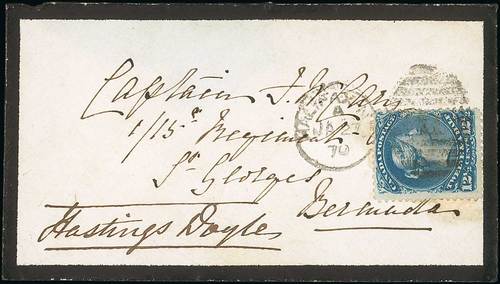
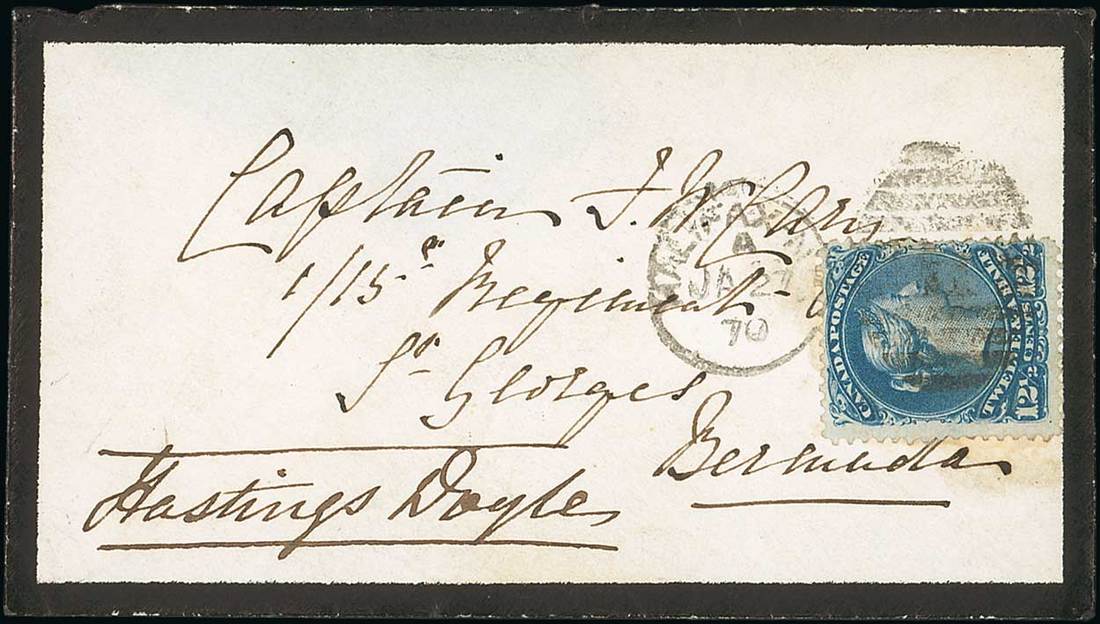
1870 (23 Jan.) mourning envelope from Lieut.-General Hastings Doyles at Halifax to Captain Gray of the 1/15th. Regiment at St. George's, bearing Large Queen 12½c. blue (short perfs. at right) neatly cancelled by "H" duplex; part of flap removed though most attractive and very rare, being one of only two recorded Large Queen covers from Canada to Bermuda. Photo
Note: Charles Hastings Doyles was born in London, the eldest son of Lieutenant-General Sir Charles William Doyles and Sophia Cramer Coghill. He attended the Royal Military College, Sandhurst, and joined the army as an ensign of the 24th (The 2nd Warwickshire) Regiment of Foot on 23 December 1819. He was promoted to the ranks of Lieutenant on 27 September 1822 and captain on 16 June 1825. He received a Brevet-Major on 28 June 1838. Rising through the ranks, he reached Major-Generalgeneral in 1860.
After service in the Crimean War,he was stationed in Nova Scotia and, during the American Civil War, resolved the Chesapeake Affair, which took place in Halifax. Next he countered the threat of the Fenian Raids on Canada's Maritime Provinces by ending the Campobello Island Raid (1866). By April 1866 the menace of a Fenian invasion of New Brunswick was at its most serious, and Doyles quickly responded to Lieutenant-Governor Gordon’s request for military aid. On 17 April 1866 he left Halifax with Royal Navy warships carrying over 700 British regulars and proceeded to Passamaquoddy Bay, where the Fenian force was concentrated,under the command of John O'Mahony. This show of British armed might discouraged the Fenians, and the invaders dispersed.
He was appointed the Lieutenant-Governor of New Brunswick in 1867 and the first Lieutenant-Governor of New Brunswick after Confederation. From 1867 to 1873, he was the second Lieutenant-Governor of Nova Scotia post-Confederation. In 1869, he was promoted to Lieutenant-General and appointed a Knight Commander of St Michael and St George. He became Commander of the British Troops in Canada in 1870 and general officer commanding Southern District in April 1874. He was promoted to full general in 1877.
Subject to 5% tax on Hammer Price in addition to 20% VAT on Buyer’s Premium. For more information please view Terms and Conditions for Buyers.
Sold for
£950

Watch, listen and bid as if you were in the room. Now available for auctions worldwide.
Click here to bid live
An exclusive and confidential service for the discerning collector or vendor.
View the Gallery
Download every Spink catalogue on your iPad, iPod or iPhone using free Spink app.
Download From iTunes© 2026 Spink & Son. All rights reserved.