
Auction: 17025 - Bermuda, Crossroads of the Atlantic: A Postal History from 1617 to 1877 - The David Pitts Collection
Lot: 118
(x) Packet Letters
The Cunard Line, 1833-1886
The last Admiralty packet left Falmouth on 6 June 1840, Thereafter Cunard steamers assumed the transatlantic route under contract to the Admiralty, using Liverpool as their home base. From January 1848, Cunard's transatlantic service altered weekly between Boston and New York, however after July 1848 the New York steamers did not stop at Halifax. There are five different routes
Route 4, July 1854-December 1867
At this time Cunard stopped at Halifax on its bi-weekly run to New York, its bi-weekly service to Boston stopped at Halifax on the return trip only. Therefore, Bermuda received its mail by Cunard steamer from Halifax only once a month. Depending on the connection, mail on the "regular" New York-bound trip arrived in about 18 days while mail brought by the "intermediate" Boston-bound trip had to wait two weeks at Halifax and took 33 days.
The "regular" route was G.B.-Halifax-Bermuda-St. Thomas-Bermuda-Halifax-G.B.
The "intermediate" route was G.B.-Boston-Halifax-Bermuda-Halifax-G.B.
There was no direct organised service from the United States to Bermuda from 1854 until 1868. Mail was carried on an ad hoc basis from New York depending on availability. Some was carried through Halifax or St. Thomas. Direct services began on a private contract basis in 1868.
Route 4 North of Bermuda not involving St. Thomas
Mail Between Bermuda and England
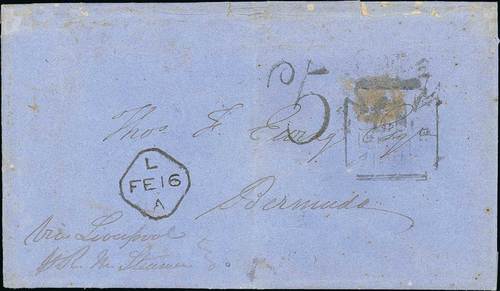
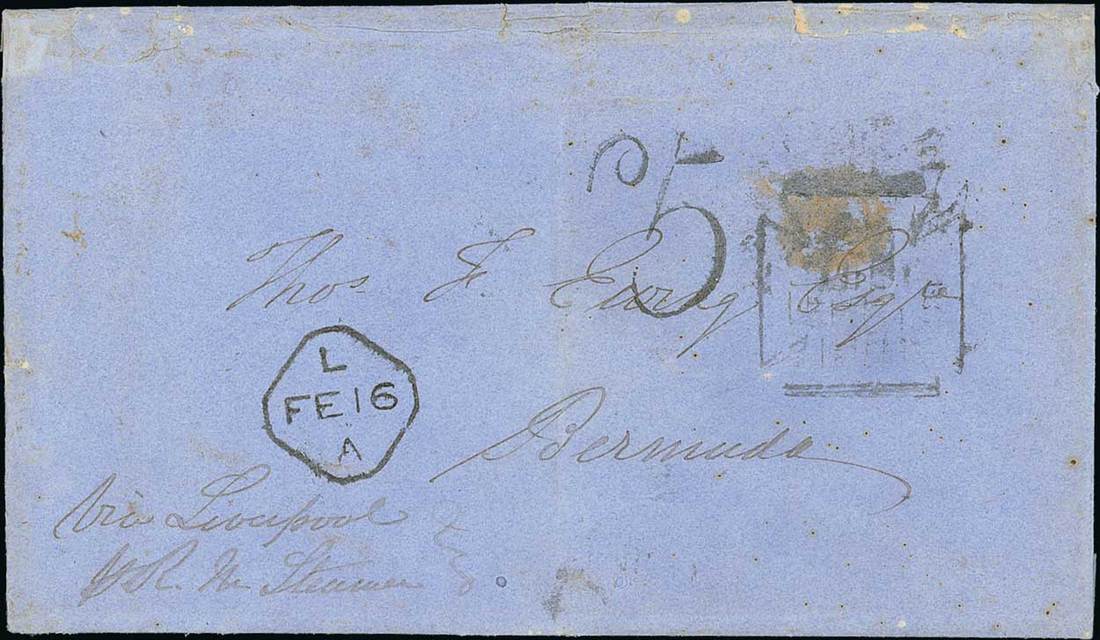
1856 (13 Feb.) entire letter from London "via Liverpool per R.M. Steamer" to Bermuda, per Cunard Africa to Halifax and per Curlew" to Bermuda where she was wrecked near North Rock on 18 March, showing London and Liverpool datestamps, and "d5" rate handstamp; wear faults at top though the unique example of mail known from this wreck. Photo
Note: The "Curlew" sailed from Halifax for Bermuda on 14 March 1856. Approaching Bermuda she struck the reefs about 1½ miles east of North Rock at 4a.m. and became a total wreck. Two of the boats were smashed and a third washed from its davits though the fourth was launched successfully. The three passengers and crew were able to get in to the fourth boat, and the Captain and two others who stayed aboard were rescued later. The "Curlew" mail was contained in nine bags with seven recovered 48 hours later, these being taken to St. George's
literature:
"Maritime Disaster Mail" by Hoggarth and Gwynn, page 29
Subject to 5% tax on Hammer Price in addition to 20% VAT on Buyer’s Premium. For more information please view Terms and Conditions for Buyers.
Estimate
£1,200 to £1,500

Watch, listen and bid as if you were in the room. Now available for auctions worldwide.
Click here to bid live
An exclusive and confidential service for the discerning collector or vendor.
View the Gallery
Download every Spink catalogue on your iPad, iPod or iPhone using free Spink app.
Download From iTunes© 2026 Spink & Son. All rights reserved.