Auction: 14001 - Orders, Decorations, Campaign Medals and Militaria
Lot: 4
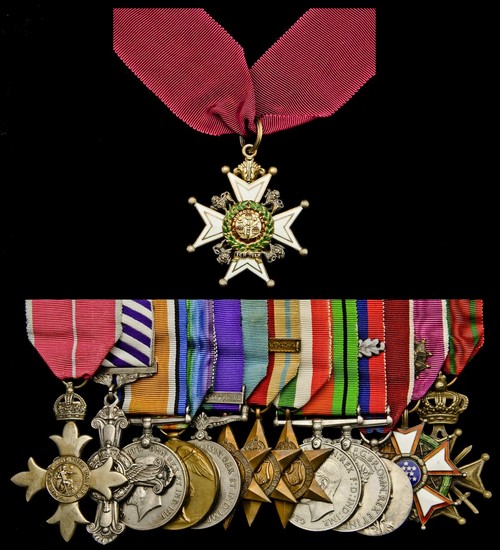
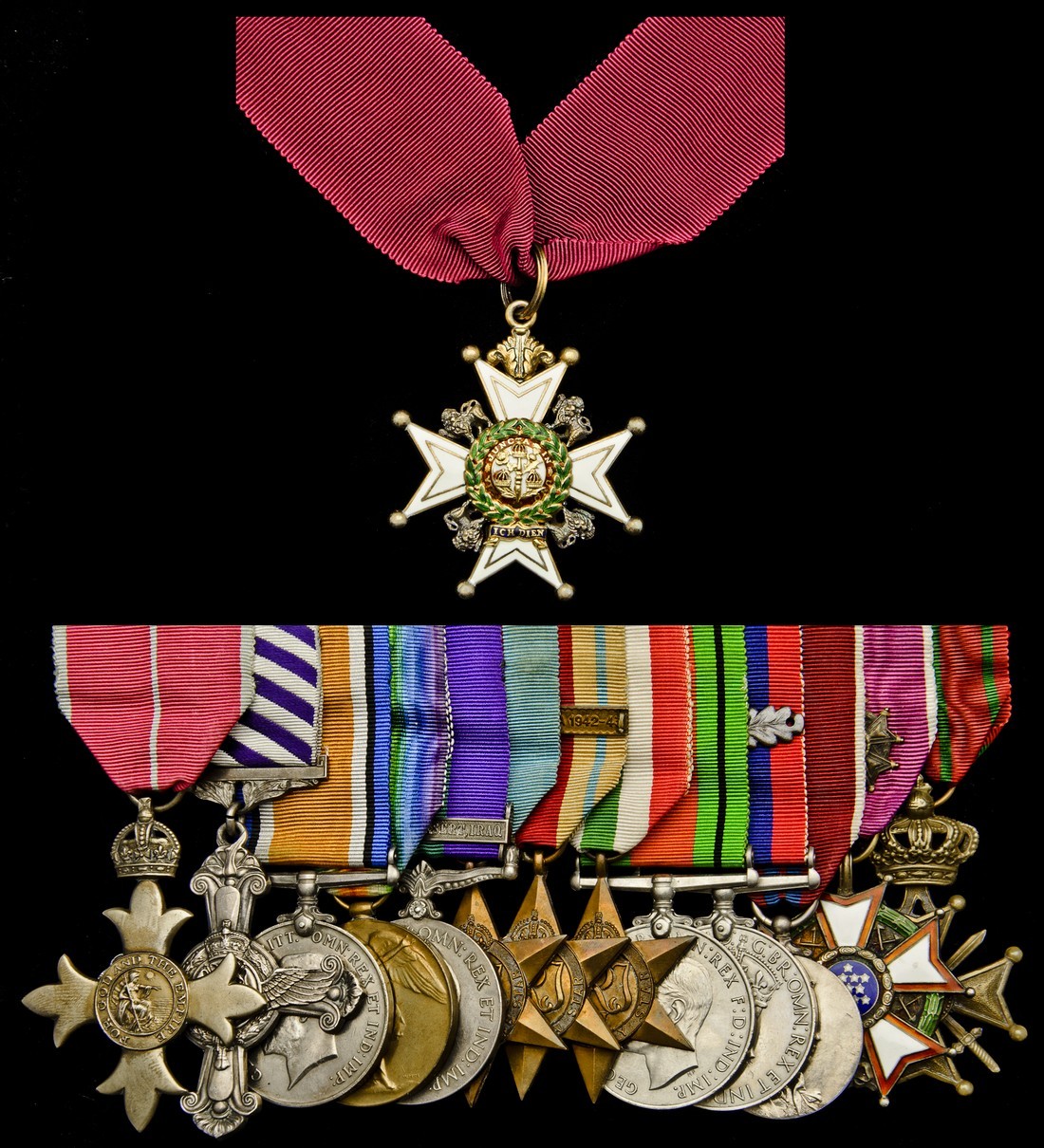
The Remarkable Second War C.B., 'Southern Desert, Iraq' O.B.E., Great War Fighter "Aces" D.F.C. Group of Fifteen to Dolphin Pilot Air Commodore F. Woolley, Royal Air Force, He Was Credited With 4 Victories, With Other Sources Suggesting As Many As 8 During July to November 1918. He Served as a Special Service Officer With Air Staff Intelligence in Iraq, Where He Spent Three Years in the Desert With Bedouin Tribesmen Collating Intelligence. During the Second War He Served as Chief Intelligence Officer, Headquarters Mediterranean Allied Air Forces, 1943-45
a) The Most Honourable Order of the Bath, Military Division, Companion's (C.B.) neck Badge, silver-gilt and enamel, with neck riband, in Garrard, London, case of issue
b) The Most Excellent Order of the British Empire, 1st type, Military Division, Officer's (O.B.E.) breast Badge, silver-gilt (Hallmarks for London 1930)
c) Distinguished Flying Cross, G.V.R., unnamed as issued
d) British War and Victory Medals (Lieut. F. Woolley. R.A.F.)
e) General Service 1918-62, G.V.R., one clasp, Southern Desert, Iraq (F/L. F. Woolley. R.A.F.)
f) 1939-1945 Star
g) Africa Star, with North Africa 1942-43 Bar
h) Pacific Star
i) Italy Star
j) Defence and War Medals, M.I.D. Oak Leaf
k) Coronation 1953
l) United States of America, Legion of Merit, Officer's breast Badge, gilt and enamel, reverse officially named 'F. Woolley', with miniature Star emblem on riband
m) Belgium, Kingdom, Croix de Guerre, A.I.R., bronze, generally very fine or better, mounted as worn, the Pacific Star loose, with the following related items:
- The recipient's Flying Log Book, covering the period 18.11.1932- 7.8.1941
- Commission Appointing Frank Woolley a Lieutenant in the Royal Air Force, dated 1.11.1918
- Commission Appointing Frank Woolley a Flying Officer in the Royal Air Force, dated 10.7.1929
- Bestowal Document for the C.B., named to Acting Air Commodore Frank Woolley, O.B.E., D.F.C., R.A.F., and dated 1.1.1946, together with Central Chancery enclosure
- Bestowal Document for the O.B.E., named to Flight Lieutenant Frank Woolley, D.F.C., R.A.F., and dated 3.6.1931
- Bestowal Document for the American Legion of Merit, named to Air Commodore Frank Woolley, Royal Air Force, together with a copy of the citation, on White House, Washington, headed paper, and signed 'Harry Truman'
- The recipient's riband bars, showing the additional entitlement to the Pacific Star
- Various photographs of the recipient, including one of him being presented with the American Legion of Merit by Major-General B. Giles, U.S. Army Headquarters, Cairo, 24.1.1946
- Box of issue for the American Legion of Merit
- Air Commodore's rank insignia; Group Captain's epaulettes; various cloth insignia, buttons, and other ephemera
- Copy of the recipient's obituary (lot)
C.B. London Gazette 1.1.1946 Acting Air Commodore Frank Woolley, O.B.E., D.F.C., Royal Air Force.
O.B.E. London Gazette 3.6.1931 Flight Lieutenant Frank Woolley, D.F.C., Royal Air Force.
The Recommendation states: 'This Officer has been a Special Service Officer in Iraq since March 1928. Although occupying the most lonely and isolated post in the whole Command, he has consistently displayed, under extremely trying conditions, a tact, patience, and perseverance which are worthy of the highest praise.'
D.F.C. London Gazette 3.6.1919 Lt. Frank Woolley
'In recognition of distinguished services rendered during the war.'
American Legion of Merit, Officer London Gazette 27.11.1945 Acting Air Commodore Frank Woolley, O.B.E., D.F.C., R.A.F.
'In recognition of valuable services rendered in connection with the war.'
The Recommendation states: 'Air Commodore Frank Woolley, Royal Air Force, as Chief Intelligence Officer, Headquarters Mediterranean Allied Air Forces from February 1943 to May 1945, displayed wise judgment and unqualified devotion to duty in the successful fulfilment of his assignment. Called upon to furnish a synthesis of all intelligence information regarding conduct of operations and to integrate the Anglo-American intelligence structure of the headquarters, he overcame many obstacles to provide source information of high value and veracity and at the same time achieved a smoothly functioning, closely knit intelligence organization. Commodore Woolley's exceptional ability was of great benefit to the conduct of air operations.'
Belgian Croix de Guerre London Gazette 15.7.1919 Lieut. Frank Woolley, D.F.C., 79th Sqn.
M.I.D. London Gazette 2.6.1943 Acting Air Commodore F. Woolley, O.B.E., D.F.C.
Air Commodore Frank Woolley, C.B., O.B.E., D.F.C., (1899-1981), was born in Ilkeston, Derbyshire, and was educated at the County Secondary School. On his 18th birthday he joined the Army straight from his school O.T.C., and was accepted for a Commission in the Territorial Forces Association. Posted to the 7th Training Reserve Battalion at Rugeley, he subsequently applied to join the Royal Flying Corps, and after initial tutoring at Denham was Commissioned a Second Lieutenant in the R.F.C. on the 7th November 1917. After spending six months at Upavon, he went to France in July 1918, posted to No.1 Aero Supply Depot, before receiving his first operational posting with No.79 Fighter Squadron (Sopwith Dolphins), based at St. Marie Cappel, east of St. Omer, on the 14th July, with whom he fought and flew for the rest of the War. He was without doubt heavily engaged with the enemy for the next four months, '...and the local papers in his home town of Ilkeston credited him with eight victories, and recorded that he himself had been shot or forced down no fewer than three times, evidence of an exciting four months' flying.' (Winged Warriors, Derbyshire Fighter Pilots in World War I, by Barry Marsden refers).
His first victory was on the 27th September, when, according to an account that appeared in the Ilkeston Advertiser, 'he was on readiness at his home base when word was received that an enemy two seater was busy on a reconnaissance over the British front line. He was ordered to intercept the hostile aircraft, and, piloting a Dolphin, sighted it below him somewhere north-west of Armentieres. The first burst from his twin Vickers killed the enemy observer, and the subsequent running battle took both warplanes over the town, where the observation machine suddenly dived away to smash through the roof of a building. When Frank landed back at his home airfield his delighted CO praised his "splendid effort", and promised that "the facts would be reported to the proper quarter."' (ibid). Woolley's own account of the action confirms this: 'I was at 2,000 feet among the clouds South West of Armentieres when I saw a hostile 2-seater, probably an Albatros, about 1,000 feet below me. On being engaged the enemy aircraft dived towards Armentieres. I dived after him and fired two bursts into him at close range. The enemy aircraft spun and crashed into a house in Armentieres.' (recipient's combat report refers).
The following day Woolley shot down another aircraft: 'I saw 10 Fokker Biplanes attacking a Bristol Fighter. I climbed into a cloud at 6,000 feet whilst Lieutenant McNeaney attacked the enemy machines. A dog fight ensued in which I saw two Fokkers go down after which Lieutenant McNeaney went down, followed by a Fokker. I attacked this enemy aircraft and fired a short burst at point blank range, and saw him go down and crash.' (ibid).
A month later, on the 26th October, Woolley despatched an L.V.G. two-seater at 3,000 feet south-east of Renaix, before recording his final confirmed victory on the 4th November, when 'at 9,000 feet I spotted a Halberstadt two-seater working over Renaix. I flew north and then east and so got east of him and in the sun. I then dived on the enemy aircraft who turned west and then north. I fired a burst at very close range. The enemy aircraft went into a vertical dive and crashed in a gulley between Sulsique and Renaix.' (ibid).
After the Armistice Woolley took up adjutant duties with the Squadron, and became a Flight Commander. In December the Squadron became part of the Allied Occupation Force, and moved to Cologne. Here he accepted the opportunity to fly numerous German aircraft that had been surrendered, including Fokker DVIIs, Rumplers, and Halberstadts. Whilst stationed in Germany he learnt of the award of his D.F.C., and also received the Belgian Croix de Guerre, having the latter pinned on his chest by King Albert himself. He transferred to the unemployed list in October 1919, but was recalled to a short-service Commission the following June, and served at R.A.F. Lee-on-Solent and Calshot. Qualifying as a pilot flying seaplanes and multi-engined flying boats, he fell in love with the Solent area, and wrote to tell his fiancée: 'I am sure that you will love this place too, and if I live long enough to retire this is where we shall live.'
Southern Desert, Iraq- With the Bedouin
In July 1927 Woolley was appointed to a permanent Commission in the General Duties branch of the Royal Air Force, and having been promoted Flight Lieutenant, 1.1.1928, he embarked upon a course in Arabic at the School of Oriental Studies in London. After completing the course in March 1928 he was immediately posted to HQ Iraq as a Special Service Officer with Air Staff Intelligence, and for the next three years was responsible for the collection of intelligence in the vast unmapped desert west of Basra, spending the time living with the Bedouin tribesmen, 'sharing the hardships of their primitive, nomadic lifestyle, enduring searing heat, frequent dust and sandstorms, plagues of flies, and living off revolting food and foul water.' (Winged Warriors, Derbyshire Fighter Pilots in World War I, by Barry Marsden refers). Separated from any form of civilisation by hundreds of miles of desert, with wireless transmitted Morse code his only form of contact, his task was to obtain information on the activities of hostile tribes operating from Saudi Arabia. During his time in Iraq he maintained close contact with Major (later Sir John) Glubb, Glubb Pasha, the founder of the Arab Legion, who had been seconded from the Royal Engineers to the Iraqi Government as Administrative Inspector. In recognition of his sterling service under the most trying conditions, Woolley was awarded a richly-deserved O.B.E. in June 1931. His next job in the Middle East was to visit and provide intelligence on the local Sheikhs through whose territory the pipeline was being built from the Arabian oil fields to the sea ports at Haifa and Tripoli, before returning to flying duties in the United Kingdom, including torpedo bombing in co-operation with the Royal Navy.
A New War- The Same Game
On the outbreak of the Italian- Abyssinian War, Woolley was speedily posted to the Sudan by air to reorganise the rudimentary intelligence facilities in that area, perceived as vital if Britain were to be successfully involved in any hostilities, which at a time seemed likely, and was promoted Squadron Leader, 1.6.1936. When the crisis came to an end he went to Singapore as Senior Air Staff Officer to Air Commodore (later Marshal of the Royal Air Force) Tedder, AOC Far East Command. Promoted Wing Commander, 1.4.1939, he served during the Second World War, first in Singapore; then in Ceylon, with the rank of Group Captain, where he formed and commanded No. 222 Group, a task which involved the construction of airfields and other bases for operating bombers, fighters, and reconnaissance aircraft to combat a Japanese attack on the island; and then, with the rank of acting Air Commodore, in Algiers on the staff of Air Chief Marshal Sir Arthur Tedder as Chief Intelligence Officer, Mediterranean Air Command HQ, a post he held until in various guises the end of the War. Recommended for a C.B.E. at the end of hostilities, the recommendation stating: 'this Officer has been Chief Intelligence Staff Officer since September 1943, and has not only been responsible for the whole range of intelligence activities in the Mediterranean and North-African theatres, but also the organisation and building up of an integrated Anglo-American intelligence structure.', he was instead created a Companion of the Order of the Bath, and awarded the American Legion of Merit, receiving the latter in Cairo from Major General Benjamin Giles, Commander of United States Forces Middle East.
On his return to the United Kingdom, Woolley was given the command of R.A.F. Lyneham, during which period it became the main base for the British contribution to the Berlin Airlift in 1947, before returning to staff duties as Assistant Director of the Joint Intelligence Bureau at the Ministry of Defence. He retired on the 6th August 1954, with the rank of Air Commodore, after 37 years with the Royal Air Force, during which period he had flown 54 different types of aircraft, from a Dolphin to a Vampire.
Air Commodore Woolley married Gladys Willgoose at Ilkeston in August 1921, and as promised retired to Lee-on-Solent, where in 1971 they celebrated their Golden Wedding Anniversary. His son, Frank Geoffrey Woolley, served with the Royal Air Force in the Second World War, and like his father received a D.F.C. before his twentieth birthday.
Subject to 20% VAT on Buyer’s Premium. For more information please view Terms and Conditions for Buyers.
Sold for
£8,500
Sale 14001 Notices
The lot now additionally contains the Bestowal Document for the recipient's Croix de Guerre
Watch, listen and bid as if you were in the room. Now available for auctions worldwide.
Click here to bid live
An exclusive and confidential service for the discerning collector or vendor.
View the Gallery
Download every Spink catalogue on your iPad, iPod or iPhone using free Spink app.
Download From iTunes© 2026 Spink & Son. All rights reserved.