
Auction: 13001 - Orders, Decorations, Campaign Medals and Militaria
Lot: 3
The Outstanding ´Battle of France´ 1940 D.S.O., 1940 D.F.C. Group of Five to Hurricane Ace, Wing Commander J.S. Dewar, 87 Squadron, Royal Air Force, Who, Despite Flying With a Broken Shoulder, Was Accredited With At Least 5 Victories in 12 Days Over France; He Bagged Another 2 and 1 Probable on the Second Day of the Battle of Britain; Before Adding Another Ju 88, A Probable and a Shared Before the End of August 1940; Dewar Was Killed, 12.9.1940, ´He Had Set Out For Tangmere, But Had Failed to Arrive. For Some Time His Fate Was Unknown; Then His Body, Riddled With Shot, Was Washed Up On The Coast
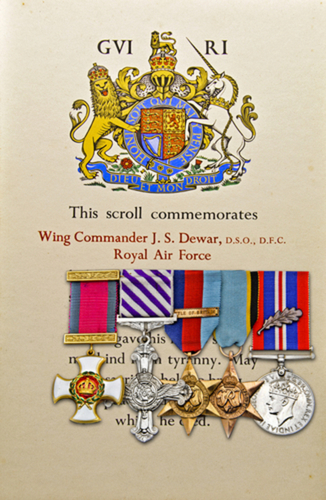
a) Distinguished Service Order, G.VI.R., silver-gilt and enamel, reverse of suspension bar officially dated ´1940´, with integral top riband bar
b) Distinguished Flying Cross, G.VI.R., reverse officially dated ´1940´
c) 1939-1945 Star, with Battle of Britain Bar
d) Air Crew Europe Star
e) War Medal, M.I.D. Oak Leaf, good very fine, with the following contemporary related items and documents:
- Memorial Scroll, named to ´Wing Commander J.S. Dewar, D.S.O., D.F.C., Royal Air Force´, glazed and framed
- Bestowal Document for the Distinguished Service Order, dated 31.5.1940, signed by Anthony Eden, glazed and framed
- M.I.D. Certificate, dated 25.5.1940, glazed and framed, glass cracked
- Three R.A.F. Swimming Prize Medals, engraved ´1930 100 Yards, 2nd´; ´1930 220 Yards, 2nd´ and ´Relay Race 1932, 2nd´ respectively; Running Prize Medal, engraved ´R.A.F. Thorney Island, 2nd 1939´
- Assorted Shoulder Titles and buttons
- Pocket Watch, 9ct gold, by Bruford & Son Ltd., Exeter, reverse engraved ´Presented S/Ldr J.S. Dewar, D.S.O., D.F.C. By N.C.O.s and Men of 87 Squadron 1939-BEF-1940´, in case
- Presentation Cigarette Box, silver (Hallmarks for Birmingham 1937), lid engraved ´F/Lt. J.S. Dewar R.A.F. From The Officers Of "A" Flight A.T. Section A&A.E.E. Martlesham Heath 10th July, 1937´, additionally engraved with five officers names
- R.A.F. Sweetheart´s Broach, 9ct gold, in Gieves Ltd. case
- Napkin Ring, silver (Hallmarks for Birmingham 1905), engraved ´J.S.D. 1907´, in leather case, embossed ´J.S.D. 1907´
- Commemorative Battle of Britain Tankard, pewter
Two Wooden wall plaques for 87 Squadron, and the Aeroplane & Armament Experimental Establishment; Trunk Suitcase with the initials ´J.S.D.´
- Model wooden ship, with plaque engraved, ´To F/Lt J.S. Dewar from the N.C.O.´s and Men of A Flight A.T. Section July 10th 1937´
- Sir William Rothenstein Portrait Print of the recipient as illustrated in Men of the R.A.F.; with a copy of the former publication, inscribed ´To Mum, wishing her many happy returns of her birthday, from Kay [Dewar], May 1942´
- Order of Service for The Unveiling and Dedication of The Battle of Britain Chapel in Westminster Abbey, dated 10.7.1947; Order of Service for Unveiling of the Battle of Britain Memorial, Westminster Abbey, 10.7.1947
- Oxford & Cambridge Schools Examination Board Schools Certificate; Officer Training Corps Certificate, dated 20.5.1924; Squadron Leader Dewar´s Calling Card
- Charcoal sketch of Dewar, glazed and framed
- Photograph album mainly covering his service with 13 (Army Co-operation) Squadron, Andover, from December 1927, and his Wedding through to his funeral; with a number of family photographs (lot)
D.S.O. London Gazette 31.5.1940 Squadron Leader John Scatliff Dewar, D.F.C. (26029)
The Recommendation, dated 25.5.1940, states: ´Before intensive operations started this officer injured his right shoulder in a severe flying accident. Despite this, he flew regularly and led his squadron with skill and dash, more than 60 enemy aircraft being destroyed by them. He remained in command of the squadron throughout the operations, in spite of the injured shoulder, trained his new pilots well and continued throughout to be a very efficient commander, inculcating an excellent spirit in his squadron.´
Covering Remarks by No 14 Group Commander: ´Squadron Leader Dewar was in the Saar area when intensive operations started. He had had a severe flying accident on May 7th, which incapacitated his right shoulder. In spite of this he flew consistently and led his squadron with skill and dash. Under his leadership No 87 Squadron accounted for more than 60 enemy aircraft. He remained in command of his squadron until the evacuation, in spite of his injured shoulder, he trained his new pilots well, and throughout continued to be a very efficient commander. I cannot speak too highly of the spirit he inculcated in his squadron. I recommend the immediate award of the Distinguished Service Order.´
D.F.C. London Gazette 31.5.1940 Squadron Leader John Scatliff Dewar (26029)
´This officer has shot down five enemy aircraft and led many patrols with courage and skill.´
Wing Commander John Scatliff Dewar, D.S.O., D.F.C., born Mussori, Lahore Province, India, 1907; educated at King´s School, Canterbury; entered Cranwell as a Cadet, January 1926, where he excelled and graduated with ´Exceptional´ ratings; posted as Pilot to 13 (Army Co-operation) Squadron (Avro Ansons), Andover, December 1927; posted as Flying Officer to the School of Naval Co-operation, Lee-on-Solent, July 1929; joined 822 Squadron on H.M.S. Furious (Carrier), May 1933, and stayed aboard her as Flight Lieutenant with 801 (Fleet Fighter) Squadron, July 1934; whilst serving on the Furious Dewar was washed overboard during a gale in the Bay of Biscay, fortunately he was quickly rescued; posted as a test pilot to the Aircraft & Armament Experimental Establishment, Martlesham Heath, June 1936, before taking up a position as Squadron Leader at SHQ Thorney Island, March 1938.
The Battle of France - 12 days, 1 Arm and 5 Victories
Dewar undertook a refresher course at 11 Group Pool, St. Athan, before being posted to 60 Wing in France, 25.11.1939; at the start of the following month he took command of 87 Squadron (Hurricanes), Lille/Seclin, France; Dewar´s squadron, along with her sister squadron No. 85, formed 60 Wing of the Air Component of the B.E.F.; during the early part of 1940 they carried out front line patrols, but with the advent of the Battle of France in May, they were at the forefront of the defensive fighting; on the 7th May Dewar broke his right shoulder in a flying accident - despite being severely incapacitated for flying he still led his squadron to claim over 60 enemy aircraft, 5 of which he claimed himself, during 12 days of intensive fighting; the squadron was evacuated back to Debden to refit (having lost their records during the evacuation), and upon his return to England Dewar was one of the first four officers to receive the double award of D.S.O. and D.F.C.; the celebration of this award is taken up by Sir William Rothenstein in Men of the RAF, ´When I returned during June I found fresh squadrons, among them one, under Wing Commander Dewar, which had done Homeric work in France during the retreat. But I heard nothing of self-glory in the stories they told of their exploits. ´In quietness and in confidence shall be your strength.´ Our young airmen do not dramatize themselves, scarcely, indeed see anything dramatic in their daily or nightly adventures... Nor did I see a wink or a glance exchanged between the officers and the attractive young W.A.A.F.´s waiting at their tables. The men´s amusements and dissipations were simple enough - to foregather in some country pub, to drive to the nearest town, there to have a drink or two, or to visit the local cinema or a theatre. I have in mind an occasion when, the D.S.O. having been given to Squadron Leader Dewar, D.F.C.s were awarded to three other pilots of the squadron. The event must be fitly celebrated: they insisted on my joining in the jubilation. A lorry was requisitioned, wherein we drove to an inn some miles away, much frequented by airmen, where, in a crowded taproom, we drank lukewarm beer, each of my new firends treating in turn. To my amusement the proprietress came from behind the bar and placing a plump hand on my shoulder said: ´I do love you boys coming round to us!´ To me, approaching the end of my seventh decade! An airman from the Station, sitting with a bright-haired lady, invited my friends to go on with them to another place, what kind of place I failed to gather. He would lead the way in his car. It was a dark and starless night; no one knew where we were going, nor was it easy to keep in the track of the swifter car. We were uneasily seated on narrow benches; and at each turning the lorry swung and swerved. At last, after driving many miles, we followed the car through wide-open gates into the grounds of a Georgian mansion. As we turned in there was a loud report, a front tyre had burst. Alas, no jack or repairing outfit could be found in the lorry. What a dilemma! Then, to my surprise and amusement, I found myself in a Georgian interior, transformed into a gaudy night club, with cubist decorations. Our friend had settled down at a table with his attractive lady, and begged us to join them. But our party was preoccupied with the burst tyre; I sat down to a glass of wine. A jazz band was playing the usual dance tunes. At a table nearby three or four elderly military officers, the only guests at the club, sat with some stout, middle-aged ladies. From time to time a couple rose, to gyrate round the room. It was not a Rabelaisian sight; far from it... Somehow my friends had managed to get a fresh tyre - it was now too late to linger, we must get back to the Station. Getting back proved a risky affair. Our driver had but a vague notion of the route. There was no car, and no sign-posts to guide us. And even warm beer is not ineffective.
When at last we reached the Station gates and were challenged by the sentries, none of my friends had their identity cards with them, and all were taken to the Guard Room, to explain themselves. No, not a Rabelaisian evening!´
The Battle of Britain
At the start of June Dewar took 87 Squadron to Church Fenton, Yorkshire; it became operational again on the 21st, however given the geography of where it was based there was little action; the squadron moved to Exeter, 5.7.1940, and carried out its first combat over the UK, 11.7.1940 (the second day of the Battle of Britain); on the latter date the squadron claimed 4 Bf 110´s and 1 probably destroyed - of this total Dewar was responsible for 2 of the destroyed aircraft and the probable; the first being shot down 16 miles east of Weymouth, the second 4 miles east of Shambles and the last over Portland-Grange Heath; the following day Dewar was promoted to Acting Wing Commander and made Station Commander at Exeter; despite his new role he continued to fly occasional operational sorties during the height of the battle - often ´borrowing´ a Hurricane from his old squadron; on 13.8.1940 he shared a Ju 88 20 miles south of Bognor, and on the 25th August he recorded another Ju 88 shot down and a probable Bf 109E both near Lulworth; on 12.9.1940 he borrowed another Hurricane (this time V 7306 from 213 Squadron), Rothenstein takes up the narrative, ´Dewar wrote that he had been moved to Exeter; from there he had set out for Tangmere, but had failed to arrive. For some time his fate was unknown; then his body, riddled with shot, was washed up on the coast. It was thought he had got entangled in a scrap, and was shot down over the sea.´; an airman based at Exeter gives the following, ´Then one afternoon we lost our Station Commander, Johnny. He had borrowed one of our machines to fly to Tangmere for a conference. He was in excellent spirits when he took off. Just after he had left, Opps told us that there was a blitz in that sector. They warned Johnny on the R.T. He gave the usual answer, "Message received and understood." Then nothing more. Johnny´s body was washed up, riddled with bullets, five [sic] days later. We lost a grand Station Commander, and our friend´; Dewar´s body washed ashore at Kingston Gorse, Sussex, eighteen days after he had been reported missing; Wing Commander Dewar is buried in St. John the Baptist churchyard, North Baddesley, Hampshire.
Sold for
£42,000

Watch, listen and bid as if you were in the room. Now available for auctions worldwide.
Click here to bid live
An exclusive and confidential service for the discerning collector or vendor.
View the Gallery
Download every Spink catalogue on your iPad, iPod or iPhone using free Spink app.
Download From iTunes© 2026 Spink & Son. All rights reserved.