Auction: 13001 - Orders, Decorations, Campaign Medals and Militaria
Lot: 18
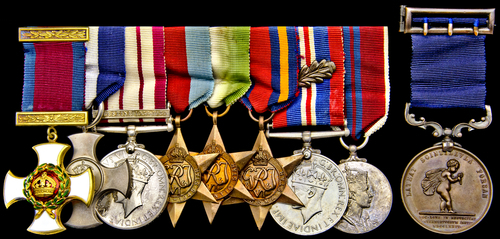
The Fine Second War D.S.O., D.S.C. Group of Eight, Which Reflects A Most Interesting Career, to Captain G.A.G. Ormsby, Royal Navy: A Qualified Anti-Submarine Officer Who, in H.M.S. Afridi, October 1939, Was Commended For His Conduct In Combatting Three U-Boats Over Five Days; He Was Later Present In H.M.S. Cossack During Her Historical Interception, Boarding, and Capture of the German ´Prison Ship´ Altmark, Used by the Graf Spee to Store Its Prisoners En-Route For Germany. After Altmark´s Capture, ´Any British Down There?´ Was Shouted Down To The Prisoners- ´Yes, We´re All British´ Came The Answer. ´Come On Up Then´ Came The Reply, to Which Were Added The Immortal Words That Made The History Books: ´The Navy´s Here!´
Ormsby Served Three Tough Years in the Atlantic as Escort Captain and Led the 10th Support Group on Anti-Submarine Operations in the Western Approaches From H.M.S. Spey; On 18.2.1944 He Sank The U.406 In Which A Group of Radar-Counter-Measure Scientists Were Numbered Among the Survivors, From Whom The Allies Gained Valuable Information On German Progress In That Field; On The Following Day Ormsby Sank The U.386, Which Prompted The C-in-C Western Approaches to Report: ´This Is How Things Should Be Done.´
a) Distinguished Service Order, G.VI.R., silver-gilt and enamel, reverse of suspension bar dated ´1944´, with integral top-riband bar
b) Distinguished Service Cross, G.VI.R., silver (Hallmarks for London 1939), reverse dated ´1940´
c) Naval General Service 1915-62, G.VI.R., one clasp, Palestine 1936-1939 (Lt. Cdr. G.A.G. Ormsby. R.N.)
d) 1939-1945 Star
e) Atlantic Star
f) Burma Star
g) War Medal, M.I.D. Oak Leaf
h) Coronation 1953
i) Royal Humane Society, small bronze medal (unsuccessful) (Lt. Comdr. Gerald A.G. Ormsby. D.S.C., R.N. 16th Feb. 1940.), with integral bronze top-riband buckle, generally very fine or better, mounted as originally worn with the exception of the last, which is loose; with The Royal Life Saving Society Award of Merit medal, silver, engraved ´G.A. Ormsby. 1924´, all housed in a Gieves Ltd leather case, embossed with the initials ´G.A.G.O.´, with the following related contemporary items and documents:
- Captain´s Peaked Hat
- Bicorne Hat together with Dress Epaulettes, all by Gieves, in original fitted velvet tin case, named to ´G.A.G. Ormsby, R.N.´
- Four sets of Shoulder Boards, various ranks
- Uniform including Jacket with full medal ribands; and evening Dress Jacket, Trousers (2)
- Pair of Zeiss Binoculars (7x50), in initialled leather case
- Bestowal Document for the Royal Humane Society Bronze Medal, named to ´Lieut-Commander Gerald A.G. Ormsby, D.S.C., Royal Navy´, dated 10.9.1940, in embossed scroll holder
- Several Photographs and newspaper cuttings (lot)
D.S.O. London Gazette 6.6.1944 Commander Gerald Anthony Gore Ormsby, D.S.C., Royal Navy (Richmond)
´For outstanding leadership, skill and devotion to duty in H.M. Ships...Spey...in successful actions with U-Boats, while on convoy escort duty in the Atlantic.´
D.S.C. London Gazette 1.1.1940 Lieutenant-Commander Gerald Anthony Gore Ormsby, R.N., H.M.S. Afridi
´For outstanding zeal, proficiency, skill and energy in successfully combating enemy submarines.´
Ormsby is jointly commended with Leading Seamen P.J. Coan (awarded a D.S.M. for the same action) and A.B. Wyatt in The Captain of 4th Destroyer Flotilla Confidential Report, 24.10.1939, which includes the following detail ´H.M.S. Afridi, Gurkha, Hastings, Woolston and Valorous. Attacks on German U-Boats on the 13th, 16th and 18th October 1939...Assessment Committee consider that attacks were carried out on a U-Boat, that was probably sunk.
On 13th October off Beachy Head several tons of oil was released.
On 16th October there was much oil, but darkness curtailed further observation.
On 18th October the quantity of oil was small, 5 or 6 acres, but the supply was from a fixed point continuous and increasing.
I desire to bring to your notice that these successes arise directly from the skill and zeal of my Anti-Submarine Officer, Lieutenant-Commander G.A.G. Ormsby, and are the good results of his careful training of the A/S ratings.
Leading Seaman P.J. Coan (H.S.D.), P/J. 56312, is a very experienced and zealous operator, and his knowledge and experience played an essential part in the attacks on these three U-Boats.
The first contact on 13th October off Beachy Head was obtained at 2300 yards at 22.5 knots by Able Seaman A. Wyatt (S.D.), P/SS.X.19962, 1st Operator, and Leading Seaman Coan, 2nd Operator, and I consider that the detection, classification and holding of the contact without hesitation was a notable achievement: Any hesitation would almost certainly have caused it to have been passed as one of the numerous wrecks in the vicinity.
In the attack on 16th October in the Firth of Forth and on 18th October off St. Abbs Head contacts were obtained by Wyatt and Coan respectively, and with a confidence and lack of hesitation which is essential to A/S operations, but not always available.
The wrecks of the last war which litter our coastal waters demand extra skill in quick classification of contacts, or else the service on which the ship is employed would be continuously delayed and the U-boats left more free.´
M.I.D. London Gazette 13.2.1945 Commander Gerald Anthony Gore Ormsby, D.S.O., D.S.C., Royal Navy (H.M.S. Taff)
´For courage, leadership and determination in anti U-boat operations.´
Captain Gerald Anthony Gore Ormsby, D.S.O., D.S.C., born Dublin, 1909; entered the Royal Navy as Cadet at Dartmouth, 1923; appointed Midshipman H.M.S. Kent (Cruiser), on the China station before being posted to the cruiser Carlisle, ´for service on the African station, where he was involved in an affair which caused something of a stir. Tshekedi Khama, the Regent of the Bamangwato tribe of the Bechuanaland Protectorate (now Botswana), was an African chieftain of rather too independent views to suit the British colonial authorities.
In September 1933 he broke the law of the Territory by ordering a white man to be flogged after a dispute concerning a native woman with whom the white man had been living.
The High Commissioner was on leave, and the Acting High Commissioner, the C-in-C Africa station, Adml. Sir Edward Evans (Evans of the Broke) dispatched what amounted to a Naval Brigade on the Victorian Navy pattern.
Nine officers, including Ormsby, and 150 sailors and marines from Carlisle, with three howitzers, six Lewis guns, 100 rifles and supplies for three weeks, travelled 1,100 miles up country by train, lorry and finally on foot.
Evans himself arrived in state to hold a formal hearing under a fig tree, attended by a contingent of tribesmen, who were over-awed by the regal trappings of the Royal Marines. The tribesmen had been relieved of their guns by Carlisle´s sailors, who gave them all a cloakroom ticket so that they could reclaim their firearms later. Khama was deposed, but later reinstated´ (Obituary included in lot refers); served at H.M.S. Osprey (Anti-Submarine Training Establishment), Portland, from 1937; qualified as Anti-Submarine Officer, and with the outbreak of the Second War was posted to H.M.S. Afridi (Destroyer); the latter formed part of the 4th Destroyer Flotilla and was assigned for service with the Humber Force in the North Sea; Ormsby was quickly into action in October, and was involved in attacks on three U-boats over the course of five days, one of which is believed to have been sunk (D.S.C.); Ormsby was appointed Lieutenant-Commander and Anti-Submarine Officer to the Afridi´s sister ship H.M.S. Cossack, January 1940.
The Altmark Incident
Ormsby´s first action in his new ship was on the night of 16.2.1940; commanded by Captain Philip Vian, R.N. she intercepted the tanker Altmark enroute for Germany carrying 300 prisoners of war who had been picked up from ships sunk by the Graf Spee; travelling through the neutral waters of Norway the Altmark sought refuge in Josing Fjord; Cossack followed her in, however the Norwegian naval escorts positioned themselves to block any attempt to board the German ship; given the sensitivity of the neutrality aspect Vian had to wait for Admiralty orders before deciding upon a course of action; he received the following from the then First Sea Lord Winston Churchill:
´Unless Norwegian torpedo-boat undertakes to convoy Altmark to Bergen with a joint Anglo-Norwegian guard on board, and a joint escort, you should board Altmark, liberate the prisoners, and take possession of the ship pending further instructions. If Norwegian torpedo-boat interferes, you should warn her to stand off. If she fires upon you, you should not reply unless attack is serious, in which case you should defend yourself, using no more force than is necessary, and ceasing fire when she desists.´
Armed with these instructions Vian acted decisively, as his account of the action shows:
´Having placed Cossack in a position from which our pom-poms could play upon Norwegian decks, whilst their torpedo tubes were no instant menace to us, I said we could parley no longer, and must board and search the Altmark forthwith, whether we fought them or not. Kjell´s captain decided that honour was served by submitting to superior force, and withdrew. On rounding the bend in the fjord, Altmark at last came into view. She lay bows inshore, encased in ice, her great bulk standing black against the snow-clad mountains.
Thoughts of the six-inch guns with which the Altmark was said to be armed were naturally in our minds. Though our own guns were manned we were obviously an easy target, and the enemy´s first shots might well immobilise us at once. There was nothing for it, however, but to go ahead and get to grips as quickly as possible.
The Altmark Captain was determined to resist being boarded. On sighting Cossack, he trained his searchlight on our bridge to blind the command, and came astern at full power through the channel which his entry into the ice had made. His idea was to ram us. Unless something was done very quickly the great mass of the tanker´s counter was going to crash heavily into Cossack´s port bow.
There followed a period of manoeuvring in which disaster, as serious collision must have entailed, was avoided by the skill of my imperturable navigator, McLean, and by the speed with which the main engine manoeuvring valves were operated by their artificers.
Lieutenant Bradwell Turner, the leader of the boarding party, anticipated Cossack´s arrival alongside Altmark with a leap which became famous. Petty Officer Atkins, who followed him, fell short, and hung by his hands until Turner heaved him on deck. The two quickly made fast a hemp hawser from Cossack´s fo´c´s´le, and the rest of the party scrambled across.
When Turner arrived on Altmark´s bridge he found the engine telegraphs set to full speed in an endeavour to force Cossack ashore. On Turner´s appearance, the captain and others surrendered, except the third officer, who interfered with the telegraphs, which Turner had set to stop. Turner forbore to shoot him.
It was now clear that as a result of her manoeuvres Altmark would ground by the stern, which she did, but not before Cossack, the boarding party all being transferred, had cast off, to avoid the same fate.
It was expected, with the surrender of the German captain, that the release of our prisoners would be a drawing-room affair. That this was not so was due to the action of a member of the armed guard which Graf Spee had put aboard. He gratuitously shot Gunner Smith, of the boarding party, in an alleyway. This invoked retaliation, upon which the armed guard decamped; they fled across the ice, and began to snipe the boarding party from an eminence on shore. Silhouetted against the snow they made easy targets, and their fire was quickly silenced by Turner and his men.
In the end German casualties were few, six killed and six badly wounded. The boarding party had none, save unlucky Gunner Smith, and even he was not fatally wounded.
Resistance overcome, Turner was able to turn to the business of the day. The prisoners were under locked hatches in the holds; when these had been broken open Turner hailed the men below with the words: “Any British down there?” He was greeted with a tremendous yell of “Yes! We´re all British!” “Come on up then,” said Turner, “The Navy´s here!”
While the boarding party were in the process of securing the Altmark Ormsby was involved in an incident himself, ´While Vian watched and wondered a lamp on the Altmark began to flash a message. Among the boarding party was a young signalman named Donald Davies, lent for the raid by H.M.S. Afridi. Davies had fitted up his lamp and had already signalled that the operation was going well. But now he had a serious, frightening message. "Altmark captured and now in our charge," the officers on Cossack´s bridge read from the flashes. "Reported due to blow up at midnight."
The officers looked at each other with dismay. The message bore the hallmark of truth. "Just the sort of thing Jerry would do," said Hector MacLean. "And if he blows her up, trust him to do it at precisely midnight."
It was clear to Vian that the whole action must be speeded up. Even without a hitch, it was doubtful whether the boarding party could liberate the prisoners by midnight, but they would have to try. He looked around at the Norwegian gun-boats, but could see no sign of activity. Of the ships in the fjord, only they were quiet. It was improbable that they would interfere now that the boarding had taken place. Vian gave the order: "Back to the Altmark."
The tanker loomed large and black against the white snowy background and Vian was almost alongside when a shout went up.
"Man overboard."
"Who on earth is it?" demanded Vian. Now that every minute counted, a mishap of this sort could jeopardize his own ship and all the prisoners.
"Man from 14 Mess, sir," a petty officer caller back.
"How can you tell that?" snapped Vian.
"Officers have recognized him, sir."
Get him with grappling irons!" Vian shouted instantly. "Nobody is to go over the side after him."
His order was too late. Already Tony Ormsby, Lieutenant-Commander and Anti-Submarine Officer, and Lieutenant Burkett, had dived into the icy water and were swimming strongly towards the unfortunate seaman. Each took a hold on the man and propelled him back towards the Cossack. Ratings threw down lines and hauled the three men up; the sailor was unconscious, the officers shivering.
"Blimey," a petty officer called out as he bent over the rescued man. He examined the identity disc which said: A. Berndsen, Altmark. "This isn´t one of our blokes. It´s one of theirs." It was a German sailor who had jumped overboard from the German ship. Berndsen was dead´ (The Navy´s Here, The Story of the ´Altmark´ Affair and the Battle of the River Plate, Frischauer & Jackson, refers).
Both Ormsby and Burkett were awarded the Royal Humane Society´s bronze medal for their heroic efforts in the freezing water.
U-boat Hunter
Ormsby joined the Anti-Submarine Warfare Division in the Admiralty, before being appointed Anti-Submarine Officer to H.M.S. Warspite (battleship), Mediterranean station,1941; appointed to the command of H.M.S. Pheasant (Sloop - converted into a specialised convoy defence vessel, with anti-aircraft and anti-submarine capability), and ´then served three extremely hard years as an escort captain in the Atlantic. During that time he had no leave and, when at sea, never a complete night´s sleep, snatching an hour when he could in a hammock in the chart-house´ (Obituary refers); appointed to the command of H.M.S. Spey (Frigate) and in her led the 10th Support Group on anti-submarine operations in the Western Approaches; his expertise on submarines came to the fore when leading his group in the defence of the outward bound Atlantic convoy ONS29, on the evening of the 18/19th February 1944; Roskill offers the following in The War at Sea, ´Late on the 15th [February] another outward bound convoy, actually OS68 though the enemy believed it to be ON224, was reported by aircraft off north-west Ireland. No less than twenty U-boats were ordered to close towards it; but, as had happened so often before, the Luftwaffe found it impossible to keep in constant touch with their quarry. The first two Ju.290s to be sent out on the 16th were shot down by Fleet Air Arm fighters and Coastal Command´s interception patrols, and the result was that the convoy was not reported again until late in the afternoon. The enemy thereupon decided to attack during the night of the 17th-18th and concentrated a score of U-boats in lines three deep across its path. As, however, their night air reconnaissance failed, the U-boats did not receive the expected homing signals. In fact there were two convoys approaching the enemy concentration, for ONS29 was about 150 miles south-west of ON224, and the latter was overtaking the former. The threat to them both had not gone unobserved in London; strong air cover was being continuously provided by Coastal Command, and three escort group had been diverted.... the 2nd and 7th Escort Groups, with Walker in command, were sent to reinforce ON224, while the 10th Group joined up with ONS29. The former convoy was also diverted further to the south during the night of the 17th-18th; but all this remained hidden from the enemy until late on the 18th, because his air searches had once again failed. When the German wireless-interception revealed ON224´s diversion on the afternoon of the 18th, they sent the U-boats in pursuit. At 3.20 the 10th Escort Group obtained contact near ONS29, and the frigate Spey sank U406. Among the forty-five survivors was a party of scientists embarked to investigate radar counter-measures, and from them we gained valuable information on enemy progress in that technique.
By the small hours of the 19th the two convoys ON224 and ONS29 were not far apart, and the U-boats were still pursuing them. Liberators forced several of them down that night. At daylight Walker decided to sweep back along the convoy track to seek enemies whose presence had been detected earlier. At 10am the Woodpecker obtained a contact, and after a seven-hour hunt she and the Starling forced U264 to surface and abandon ship...That same afternoon the 10th Escort Group, which was on its way to join ON224, added to the score by sinking U386.´
Ormsby initially engaged U386 with depth charges, forcing her to the surface about 800 yards from his frigate, ´As H.M.S. Spey altered course to close and opened fire with all guns, the U-boat started to proceed ahead. At the same time the enemy returned the frigate´s fire, until a shallow pattern of depth charges, fired by H.M.S. Spey, straddled the U-boat.
Soon afterwards, several members of the crew were seen abandoning ship. Meanwhile, the enemy, which was down by the stern and badly damaged by the frigate´s gunfire, continued to go ahead.
H.M.S. Spey obtained many more hits with her 4in. guns and close-range armament. A few minutes later another party of men emerged from the conning-tower hatch of the U-boat and jumped into the sea. Shortly afterwards the bows of the U-boat reared out of the water and the enemy sank stern first.
Commander Ormsby commented that the crew of the second U-boat "showed considerable courage in attempting to man their guns in the face of a hail of Oerlikon and pom-pom fire and several 4in. hits" (Newspaper cutting included in lot refers); Admiral Sir Max Horton, the C-in-C Western Approaches wrote on Ormsby´s report of proceedings: "This is how things should be done", and Ormsby was awarded the D.S.O.
The Indian Ocean - A New Hunting Ground
Ormsby was appointed to the command of H.M.S. Taff (frigate), May 1944; from her he commanded the 60th Escort Group as part of the East Indies Fleet; the latter was involved in the sinking of U198, off the Seychelles,12.8.1944; Ormsby was Mentioned in Despatches for this before taking part in the rescue of the crew of the merchantman Troilus, 10.9.1944; the day before the Troilus had been torpedoed and sunk by U859 300 miles north-east of Socotra Island; working in conjunction with H.M.S. Nadder 95 survivors of the attack were rescued; Ormsby relinquished his command of the Taff in June 1945, and qualified as a Torpedo Anti-Submarine (TAS) Officer; he served at the Anti-Submarine Warfare Division of the Admiralty before commanding H.M.S. St. Kitts (Destroyer), 1950-1951; in 1954 ´he joined the NATO Staff at Fontainebleu, near Paris. His final appointment before his retirement in 1959 was as employment development officer, with the task of finding suitable jobs in commerce and industry for the numerous officers who were leaving the Navy under the "Golden Bowler" scheme. Ormsby then became Director of Studies at Greenlands Administrative Staff College, at Henley on Thames. In 1977 he was a member of the working party which set up the Sue Ryder home in the house at Nettlebed, Oxon, formerly owned by Peter Fleming and Celia Johnson. In 1979 he became its first Administrator and Chairman of the house committee´ (Obituary refers).
Sold for
£16,000

Watch, listen and bid as if you were in the room. Now available for auctions worldwide.
Click here to bid live
An exclusive and confidential service for the discerning collector or vendor.
View the Gallery
Download every Spink catalogue on your iPad, iPod or iPhone using free Spink app.
Download From iTunes© 2026 Spink & Son. All rights reserved.