
Auction: 13001 - Orders, Decorations, Campaign Medals and Militaria
Lot: 153
An M.G.S. to Corporal J. Burke, Grenadier Guards, Who Served With the Regiment in the Peninsula and at Waterloo, But Later, When In Liquor, Was Found Guilty of Mutinous Conduct and Sentenced to 700 Lashes
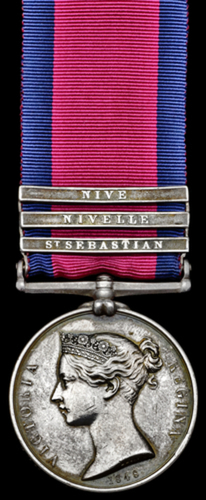
Military General Service 1793-1814, three clasps, St. Sebastian, Nivelle, Nive (John Burke, Corpl. 1st. Foot Gds.), minor edge bruise, good very fine
Corporal John Burke, born Caterland, Co. Kerry c. 1787; enlisted in the 1st Foot Guards, August 1812; served with the 1st Battalion in the Peninsula from Autumn 1812, and present as one of 40 volunteers from the Battalion at the siege and capture of St. Sebastian, 31.8.1813; subsequently served with the 3rd Battalion, in Lieutenant-Colonel H. D´Oyly´s Company, during the Waterloo Campaign, 16-18.6.1815 - as part of the 1st Guards Brigade the Battalion was heavily involved in the fighting at Quatre Bras, 16.6.1815; and distinguished themselves on the day of the Great Battle by defeating the Imperial Guard . As a result of their heroism and the significance of their contribution to the Battle the 1st Foot Guards were re-styled the Grenadier Guards, a unique occasion in the history of the British Army of a title being won on the battlefield. The 3rd Battalion in particular sustained 59% casualties, including their Commanding Officer.
700 Lashes
In November 1823, Burke was part of the detachment tasked with guarding the Bank of England. At a General Court Martial held at the Tower of London, 17.11.1823, the following charges were read out:
Charge 1: For being in liquor when for the Bank Piquet on the afternoon of Friday the 7th day of November 1823.
Charge 2: For highly unsoldierly and mutinous conduct in fixing his bayonet and coming to the charge with it on Sergeant Andrew McFarlane and threatening to run him through the body if he approached him.
Charge 3: For highly unsoldierly and mutinous conduct in refusing to go to the Guard Room when ordered by Drill Sergeant Charles Graves of Lieutenant-Colonel Higginson´s company and coming to the charge on the said Drill Sergeant Charles Graves with his bayonet fixed and defying the said Drill Sergeant to confine him, declaring that he would not be confined but by an officer.
Charge 4: For resisting the escort sent from the Main Guard to secure him and threatening to use violence towards them.
Burke was found guilty on all charges and sentenced to 700 lashes. The sentence was approved and carried out in full.
Burke was discharged in September 1829, after 19 years and 84 days with the Colours, and subsequently emigrated to Montreal, Canada. In 1850 he applied for an increase in pension on the grounds of age and infirmity, stating that he had been severely wounded at Waterloo. The Board´s decision was ´Nil. Character indifferent. No mention of wound.´
Provenance: Sotheby, February 1912
Glendining, March 1969
Sold for
£2,800


Watch, listen and bid as if you were in the room. Now available for auctions worldwide.
Click here to bid live
An exclusive and confidential service for the discerning collector or vendor.
View the Gallery
Download every Spink catalogue on your iPad, iPod or iPhone using free Spink app.
Download From iTunes© 2026 Spink & Son. All rights reserved.