
Auction: 13001 - Orders, Decorations, Campaign Medals and Militaria
Lot: 12
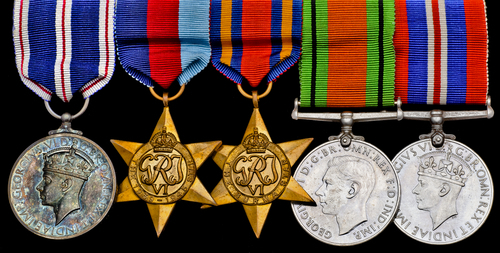
The Second War 1942 ´Retreat from Myitkyina´ K.P.M. for Gallantry Group of Five to ´Last-Ditcher´ Major G.J.K. Stapleton, Burma Frontier Force
a) King´s Police and Fire Service Medal, for Gallantry, G.VI.R. (Capt. G.J. Stapleton. I.A., Burma Frontier Force)
b) 1939-1945 Star
c) Burma Star
d) Defence and War Medals, nearly extremely fine, mounted as worn, with the following related items:
- The recipient´s related miniature awards; 1st Kumaon Rifles gold lapel badge; and belt buckle
- The recipient´s hip flask, carried by him during the Retreat
- Portrait photograph of the recipient
- ´Retreat from Myitkyina´, the recipient´s account of his time in Burma (5)
K.P.M. for Gallantry London Gazette 1.1.1943 Captain Gregory Joseph Stapleton, Indian Army, Burma Frontier Force.
The recommendation states: ´Captain Stapleton was on active service with a unit of the Frontier Forces in Minbu, where he was wounded. He refused to be evacuated to India and arrived in Myitkyina at the beginning of May [1942]. When Myitkyina was bombed on the 6th and 7th May he did excellent work in assisting to remove refugees to the hospital, and then made his way to the Hukawng Valley.
On arrival in the Hukawng Valley, Captain Stapleton, who had no men of his own under his command, collected nearly 300 Chin members of the Frontier Force who were stragglers and formed them into a disciplined body and inspired them with his own devotion to duty. With their aid he was able to clean up camps and villages along the refugee route; he disposed of corpses, protected civil officers collecting and distributing rations, and rendered aid to the sick and dying along the road; he also enforced order and discipline among the refugees generally. By this devotion to duty and voluntary assistance to the civil administration he and his men were delayed in their journey to India until after the monsoon had broken in full force, the streams had risen, and the chances of contracting a fatal disease greatly increased. He thereby jeopardised his own chance of reaching India safely. Owing to a fortunate break in the weather he was able to continue his journey and he and his men continued to preserve order along the route from which the forward camps of the Assam refugee organisation had been forced to withdraw.
Captain Stapleton´s action did much to restore confidence among the local villagers living near the route thus enabling civil officers to enlist the services of these villagers later in assisting refugees. Captain Stapleton´s devotion to duty is all the more praiseworthy since he had not fully recovered from the effects of his wound and at no time was he really fit.´
Major Gregory Joseph Kenneth Stapleton, K.P.M., born 1.9.1908, the son of Commander Gregory Stapleton, R.N.; Commissioned Second Lieutenant, Indian Army, 7.2.1936; promoted Lieutenant, 1.3.1936; Captain, 18.3.1939; served with the Burma Frontier Force during the Second War, and took part in the final evacuation of Burma.
Retreat from Myitkyina
´By the 6th May 1942 Burma had been lost. Far up in the north one aerodrome remained in our hands at Myitkyina. From this the Governor of Burma, Sir Reginald Dorman-Smith, on direct orders from Churchill, had lately been flown out, and from it transport planes were trying to get out as many sick and wounded refugees as possible. I arrived in Myitkyina in the middle of an air alarm on the last train to run under British Command in Burma for many a long day. The road leading out of the town was choked with a mass of refugees, many driving bullock carts. Nowhere was there any sign of discipline. It was a complete and utter rout, the very dregs of our defeat. I had a flesh wound in my leg so I could only keep going, riding a pony, which was impossible on small paths and game tracks. Three days later the track crossed a steep range of hills winding among Kachin villages. Not surprisingly, there was little sign of the inhabitants. We were heading for Maingkwan which lay to the west, but had no idea if that place was in Jap hands or not. That evening we arrived in Maingkwan which, except for refugees, was quite empty. It was a sizable town and was the centre of the jade trade before the War. By now the question of food was getting worrying. We had enough rice and flour for a few days but certainly not enough to get us to India. The only thing was to press on. On the road leading north out of Maingkwan we encountered the long line of dead and dying which was to last till we came to safety in Assam, weeks later. Some were lying in the watery mud, some on drier spots where they had lain to rest, and with this terrible, macabre, heartrending line came the stench of corpses. At night we generally found a village abandoned by the inhabitants, but every sleeping place taken up, with here and there a miserable smoking fire. At one village, called cholera camp, everywhere we looked we saw the dead and dying from this terrible sickness. There was a hut in the village full of rice in bags, but on the bags were corpses, so few would take the food.
A day or two later we reached the Cindwin River which was in full spate and, at the place we came to, perhaps half a mile wide. After crossing the river by canoe, a journey rendered extremely hazardous by the enormous trees which were continuously being carried down past us and which we could only pray would not ram us, we continued north. We were now out of the swamp area and the paths were much drier, though the stream of dead and dying grew every day more terrible. After two days we reached a village where there was a food dump but, as usual, there were corpses in it and under it. Worst of all, right in under the piles set, perhaps four feet apart, was a bullock, very dead indeed- and one fully appreciated that even the starving felt no enthusiasm for drawing rations from the store. A rope was soon found abandoned in a hut with which to try and remove the bullock, but it was obvious that I was expected to set the example by tying the first knot to the animal. The bullock was a long way in among the piles, and one whiff would have made anyone sick- the sight of it nearly accomplished that alone. However, I managed to get a knot on somehow, and we extracted the bullock and made a huge bonfire of it, and other unpleasant remains round about.
After issuing the food in the hut we went on our way, and after two more days we reached Shwinbwiyang. Here we found a big area of dry paddy fields near which there was a village. Aircraft from India had contacted this place and were dropping supplies daily while the weather was fine. Here we found that a Major, who was pretty relieved when I told him that I had a force with me, and that I would take over so that he could try and get on himself. The first thing we did after taking over was to pass round orders to the great number of refugees collected here- about three thousand- that anyone touching stores dropped from the air would be shot on sight, and no one was to go on the dropping ground during a drop until all stores were collected. We were forced to take this rather high-handed action as the people were fighting amongst themselves for the food and the sick, women, and children were getting a very bad deal. Some of the stronger and better armed, particularly Sikhs, were cornering large quantities of food and setting up shop, selling at exorbitant prices. Soon we had a good organization of issuing stores in full swing. We made a hospital from a large hut so that, at least, the sick could get food and water. We could do little more that this for them. A medical orderly called Katz had joined up with us and helped a lot in this. Every day we carried out the dead and burnt them. Many of the patients had cholera, but believing I had had an anti-cholera injection shortly before, I had no fear of contracting the disease. Later on, going through my records, I discovered that the injection had been for something quite different!
A few days later the rains broke and the men could not be asked to stay on here any longer, so we decided to go, taking enough food for one good meal a day for five days. Katz the medical orderly volunteered to stay on until he might be rescued until after the rains were over. This was an extremely brave act as the chances of his survival were at least ten to one against. In the event he did survive and was rescued by a column some months later. For this he was awarded the George Medal- an award, in my opinion, sadly insufficient. We set off at dawn and were soon winding through terrible jungle along a narrow twisting path. About mid-day we came to the first stream, already at least six foot deep and fast running. By felling a tree we managed to scramble across, followed by the crowd of refugees who had collected there. From now on the way led ever upwards into the Pat Kai Range and grew nightly colder. All the time we went through the same terrible scenes of death which had preceded Shwinbwiyang. My job was now to see that a sufficient distance was done each day and to find a suitable place to camp for the next night. This was not easy as we had to find water and many streams were fouled by the dead lying in them. After some days we came to a village where aeroplanes were dropping supplies. We camped above the village for the night. In the morning there was an air drop and I went down to see what was happening. The scene was indescribable chaos. As the bags fell the bigger and stronger rushed to get what they could. Armed gangs threatened anyone weak enough and seized what food they might have. Shops were set up which enabled those with money to get something- the thousands of weak and sick did without. We succeeded in restoring order though it was first necessary to shoot. As there were, we estimated, some three thousand people in this place, of whom perhaps seven hundred were armed, our maintenance of order was a complete bluff. The rains, accompanied by mist, now set in hard and though we heard planes overhead several times, they could not find us. Five days went by and the situation became desperate. At the village below was the river cutting us off from going forward. According to reports it was two hundred yards wide and in full flood, and a Major and one hundred and fifty people had been drowned trying to cross. We lived there for five days on a maize cob per man per day until even these, found in a village field, ran out. Every day more and more people died. We found a gang of sweepers, complete with leather helmets which had been part of their uniform, and got them to collect the dead daily and cast them down a deep ravine. It was reminiscent of the great plague as this gang went from house to house each morning, calling "Bring out your dead."
On the sixth day the clouds cleared somewhat but the planes still failed to see us. Walking by the stream thinking of some method of attracting attention, I saw some clothing a woman had washed and left here. We issued an order that every white article of clothing must be washed and produced. A large collection came in and with these we wrote on the hillside: "3,000 SICK STARVING S.O.S." The planes saw it. Down came the drop, five planes on that day alone and many after. Now we had some food the next thing was to try and get on, so I took twelve Lushai down with me to the river. The ford was, as we had heard, many feet deep, at least two hundred yards across, and coming down in a raging torrent. The only hope lay in a narrower gorge which we found lower down. We found a suitable spot and making a rope from parachute lines wound together produced a rather hazardous means of getting across. The Lushai are magnificent in mountain streams, and we were lucky to have them. Hastening back to camp I was met by a messenger to say that a plane had dropped a message from General Wood in India. It stated that the way forward was quite impossible, and that the only hope was to try to get back to Shwinbwiyang. We went into conference. Shwinbwiyang was unthinkable, but was there an alternative route? We decided to push on, in the hope that new dropping points might be opened or elephants sent out to rescue us. After crossing the river there was a terrible climb which proved too much for many. But now and again there occurred something of a break in the rains so, in spite of General Wood´s warning, the rest of the way was no worse than what we had previously gone through. After several days we met the first of the camps pushed out from India by the Tea Planters Association of Assam. After that, though there were several days more, it was only walking from camp to camp. At last we reached the little town of Margarita [a name shared by Stapleton´s fiancée], so named by the Italian engineers who built the railway line for the coal mines nearby. It seemed a good omen! On arriving in Ledo, without having lost a single weapon, there followed a long spell in hospital. I weighed seven stone instead of my usual eleven, and peering at my hospital card one day I saw "Malignant malaria, benign malaria, suspected typhoid, semi-starvation, and influenza." It seemed enough for one man.´ (Abridged version of Retreat from Myitkyina refers).
For his gallantry in the retreat through Burma as one of the real "last-ditchers", Stapleton was awarded the King´s Police Medal; his two senior G.C.O.´s received the Burma Police Medal; and every man who served under him for the duration was either promoted or granted a month´s extra pay. Subsequently promoted Major, Stapleton married Margarita Chamberlayne in 1945; he died in 1982.
Sold for
£4,000


Watch, listen and bid as if you were in the room. Now available for auctions worldwide.
Click here to bid live
An exclusive and confidential service for the discerning collector or vendor.
View the Gallery
Download every Spink catalogue on your iPad, iPod or iPhone using free Spink app.
Download From iTunes© 2026 Spink & Son. All rights reserved.