
Auction: 12002 - Orders, Decorations, Campaign Medals & Militaria
Lot: 285
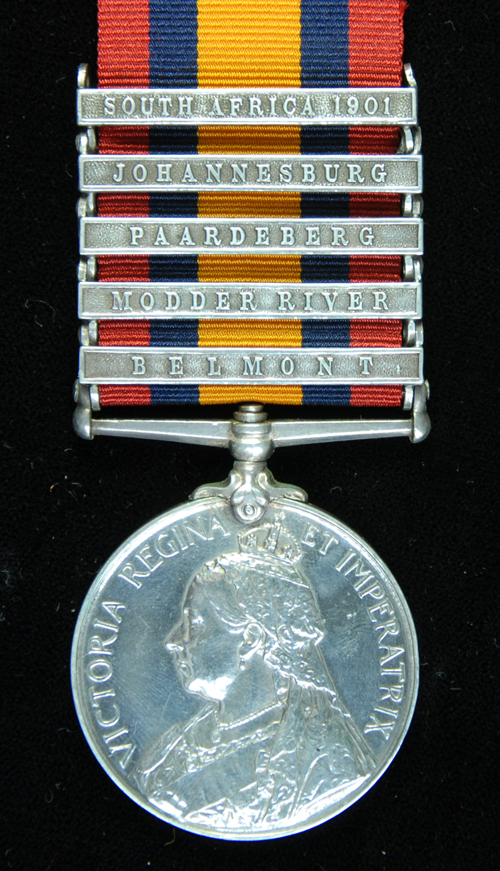
Queen´s South Africa 1899-1902, five clasps, Belmont, Modder River, Paardeberg, Johannesburg, South Africa 1901 (Major H.J.W. Farrell. 75/By: R.F.A.), unofficial rivets between 4th and 5th clasps, very fine, with three photographic images of the recipient in uniform Estimate £ 400-500 Major Henry John William Farrell, born 1867; commissioned Second Lieutenant, Royal Artillery, 1887; advanced Captain 1897; served Second in Command with the 75th Battery, Royal Field Artillery, during the Second Boer War; during which he joined the advance on Kimberley, took part in the actions at Belmont (where he was wounded, 28.11.1899), Enslin, Modder River (Mentioned in Lord Methuen´s Modder River Despatch, 28.11.1899 - "Captain Farrell, wounded a second time, continued to do his duty having first placed a wounded man on one of the carriages") and the action at Magersfontein, where ´Once more all honour to the guns which saved us, as they saved us at Magersfontein, which were fought on an open plain where no infantry could stand erect within 900 yards of the enemy´s trenches. In the 75th Field Battery, which was the most exposed, Captain Farrell, who had been shot through the left leg four days before at Belmont, was shot through the right at the Modder, but, declining to be invalided, was with his guns at Magersfontein, and Major Lindsay, wounded in the hand, also refused to be laid by. That is how the Royal Artillery understands "Ubique"´; Farrell took part in the operations in the Orange Free State, February to May 1900, including those at Paardeberg and the actions at Poplar Grove and Zand River; was present in the action near Johannesburg and Pretoria and From July to 29th November, took part in the operations west of Pretoria, which included the action at Zilikat´s Nek; Farrell distinguished himself again during the Boer attack on a convoy at Buffelspoort, 3.12.1900, ´the first section, numbering 138 wagons and occupying a mile and a half of road was preceded by one company of the West Yorkshire Regiment, 70 strong, and two guns of the 75th Battery, with an escort of 21 men of the Yorkshire Light Infantry. Another weak company of the West Yorkshire Regiment formed the rearguard, and the whole was under Major Wolrige-Gordon, of the Argyll and Sutherland Highlanders... Soon after daylight on the 3rd, when the head of the advanced guard had reached the difficult ground around Buffelspoort... a party of 600 Boers under De la Rey and J.C. Smuts, advised by their spies of the weakness of the escort, burst suddenly upon the centre and rear of the convoy and made a prize of it. When the attack began, Gordon, who was with the advance guard, took post with half a company and the guns on a rocky knoll close to the road, and sent his other half company to a commanding hill 400 yards distant. But the greater part of the convoy, owing to the nature of the ground, was out of sight of the advanced guard, and the brunt of the attack fell upon the weak company of the rearguard, which, in spite of stout resistance, was overwhelmed by weight of numbers and captured at 1pm. Looting and burning the waggons, the Boers worked their way to the head of the convoy and delivered a fierce attack upon Gordon and the guns. The detached half-company shared the fate of the rearguard, but Gordon, Captain Farrell (commanding the Artillery) and Lieutenant Lowe, with their gallant remnant of Yorkshiremen and gunners, made a superb stand. At dusk, after several hours´ fighting, most of the gunners and many of the escort had been shot down: Farrell was serving a gun himself; there were but two shells left, and the infantry were awaiting the final onset with fixed bayonets. But De la Rey had obtained all he wanted and preferred to let alone these desperate survivors. 138 wagons, 1,832 oxen and 75 prisoners had fallen into his hands; while Gordon´s casualties were 18 killed and 22 wounded´ (The Times History of the Boer War, refers); the following is added by the Official History of the Boer War, ´The guns - finely commanded by Captain H.J. Farrell RA, an intrepid officer, who when many of his men were down, armed the rest with rifles taken from the slain, and laid the field pieces himself - were run trail to trail, and with depressed muzzles shattered the front of the Boer charge at only forty yards distant with case shot and shrapnel fused to zero´; Farrell was mentioned in despatches again and received his Brevet of Major; he served in the operations in the Transvaal, May - August 1901 and those on the Zululand Frontier of Natal, September - October of the same year (Mentioned in Despatches); Major 1902; retired 1910. Provenance: Christie´s, April 1991
Sold for
£950

Watch, listen and bid as if you were in the room. Now available for auctions worldwide.
Click here to bid live
An exclusive and confidential service for the discerning collector or vendor.
View the Gallery
Download every Spink catalogue on your iPad, iPod or iPhone using free Spink app.
Download From iTunes© 2026 Spink & Son. All rights reserved.