
Auction: 11011 - Orders, Decorations, Campaign Medals & Militaria
Lot: 5
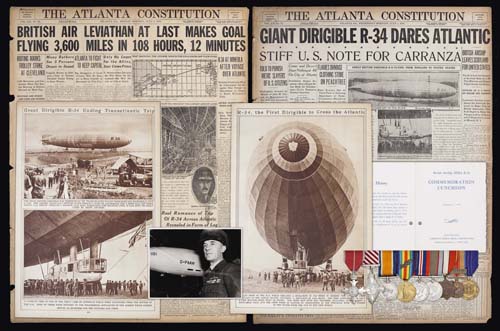
The 1937 ´Shanghai Emergency´ Military Division M.B.E., Extremely Rare ´R34´ A.F.C. Group of Nine to Second Lieutenant, Later Major-General, J.D.E. Shotter, Royal Naval Air Service and Royal Air Force; The Engineer Officer For R34´s Epic Flights Over the Atlantic in July 1919 - The First Return Atlantic Crossing By Air. Hailed as ´The Hero of the Flight´ Shotter Went on to Have a Very Colourful Career that Spanned Five Decades and Four Continents, Including as A Technical Advisor to Chiang Kai-shek a) The Most Excellent Order of the British Empire, 2nd type, Military Division, Member´s (M.B.E.) breast Badge, silver, in Royal Mint case of issue b) Air Force Cross, G.V.R., unnamed as issued c) British War and Victory Medals, M.I.D. Oakleaves (2/Lieut. J.D.E. Shotter. R.A.F.) d) War Medal (V143810 J.D.E. Shotter) e) Australia Service Medal (V143810 J.D.E. Shotter) f) Shanghai Municipal Council Emergency Medal 1937 g) Japan, Empire, China Incident 1937 Medal h) United States of America, Army Meritorious Civilian Service Medal, reverse engraved in sans-serif capitals, ´John D. Shotter´, light contact marks overall, generally very fine, with the following related items and documents: - Menu from R34 Commemorative Lunch, Sponsored by the American Bosch ARMA Corporation, and held at the Roosevelt Field, Long Island, New York, 15.12.1958 - Original copies of The Atlanta Constitution, dated 2.7.1919, 3.7.1919, and 7.7.1919; The Boston Post, dated 10.7.1919, all headlining the story of the flight of R34 - Five extremely comprehensive files of research, replete with copies of articles, letters and reports relating to the recipient and R34, and several photographic images of recipient (lot) Estimate £ 3,500-4,500 M.B.E. London Gazette 9.6.1938 Captain John Denham Shotter, A.F.C., Shanghai Volunteer Corps. A.F.C. London Gazette 23.8.1919 2nd Lieutenant John Durham [sic] Shotter ´In recognition of distinguished services rendered to Aviation, in the successful voyages of Airship R.34 from the United Kingdom to the United States of America and back :- Outward journey. Left East Fortune at 1.42am, 2nd July, 1919, and arrived at Hazelhurst Field [sic], Long Island, at 1.54pm (G.M.T.), 6th July, 1919. (Duration, 108 hours 12 minutes). Homeward journey. Left Long Island 3.54am (G.M.T.), 10th July, 1919, and arrived at Pulham, Norfolk, at 6.57am, 13th July, 1919. (Duration, 75 hours 3 minutes.) Major-General John Denham Erwin Shotter, M.B.E., A.F.C. (1890-1974), born Freshwater, Isle of Wight; educated at Buxton College; employed as an Engineer at Vickers Ltd, Birmingham, 1912-1915; enlisted Royal Naval Air Service as a Petty Officer Mechanic, 12.11.1915; service during the Great War included at H.M.S. President II, November 1915-January 1917, and at the following Airship Stations: R.N.A.S. Longside, Aberdeen; R.N.A.S. Pulham, Norfolk and R.N.A.S. Howden, Yorkshire; commissioned Second Lieutenant, Royal Air Force, 1.4.1918; posted as Engineer Officer to Inchinnan, Scotland, to help with the construction of R34, October 1918; having seen the huge airship riveted together piece by piece Shotter obviously knew the R34 inside out, and as such was perfectly placed to be Major George Scott´s (the Skipper of R34) right-hand man and the Engineering Officer for the airship´s attempt at the first return Atlantic crossing by air. To America and Back - An Engineers´ View Shotter was a member of the very seasoned crew that embarked upon R34´s epic flight over the Atlantic in the early hours of 2.7.1919; the conditions are well known to have been rough for all of the crew as were the stresses involved during the flight, however, the constant strain placed upon Shotter to keep R34 airborne was a greater physical burden than placed upon anybody else during the flights (perhaps with the exception of the Skipper); by day 2 of the voyage Maitland records (in the daily log that he kept), ´Lieutenant Shotter, Engineer Officer, who, through many causes has been prevented from getting his fair share of sleep, is beginning to feel rather exhausted, and is dosed with aspirin by Luck, who is our amateur doctor for the voyage in addition to his duties as Third Officer´; the main issue for Shotter was his constant battle with the five Sunbeam engines that were to power the huge Rigid Airship; their deficiencies and Shotter´s ingenuity became apparent with almost immediate effect, ´trouble with starboard amidships engine. Engine stopped. No details yet. Engine restarted. A small screw on water jacket had worked loose, and this has been made secure with a piece of copper sheeting and the entire supply of the crew´s chewing gum (which was hastily chewed first by Engineer Officer and two engineers!´ (Ibid); days 3-4 were to be the most tortuous of the journey for Shotter - the weather worsened which meant petrol consumption increased as the engine productivity decreased; by day 3 they had used 75% of their petrol supply with well over a 1,000 miles still to go to reach their landing site on Long Island, ´as the flight went on, John Shotter grew increasingly anxious about the petrol supply. The Sunbeam ´Maori´ engines in his charge were drinking petrol at a faster rate than had been expected. Every time R34 ran into a westerly wind her fuel consumption shot up alarmingly. With Guy Harris, the R34´s meteorologist, predicting strong winds off the American continent, Shotter had good reason to be worried´ (Flight of the Titan, The Story of the R34, G. Rosie, refers); by day 4, having started with 5 engines the airship was down to 3, and it now encountered the worst weather of the trip going over the Bay of Fundy on the Atlantic coast of North America, ´We are just getting into Fundy Bay. The petrol supply is distinctly serious. Shotter has been totalling up our available resources with ever-increasing anxiety. We cannot now afford to run all five engines at once, as they would eat up too much petrol. We have 500 miles yet to go to New York, and if we don´t get any wind or bad weather against us can do it alright on three engines, assisted occasionally by a fourth´ but as Maitland then goes on to record later the weather was not as they would have hoped for, ´It is difficult to estimate the size of these storms, but as the squalls which hit the ship were about 50 miles from the storm itself, the area covered must have been many thousands of square miles.... Shotter happened to be lying full length alongside drogue hatch when the last squall hit us and, when ship´s nose first went down, would have slid through hatch into sea if he had not hooked a girder with his foot!´; with their goal so close and yet looking so desperately unreachable, Shotter pulled out all the stops to reach Mineola and thus make history, ´In the early hours of Sunday morning John Shotter whistled up a squad of engineers and riggers equipped with cups, pots, jars and anything else that could hold liquid, to scoop every last drop of petrol from the dregs of the petrol tanks and pump it into the feed tanks to the R34´s five engines. It worked, but only just. By 07.20 the R34 was over Montauk with no need to land. By 08.00 it was clear they had enough fuel to Mineola´; by 09.30, 6.7.1919, the crew were staring down at the gathering crowds waiting to welcome them at Roosevelt Field, Mineola, Long Island, ´It is a bright clear morning, and we can see a long line of motorcars of every sort and size streaming out from New York to see us come in. There is a large motor enclosure half a mile long, where cars are standing - already six deep. I find myself mechanically counting the rows - an enormous multitude of people are gazing up at us, and a military band is playing in front of a grandstand erected for the occasion´ (Maitland refers); the first ever east-to-west flight across the Atlantic had taken 108 hours and 12 minutes, with most supplies gone and more tellingly only enough petrol left for approximately one hours´ flying. Burning the Candle at Both Ends As the crew marched out of the airship to the cheers of thousands of well-wishers they became instant celebrities - something for which a lot of them were totally unprepared for; one of the photographs ´published by the New York Times shows seven of the R34´s officers standing awkwardly in line and the only one that looks like he´s enjoying the attention is Maitland. In his white flying suit and with the brass on his peaked hat gleaming, he stands out among the dowdier uniforms. By contrast John Shotter, the hero of the flight, looks downright scruffy´ (Flight of the Titan, The Story of the R34, G. Rosie, refers); with the media whipped up into a frenzy the crew were rushed off to various functions over the course of the next few days, with barely a moment to themselves or more importantly to rest, ´By the time we reached Boston I had been without sleep for almost 80 hours and on landing at Mineola I passed out...... As the Engineer Officer of the ship on her journey across the Atlantic, I soon discovered many technical shortcomings that it had been impossible to anticipate, and which imposed a considerable strain on the engineering section of the crew, even during the brief rest periods. And of course there were accidents such as when a rigger allowed the lid of a stewpan to fly off in the slipstream, where it was caught by the propeller and thrown against the envelope. In order to inspect the damage, I had to crawl out into the slipstream over the roof of the starboard gondola - not a pleasant job, with nothing else between me and the Atlantic 3,000 ft. below...... I was taken to the Ritz Carlton in New York where - still rather dizzy - I was besieged by reporters in my room on the sixteenth floor. Apparently I had staggered as I looked down over Broadway, for my photograph appeared in the morning newspaper over the caption ´Gallant Englishman flies the Atlantic and faints at the sight of height.´ (Foreword provided by Shotter in Atlantic Airship, by P. Abbot, refers). Here We Go Again R34´s ´sojourn in the USA was not all wining and dining, at least not for everyone. There was work to be done. In the four days the airship had spent over the Atlantic it had taken quite a hammering. There were rents in the outer fabric to be repaired, some minor leaks in the hydrogen bags and the troublesome Sunbeam engines had to be stripped down, overhauled and parts replaced. Shotter and the engineers were kept busy cleaning carburettors and magnetos´ (Flight of the Titan, The Story of R34, G. Rosie, refers); it must have been to Shotter´s great relief when an increased petrol load was taken onboard for the return leg of R34´s trip; thankfully for him the strains of the 10th-13th July were not a repeat of those experienced on the east-to-west flight of a few days earlier; apart from the customary engine failure Shotter arrived at Pulham, Norfolk a relieved man; in the days following his return Shotter produced a detailed report for the Air Ministry on the machinery of R34, ´On Monday, 25 August, the press announced the awards for the R34´s crew... There was a C.B.E. (Military Division) for Scott, Air Force Crosses for Maitland, Cooke, Harris and Shotter and Air Force Medals for five Other Ranks - Gent, Mayes, Robinson, Ripley and Scull.´ (Ibid) Now to Explore the Other Side of the World Having been discharged in 1922 Shotter travelled to China in the 1930´s where he was employed as Chief Engineer and Traffic Manager of the China General Omnibus Company in Shanghai; he was appointed Officer Commanding The Transport Company, Shanghai Volunteer Corps, 1.1.1936; he moved to Australia for service during the Second World War, where he was commissioned Major, Corps of Australian Electrical and Mechanical Engineers, November 1941; transferred to the Reserve of Officers, 16.4.1946; in later life, after a very varied and well travelled career, Shotter went on to make several claims about his life as illustrated in an interview that he gave to the Washington D.C. based Star Magazine: ´Although his pioneering exploits have been obscured by time and the obliterating roar of jets, John D. Shotter can claim a fat share of "firsts" in aviation history. Examples: - First man to step on American soil from a trans-Atlantic flight. - First sender and deliverer of trans-Atlantic air mail. - First Englishman to land an airplane on a ship deck. - First engineer of the first passenger airship. - And a developer of Australia´s first bomber and first major air force. A deceptively youthful 68, Mr. Shotter is anchored to a desk today as a civilian executive in the Amry´s transportation centre here. A quiet reserved man, he looks back unemotionally on a many-sided career that has spanned five decades and four continents. In addition to his aerial achievements, he was a long-time technical adviser to China´s Generalissimo Chiang Kai-shek, a rehabilitator of Japan´s automotive Industry after World War II, a leading defender of Shanghai´s international settlement against both Chinese and Japanese assaults in 1937..... He was engineer commander of the British Dirigible R34, the first aircraft to cross the Atlantic both ways...."I didn´t expect to get home again, to tell the truth," Mr. Shotter admits. "The R34 was virtually untested when we took off from East Fortune, Scotland, on short notice. Britain, at the time, was anxious to cement relations with America, and our flight was planned hurriedly to express this feeling and to demonstrate the commercial possibilities of airships. We carried messages between King George V and President Wilson. Being first off the ship, I delivered the first trans-Atlantic air mail. I also dropped the first air-mail postcard. Above Newfoundland, I addressed it to my wife, then tossed it over. I learned later it lodged in a tree, where a trapper found it. He took it to his postmaster, and it arrived at my home about four months later. I still have it."...... Following his service aboard the R34, he was assigned to the R36, the first passenger airship. "I flew in her about a year," he said. "She crashed in 1921, and I was one of the few aboard lucky enough not to be killed."....... When Great Britain entered World War II, he went to Australia and joined that country´s Aircraft Production Commission....... "After the war, I ..... went to Japan to help rehabilitate the automotive industry there. In Japan, I met Gen. (Frank S.) Besson, now Chief of Transportation for the Army. He sponsored me, as an alien, into your civil service, and in 1954 brought me and my wife to Fort Eustis. "I owe a tremendous debt of gratitude to America and Gen. Besson. I love my work. I´m Deputy Civilian Chief of the Combat Development Group, which forecasts all Transportation Corps material needs. It´s my kind of work - up in Cloud 9 all day."´ Returning closer to home, Shotter lived out the rest of his life on Sark, Channel Islands.
Sold for
£5,800


Watch, listen and bid as if you were in the room. Now available for auctions worldwide.
Click here to bid live
An exclusive and confidential service for the discerning collector or vendor.
View the Gallery
Download every Spink catalogue on your iPad, iPod or iPhone using free Spink app.
Download From iTunes© 2026 Spink & Son. All rights reserved.