Auction: 11011 - Orders, Decorations, Campaign Medals & Militaria
Lot: 47
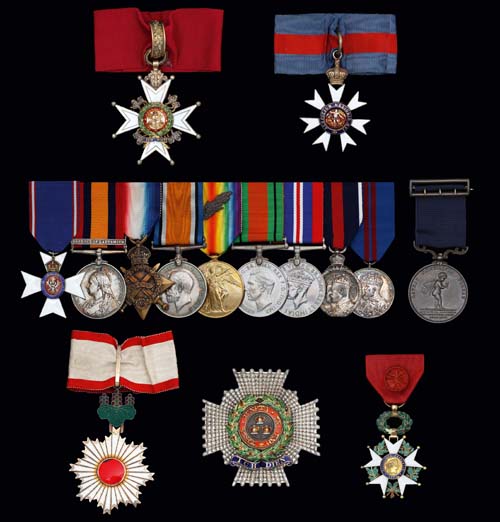
The Important K.C.B., C.M.G., M.V.O. Group of Fourteen to Admiral Sir Michael Hodges, Royal Navy, Who as a Young Lieutenant Commanded One of H.M.S. Powerful´s 4.7. inch Naval Guns During the Defence of Ladysmith; Hodges Commanded the Battlecruisers Indomitable and Renown During the Great War, Before Being Appointed Chief of Staff to Admiral Sir Charles Madden; After the War Hodges was Appointed Second Sea Lord and Commander-in-Chief of the Atlantic Fleet a) The Most Honourable Order of The Bath, Military Division, Knight Commander´s (K.C.B.) set of insignia, neck Badge, silver, silver-gilt, and enamel; Star, silver, silver-gilt, and enamel, minor green enamel damage to Star b) The Most Distinguished Order of St. Michael and St. George, Companion´s (C.M.G.) neck Badge, silver-gilt and enamel c) The Royal Victorian Order, Member 4th Class (M.V.O.) breast Badge, silver-gilt and enamel, the reverse officially numbered ´914´, enamel flaked on top arm d) Queen´s South Africa 1899-1902, one clasp, Defence of Ladysmith (Lieut: M. H. Hodges, R.N. H.M.S. Powerful), impressed naming e) 1914-15 Star (Capt. M. H. Hodges, M.V.O. R.N.) f) British War and Victory Medals, M.I.D. Oakleaves (Commre. 2 Cl. M. H. Hodges, R.N.) g) Defence and War Medals h) Coronation 1902, silver i) Coronation 1911 j) France, Republic, Legion of Honour, Officer´s breast badge, gold and enamel, minor blue enamel damage, with rosette on riband k) Japan, Empire, Order of the Rising Sun, 3rd Class neck Badge, silver-gilt, enamel, and red cabochon in centre l) Royal Humane Society, small bronze medal (Unsuccessful) (Commander M. H. Hodges, R.N. 2nd Oct. 1904) complete with bronze top riband buckle, generally good very fine (14) Estimate £ 6,000-8,000 Admiral Sir Michael Henry Hodges, K.C.B., C.M.G., M.V.O. (1874-1951), entered Royal Navy as a Cadet aboard the Training Ship Britannia, 1887; appointed as Midshipman to H.M.S. Swiftsure, 1889 and to H.M.S. Warspite in June the following year; promoted Acting Sub Lieutenant whilst serving with H.M.S. Boscawen, 1893, and later confirmed in this rank with the same seniority; subsequent service included with the Excellent, Tribune and Gleaner, before being appointed to the Royal Yacht Victoria & Albert in July 1895 and promoted to Lieutenant on 28 August 1895; served as Lieutenant in H.M. Ships Volage and Powerful; whilst serving with the latter Hodges was landed in South Africa as a member of the ship´s Naval Brigade sent to defend the town of Ladysmith; he was mentioned in Captain H. Lambton´s Despatch of 11.1.1900, as ´being in Command of a 4.7 inch gun at Cove Redoubt and Junction Hill and fought it with great skill and coolness, under, at times, a very accurate and plunging crossfire from the enemy´s guns of much heavier calibre, during the first fortnight of the siege´; he was also mentioned in General Sir George White´s Despatch of 2.12.1899, ´The following Naval Officers have been brought to notice by General Officers Commanding or Officers Commanding units... Lieutenant M. Hodges, R.N...... to be noted for early promotion to Commander´; he was awarded the Royal Humane Society´s Testimonial on Vellum, as Lieutenant of Powerful, 19.5.1899, for jumping overboard in Manilla Bay, and with assistance saving a seaman who had fallen from the ship; in recognition of his services in South Africa Hodges was, in July 1900, granted the Freedom of the Borough of Dorchester, and presented with binoculars and a silver inkstand; he held command of Flint and Crane, before being appointed as 1st Lieutenant of H.M.S Caledonia; promoted to Commander, 26.6.1902, and in connection with the Coronation Fleet Review was appointed to the Enchantress; he next joined President, for R.N. College Greenwich, Hermes and Prince George; whilst in Hermes, he was awarded the bronze medal of the Royal Humane Society for gallantly attempting to save Commander Melvill, who was drowned at Portland on 2.10.1904, on a very dark night, with a rough sea on; Hodges returned to College for Senior Officer´s Gunnery Course in June 1905, and then took command of H.M.S. Sappho; he received the thanks of the Colonial Office for assistance rendered by the Sappho during the riots in British Guyana in 1905-06, and was specially promoted to Captain on 31.12.1908, in recognition of services rendered during the disturbances at Iquique; appointed to the command of H.M.S. Doris, July 1910, and to the command of H.M.S. Cornwall in December of the following year; appointed Naval Attaché in Paris prior to the outbreak of the Great. War (made M.V.O. on the occasion of the King´s Visit to Paris in April 1914, and for his services as Naval Attaché received the Legion of Honour from the French Government); he also received the thanks of the War Office for his services while acting for the Military Attaché in connection with the purchase of aeronautical material in France; during the early stages of the War he was utilised as Divisional Naval Transport Officer at Salonika; a week after the battle of Jutland, he was appointed to command H.M.S. Indomitable, in the Second Battle Cruiser Squadron, Grand Fleet; appointed to the Command of the new battle cruiser Renown, the following year, and in 1918 he was posted as Commodore 2nd Class, Chief of Staff to Admiral Sir Charles Madden, Second in Command of the Grand Fleet; on the dispersal of the Grand Fleet in 1919 and the appointment of Sir Charles Madden as Commander in Chief, Atlantic Fleet, Hodges accompanied him to the Queen Elizabeth as Chief of Staff, and was promoted to Commodore 1st Class (C.B. and C.M.G. 1919; Russia, Order of St Anne, 2nd class, 1916; and Japan, Order of the Rising Sun, 3rd class, 1917); after the War he was appointed Rear-Admiral Commanding the Destroyer Flotillas of the Atlantic Fleet and in 1923 he was appointed Naval Secretary to the First Lord of the Admiralty; whilst in the latter post Hodges was promoted to Vice-Admiral; early in 1925 he hoisted his flag in the Iron Duke as Second in Command on the Mediterranean Station, transferring it later to the Barham (K.C.B.); after two years´ service in Command of the Barham he returned home and was appointed Second Sea Lord; he held this post until 1930, and was meanwhile promoted to Admiral in 1929; from the Admiralty he went direct to be Commander-in-Chief of the Atlantic Fleet with his flag in Nelson; an attack of pleurisy in the course of the next year caused him to relinquish his command before his time and he retired in 1932; re-employed during the 1939-45 war in shore appointments as Resident Naval Officer at Folkestone and Teignmouth, and as Flag Officer in Charge, Trinidad, West Indies. Provenance: Douglas-Morris Collection 1997.
Sold for
£6,800

Watch, listen and bid as if you were in the room. Now available for auctions worldwide.
Click here to bid live
An exclusive and confidential service for the discerning collector or vendor.
View the Gallery
Download every Spink catalogue on your iPad, iPod or iPhone using free Spink app.
Download From iTunes© 2026 Spink & Son. All rights reserved.