
Auction: 11010 - Orders, Decorations, Campaign Medals & Militaria
Lot: 8
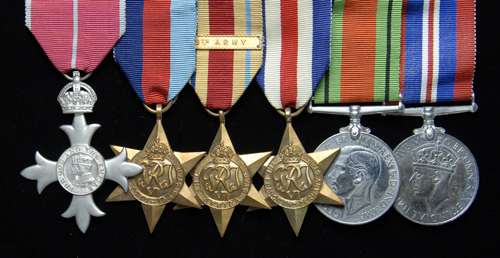
Family Group: A Particularly Fine Second War 1945 ´North West Europe´ Military Division M.B.E. Group of Six Captain H.S. Young, 12th Royal Lancers, Armoured Corps; Lieutenant-General Sir Brian Horrocks´ ADC and Right Hand Man, From the Desert in 1942, to the Banks of The Rhine and On Into Germany in 1945 a) The Most Excellent Order of The British Empire, 2nd type, Military Division, Member´s (M.B.E.) breast Badge, silver b) 1939-1945 Star c) Africa Star, with 8th Army Bar d) France and Germany Star e) Defence and War Medals, generally good very fine,with the following related items: - XXX Corps Commemorative Medallion, Alamein-Cuxhaven, 1944-1945, bronze - Campaign Medals card box of issue, addressed to ´Capt. H.S. Young, Vann House, Finchampstead, Berks´, with enclosure slip - a copy of Lieutenant-General Sir Brian Horrocks´ autobiography, A Full Life, with the inscription ´To Harold, With many thanks for all your constant support and help during some difficult times, Brian Horrocks, 7.9.1960´ Pair: Private H.E. Young, London Regiment, Died of Wounds, 24.8.1918 British War and Victory Medal (6542 Pte. H.E. Young. 20-Lond.R.), extremely fine, with Great War Bronze Memorial Plaque, ´Harold Ernest Young´, with enclosure slip, Identity Disc and comprehensive file of research (lot) Estimate £ 400-600 M.B.E. London Gazette 11.10.1945 Captain (temporary) Harold Stephen Young (170413) 12th Royal Lancers (Prince of Wales´), Royal Armoured Corps (Beckenham, Kent) The Recommendation written by Horrocks, dated 19.5.1945, states: ´Capt Young has for three years been ADC to the present Comd 30 Corps, during the campaigns in Africa and North West Europe. During the operations in the Reichswald Forest, at the crossing of the Rhine and in the subsequent advance into Germany Capt Young was responsible for the organisation and control of the Tactical HQ and Command Post of 30 Corps. On many occasions Capt Young performed the duties usually carried out by a second grade staff offr. and bore responsibilities far beyond those normal for his rank. He has during the whole of the period under review given untiringly of his services. By his unerring efficiency and easy grace combined with unremitting devotion to duty and willingness to accept heavy responsibility he has influenced in a vital and personal manner the successful outcome of the operations. He has been of the greatest assistance to me personally and his contribution to the success of this corps has been considerable.´ Captain Harold Stephen Young, M.B.E. made many contributions to Philip Warner´s book Horrocks, The General Who Led From The Front, and this publication gives us the following, ´Young´s own war had begun with the 6th Cavalry Training Regiment at Maidstone; he was moved to Shorncliffe during the autumn of 1940 when the invasion was a strong possibility and given the task of patrolling the cliffs of Dover on a horse, armed with a sword. After attending the Horsed-Cavalry Officer Cadet Training Unit at Weedon, Young was commissioned and asked in what regiment he would like to serve. Thinkly rightly that there was future for horsed cavalry, and not being inspired by tanks, he asked if he could join the Fleet Air Arm. He was told there was such an enormous waiting list there was no point in adding his name to it. He was then sent on a cavalry mechanisation course and afterwards posted, voluntarily, to the 12th Lancers. While on patrol in the desert he was caught in a Stuka attack and wounded. Although the wound was not serious, it made it impossible for him to sit in a tank for long periods, so he became a liason officer. Horrocks had arrived in the Middle East with an ADC named Spooner, an infantryman. Spooner was an excellent ADC but had no desert experience, and therefore suggested that someone used to the desert should replace him as ADC.´ Horrocks chose Young, who was to become his longest serving ADC, and in his autobigraphy he wrote, ´By now Harold Young of the 12th Lancers had become my ADC and we remained together, except for the period when I was in hospital, up to the end of the war. Few people realise what an important part an ADC plays in the military hierachy. He can be of the greatest assistance to his commander or he may be a complete menace. A general in battle leads a lonely life with immense responsibility resting on his shoulders. For much of the time he is putting on an act, disguising his innermost feelings. He alone must make the decisions which affect the lives of thousands of his men, for battles cannot be run like board meetings. A commander will spend a large part of every day driving round units accompanied by his ADC and it makes all the difference if they get on well together so that mask can be dropped when they are alone. An ADC can act as a buffer between a commander and an all-too-importunate staff, but this has to be done with considerable tact or the ADC will be accused of becoming swollen-headed. The sensible, sympathetic ADC who is trusted and liked by both the commander and staff is worth his weight in gold, and he can do a great deal to make the wheels go round smoothly. I was very lucky with mine. Later on in Europe Young was joined by Lord Rupert Nevill who in spite of a very youthful appearance turned out to be extremely shrewd. Both of them really became personal staff officers and would say quite seriously that their contribution to the successful battles fought by my corps was out of all proportion to their rank and age.´ Young was with Horrocks during his command of XIII and X Corps in North Africa 1942-43, and after the liberation of Tunis Horrocks ´arrived at Hammam Lif just in time to watch the Welsh Guards clearing the top of the hill which dominated the one road through to the south-east. In my eagerness to get on I didn´t pay sufficient attention to where our front line was, but went off with my ADC on a personal reconnaissance. Suddenly eight figures with hands above their heads jumped up almost at our feet. To my disgust I realised that they were very frightened Italians. Had they been stalwart members of the Afrika Corps it would have been different; we could have escorted them back proudly into our new lines. But for the corps commander to return with eight weedy, miserable Italian prisoners in tow would have made me the laughing stock of the entire corps. So, feeling rather ashamed of myself, I handed them over to my ADC and went back alone by another route.´ (A Full Life, Lieutenant-General Sir Brian Horrocks, refers). In June 1943, when Young was recovering from Jaundice in Cairo, Horrocks was gravely wounded during an air-raid at Bizerte. The ever faithful Young hitched a lift to Tunis to be with Horrocks, ´the only other visitor whom I remember distinctly was my ADC, Harold Young, who had established himself somewhere in the vicinity of the hospital and came in to see me regularly..... One day, unkown to me, Colonel Carter got hold of Harold Young and said that my wound was not healing satisfactorily. He could do no more for me in the field and reckoned I should be got back into a base hospital in the UK as soon as possible. This must have presented quite a problem for Harold because we were both by now very much out on a limb: everyone is so busy in war that anyone who disappears from the military scene is soon completely forgotten. He realised that the only chance was to see someone at the top so, undaunted, he set off on his own for Supreme Headquarters in Algiers. It says a great deal for his initiative - or cheek if you like - that this young British captain succeeded somehow in bluffing his way into the office of Eisenhower´s famous chief of staff, General Bedell Smith. Although I didn´t know Bedell Smith very well at the time, this made no difference to him at all. He responded at once and in a few days I was flying home to England in the forward half of a U.S. aircraft accompanied by Harold, Colonel Carter and a U.S. nurse. The rear was occupied by General Bradley going back to U.K. to start work on the invasion of Normandy in which he commanded the U.S. assault forces.´ (Ibid) Horrocks was admitted to the Cambridge Military Hospital, Aldershot, where a complicated operation followed, ´although a very sick man, Horrocks was very keen to know exactly how the war was progressing and so for several weeks Young used to travel to the War Office, be briefed, and then return to Horrocks to keep him informed. But the recovery was going to take a long time, so in the meantime Young looked around for a suitable temporary appointment. He found one at Sandhurst as an instructor. This enabled him to see Horrocks regularly.´ (Horrocks, The General Who Led From The Front, P. Warner, refers) After 6 major operations and nearly 14 months out of action Horrocks returned to the fray with Young, to retake the command of XXX Corps in August 1944. Over the course of the next year Young was at his commanding officer´s side through North West Europe, including Operation Market Garden, operations in the Reichswald Forest, crossing the Rhine and on into Germany. 6542 Private Harold Ernest Young, born Notting Hill, London and was the father of Captain Harold Stephen Young; H.E. Young served during the Great War with the 20th (County of London) Battalion (Blackheath and Woolwich) London Regiment; he died of wounds, 24.8.1918, and is buried in Dive Copse British Cemetery, Sailly-le-Sec, France.
Sold for
£600

Watch, listen and bid as if you were in the room. Now available for auctions worldwide.
Click here to bid live
An exclusive and confidential service for the discerning collector or vendor.
View the Gallery
Download every Spink catalogue on your iPad, iPod or iPhone using free Spink app.
Download From iTunes© 2026 Spink & Son. All rights reserved.