Auction: 1025 - The Turl Collection of Naval General Service Medals 1793 - 1840
Lot: 63
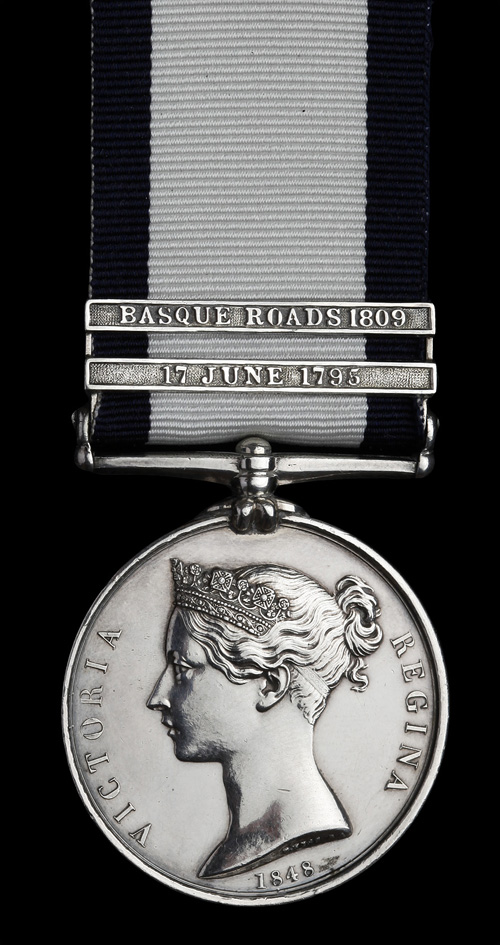
A Good Two Clasp N.G.S. to Captain Robert Hocking, Royal Navy, Who Received a Commission For Gallant Conduct When Acting as Prize Master Enroute to Elba, He Beat Off an Attack Made By Two Vessels Containing 50-60 men, His Command Consisted of ´But 5 Hands on Board, and Only 2 Rusty 4-Pounder Guns.´ He Was Later Wounded in One of the Many Cutting-Out Affairs That He Was Involved in and Received a Second Promotal Commission, Becoming Signal Lieutenant to Lord Gambier, As a Consequence of His Gallant Conduct in Command of a Fire Ship During Cochrane´s Attack On Enemy Shipping in the Basque Roads, 1809 Naval General Service 1793-1840, two clasps, 17 June 1795, Basque Roads 1809 (R. Hockings, Lieut. R.N.), minor edge nicks, good very fine Estimate £ 6,000-7,000 Robert Hockings served as Master´s Mate in H.M.S. Pallas when Vice-Admiral the Hon. William Cornwallis´s squadron brilliantly repulsed about 30 French ships off Ushant, 17.6.1795; Hockings served as Lieutenant in H.M.S. Caledonia (Admiral Lord Gambier´s flag ship) for Lord Cochrane´s successful destruction of a number of French ships, including four ships-of-the-line, in the Basque Roads, off St. Nazaire, 11-12.4.1809. Approximately 42 ´17 June 1795´ clasps issued. Captain Robert Hockings, R.N., born Gibraltar, May 1776; joined the Royal Navy as Able Seaman, 1790, under the auspices of H.R.H. the Duke of Kent; served in H.M.S. Ambuscade (Captain R.D. Fancourt) until February 1793; served as Midshipman in H.M. Ships including Eurydice, Zebra and the Romney (flag ship of Rear-Admiral S.C. Goodall); during the next four years he was employed in the Channel, and in the Mediterranean in the Lapwing and the Pallas (both commanded by Captain the Hon. Henry Curzon); when on one occasion the Pallas captured a merchant-brig, Hockings was sent with her as Prize-Master to Elba, whilst enroute in the Piombino Passage, he was attacked by two large row-boats containing about 50-60 men, ´whom, however, he beat off after a conflict of an hour, although he had but 5 hands on board, and only 2 rusty 4-pounder guns. This achievement was considered so gallant that on reaching Porto Ferrajo, where lay the Blanche frigate, Captain Hon. Henry Hotham, he was highly complimented by that officer, and recommended by him to Earl St. Vincent, the Commander-in-Chief, by whom he was received on board his flag ship the Ville De Paris, and at once appointed, 29 April 1797, First-Lieutenant of the Hamadryad 36, Captain Thos. Elphinstone - an act which the Admiralty confirmed by commission dated on 10 of the following June. Being wrecked on 25 Dec. in the same year during a violent gale in the Bay of Algiers, Mr. Hockings, who on the occurrence of the catastrophe was so seriously bruised that he still feels the effects, became First of the Auroa 28, Capts. H. Digby, T.G. Caufeild, and M. Malbon´ (O´Byrne refers); served with the latter officers on the Lisbon, Mediterranean, and Newfoundland stations until March, 1803, ´participating intermediately in the capture of many privateers, also in several cutting-out affairs (in one of which he was slightly wounded), in the destruction, too, of the French 20-gun ship Egalité, and in the land-operations at the reduction of Minorca.´ (O´Byrne refers); appointed Senior of the Phaeton (Captains G. Cockburn and J. Wood), in which he served as escort to Mr. Merry, the British Minister Plenipotentiary, when ordered to North America; proceeded to the East Indies and whilst cruising the China Seas, he shared in an action with the French frigate Sémillante, and in the capture of a ship of immense value on her annual passage from Manila to Lima; due to ill health Hockings was invalided home in January 1807, and was appointed Signal-Lieutenant to Lord Gambier in the Ville De Paris and the Caledonia, May and August 1808; as a ´reward for his subsequent conduct in command of a fire-ship during the celebrated attack made by the gallant Cochrane on the enemy´s shipping in Basque Roads, he was presented with a second promotal commission dated 11 April, 1809 - previously to which period, as has been seen, he had been for nearly ten years First Lieutenant of a frigate. Although not included in the list of the wounded on the last mentioned occasion, Capt. Hockings was severely hurt by the explosion of his vessel. Not wishing to remain idle on shore, he obtained permission soon after his promotion to rejoin the Caledonia, then the flag ship of his friend Sir Harry Neale, with whom he served as a volunteer until the close of 1810. From 25 May 1811, until driven home by the effects of the yellow fever in Oct. 1812, we find him in command of the Dominica 14, in the Channel and West Indies, and on 11 Sept. in the latter year effecting the capture of the Providence American privateer schooner, of 4 guns (pierced for 12) and 60 men. Capt. Hockings´ next and last appointment was, 26 Dec. 1820, to the Medina 20, in which sloop he appears to have afforded protection to the European consuls and merchants at Smyrna during the fearful outrages which were there perpetrated by the populace in June, 1821.´
Sold for
£8,000

Watch, listen and bid as if you were in the room. Now available for auctions worldwide.
Click here to bid live
An exclusive and confidential service for the discerning collector or vendor.
View the Gallery
Download every Spink catalogue on your iPad, iPod or iPhone using free Spink app.
Download From iTunes© 2026 Spink & Son. All rights reserved.